Die düstere Vision von Leiden und Erlösung: Hieronymus Boschs "Ecce Homo"
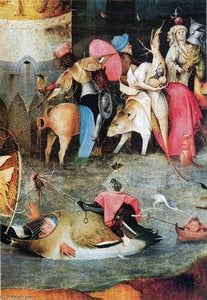
Hieronymus Bosch’s “Ecce Homo,” painted in 1475, is not merely a depiction of the crucifixion; it's a profoundly unsettling and psychologically complex meditation on suffering, judgment, and the human condition. This work, rendered in a remarkably intimate scale of 71 x 61 cm, offers a glimpse into the intensely private and often disturbing world of one of art history’s most enigmatic figures. Bosch, born around 1450 in ’s-Hertogenbosch, Netherlands, was already pushing against the established conventions of his time, foreshadowing the surreal and symbolic language that would become his hallmark.
The scene unfolds with a stark realism – a Roman soldier, likely Pontius Pilate himself, presents Jesus Christ to a crowd. However, this seemingly straightforward presentation is immediately undermined by Bosch’s masterful deployment of symbolism. The faces surrounding the cross are not those of pious onlookers; instead, they reveal a spectrum of emotions: fear, disbelief, morbid curiosity, and even a disturbing sense of anticipation. The soldier's expression is ambiguous, suggesting a reluctant acknowledgment of Christ’s fate rather than genuine sympathy. Notice particularly the detail in the eyes – some filled with horror, others with a detached fascination.
Ein Kaleidoskop der Symbolik
Bosch’s genius lies not just in his realistic portrayal of figures but in the dense layering of symbolic elements that permeate every corner of the painting. The brick wall behind the scene is not simply a backdrop; it represents the decaying foundations of societal morality and the inevitable consequences of sin. Scattered swords, a recurring motif in Bosch's work, symbolize violence, conflict, and the inherent brutality of human nature. The presence of animals – a donkey, a dog, and a monkey – adds further layers of interpretation. The donkey, often associated with humility and sacrifice, is juxtaposed against the predatory gaze of the dog, hinting at the duality of good and evil within humanity.
Crucially, Bosch’s use of color contributes significantly to the painting's unsettling atmosphere. Earthy browns, ochres, and muted reds dominate the palette, creating a sense of gloom and foreboding. The stark contrast between these somber tones and the pale flesh of Christ emphasizes his vulnerability and isolation. The subtle variations in shading – particularly around the wounds on Christ’s body – are executed with remarkable sensitivity, conveying both physical pain and spiritual anguish.
Technique und historische Bedeutung
“Ecce Homo” exemplifies Bosch's distinctive artistic technique. He employed a meticulous layering of thin glazes, building up color gradually to achieve incredible depth and luminosity. This method, known as *sfumato*, creates an almost dreamlike quality, blurring the boundaries between reality and illusion. Bosch’s work reflects the late medieval preoccupation with religious themes and anxieties surrounding mortality – a period marked by both fervent faith and growing skepticism. The painting can be interpreted as a commentary on the political machinations of Pilate and the moral failings of Roman society, alongside its profound theological implications.
Ein Ausdruck von Mitgefühl und Melancholie
Despite its unsettling imagery, “Ecce Homo” is ultimately a deeply moving work. It’s not a celebration of triumph or salvation but rather an honest confrontation with suffering and the complexities of human existence. Bosch's ability to evoke such powerful emotions through his carefully constructed symbolism and masterful technique ensures that this painting continues to resonate with viewers centuries after its creation. A reproduction of this extraordinary piece offers a unique opportunity to experience the haunting beauty and profound psychological depth of Hieronymus Bosch’s vision – a timeless testament to the enduring power of art to illuminate the darkest corners of the human soul.
Fragen & Antworten
Was sind die Technik und das Entstehungsdatum von "Ecce Homo" von Hieronymus Bosch?
Das Medium von "Ecce Homo" von Hieronymus Bosch ist Acryl auf Leinwand, und das Werk wird auf 1475 datiert.
Wie wirkt die Helligkeit von "Ecce Homo" von Hieronymus Bosch?
Insgesamt wird „Ecce Homo“ mit einer Helligkeit von Schattenanteil erfasst. Die wahrgenommene Helligkeit beschreibt, wie hell oder dunkel das Werk erscheint.
In welchem Museum befindet sich das Original von „Ecce Homo“?
Das Originalwerk „Ecce Homo“ können Sie im Städelsches Kunstinstitut Und Städtische Galerie, Frankfurt, Deutschland bewundern.



 In echtem Maßstab anzeigen
 Handgemalte Reproduktion kaufen
 Versenden als Grußkarte
 Teilen
 Details anzeigen
 Leitfaden öffnen

 Herunterladen
 Ähnliche Objekte
 Röntgenaufnahme
 Diashow
 Besucherstatistiken


 Mehr anzeigen






































 Die Glasoption ist nur für Größen unter 110 cm verfügbar.