The Luminous Legacy of Harry John Pearson
In the soft, amber glow of the Edwardian era, a period defined by both its pastoral nostalgia and its burgeoning modernity, the works of Harry John Pearson (1872–1933) offered a sanctuary of quietude. A painter who possessed an uncanny ability to freeze the fleeting essence of a moment, Pearson emerged from the heart of England to become a master of light and sentiment. His canvases do not merely depict scenes; they breathe with the atmosphere of a bygone age, capturing the delicate interplay between the natural world and the human spirit. While his name may not resonate with the thunderous fame of the high modernists, his contribution to British portraiture and landscape painting remains a profound testament to the beauty of the understated.
Born in Worcestershire, Pearson’s artistic journey began with a deep-seated connection to the English countryside. His early training at the Worcester School of Art and Design provided him with a rigorous foundation in classical technique, but it was his subsequent time at the Slade School of Fine Art in London that truly refined his vision. Under the guidance of influential figures such as Hubert Gerhard Hülsenbeck, Pearson began to weave the sensibilities of Impressionism into his meticulous style. He learned to look beyond the mere surface of a subject, seeking instead the emotional resonance found in the way light falls upon a child’s cheek or how shadows stretch across a summer meadow. This period of development saw him move toward a technique characterized by the painstaking layering of glazes, a method that granted his paintings an inner luminosity and a textural depth that feels almost tactile to the viewer.
A Tapestry of Innocence and Rural Grace
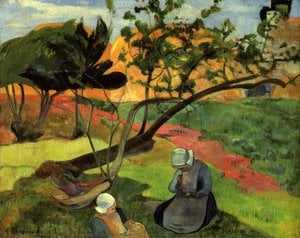
The heart of Pearson’s oeuvre lies in its profound intimacy. He held a particular fascination with the subjects of childhood and rural life, finding infinite complexity in the simplest of arrangements. His landscapes are rarely desolate; instead, they are inhabited by the warmth of human presence—a shepherdess tending her flock, or families gathered in the shade of ancient trees. These works were often imbued with a sense of nostalgia, reflecting the Victorian and Edwardian reverence for a stable, idyllic way of life. His influence was drawn from masters like Frederic Church and Jules Bastien-Lepage, yet Pearson maintained a uniquely British restraint, avoiding the overly dramatic in favor of a gentle, poetic realism.
His mastery is perhaps most evident in his portraiture, where he achieved a remarkable feat of psychological depth. In works such as 'A Young Girl', one can witness his ability to convey a sense of profound introspection. The subject does not merely sit for a portrait; she exists within a space of quiet thought, her gaze inviting the observer into her private world. This talent extended to his depictions of society women, whose portraits were frequently celebrated in contemporary periodicals like Colour Magazine and Woman’s Pictorial. Through his brush, these figures were rendered with a dignity and grace that transcended mere likeness, capturing the very essence of their character through subtle shifts in color and light.
Technique, Influence, and Enduring Significance
To study a Pearson painting is to observe a masterclass in controlled emotion. His style was defined by a meticulous approach to detail that never sacrificed the overall atmospheric effect. By utilizing fine brushstrokes and a sophisticated palette, he could recreate the shimmering heat of a golden afternoon or the cool, damp mist of an English morning. This technical prowess allowed him to bridge the gap between the Neo-Romantic interest in subjective experience and the classical tradition of representational accuracy. His work serves as a vital link in the evolution of British art, embodying the transition from the structured certainties of the Victorian era to the more fluid, emotive explorations of the early twentieth century.
Though much of his work was historically overlooked by the mainstream canon, the enduring charm of his subject matter ensures his continued relevance. His paintings remain a window into an era of perceived innocence and pastoral peace. The significance of Harry John Pearson lies not in radical disruption, but in his ability to elevate the everyday to the level of the sublime. He reminds us that there is profound beauty to be found in the quiet corners of the world—in the light through a window, the smile of a child, or the silent dignity of the landscape. His legacy is one of grace, a lasting contribution to the visual poetry of the British tradition.



 Vorschau anzeigen
 Zu Druck wechseln
 Versenden
 Teilen
 Details anzeigen

 Herunterladen
 Ähnliche Objekte
 Röntgenaufnahme
 Diashow
 Statistiken
 Weiterlesen