In echtem Maßstab anzeigen In AR an der Wand sehen Handgemalte Reproduktion kaufen Zum digitalen Bild wechseln Versenden als Grußkarte
Details anzeigen Leitfaden öffnen Zu Favoriten hinzufügen Herunterladen Ähnliche Objekte Röntgenaufnahme Diashow Besucherstatistiken

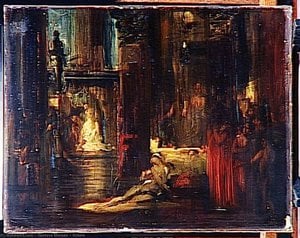
La Mort de Sapho

La Mort de Sapho depicts a woman lying on her side before a rocky landscape with a castle-like structure, symbolizing death and introspection through vibrant colors and intricate figures—a masterpiece by Gustave Moreau.

Erkunden Sie die fesselnde Symbolismus-Kunst von Gustave Moreau (1826-1898). Entdecken Sie seine allegorischen Gemälde, mythologischen Szenen und seinen Einfluss auf Matisse & Rouault. Besuchen Sie das Musée Gustave Moreau in Paris, um dieses herausragende Figuren Erbe zu erleben.

Giclée / Kunstdruck

Giclée- oder Leinwanddruck in Museumsqualität mit schneller Produktion und flexiblen Veredelungsoptionen. ( Handgemalte Reproduktion kaufen Zum digitalen Bild wechseln)

P118B $10
P118H $10
P118W $10
P438Z $10
P508JH $12
P508YH $12
P805H $10
P805Z $10
P919BZ $10
P919G $10
P919XJ $10
P959ZH $10
P968JZ $12
W106C $8
W218G $10
W218JH $8
W218Y $10
W307PJ $10
W316G $10
W316PJ $8
W316Y $10
W398PJ $8
W4111J $10
W500HY $15
W500JH $15
W692G $12
W849H $8
W940BG $15
W953PJ $8

Standardformat
individuell anpassbar
CM
INCH

Wählen Sie aus unseren vordefinierten Formaten, die den ursprünglichen Proportionen des Kunstwerks entsprechen.

Breite
Höhe

Sie können Ihre eigenen Maße eingeben, um ein bestimmtes Format oder einen speziellen Platz einzupassen. Wenn das von Ihnen gewählte Format nicht den Proportionen des Originalbildes entspricht, werden wir das Kunstwerk entweder beschneiden oder das Bild mit einem gespiegelten oder einfarbigen Rand erweitern. Ein digitaler Entwurf wird Ihnen zur Genehmigung zugesandt, bevor die Produktion beginnt.
Bitte beachten Sie, dass die Vorschau auf dem Bildschirm nicht den tatsächlichen Zuschnitt oder die Erweiterung widerspiegelt. Nur der Entwurf zeigt die endgültige Komposition präzise an.
Obwohl Sondermaße verfügbar sind, empfehlen wir die Auswahl eines Maßes aus der vordefinierten Liste, um die ursprünglichen Proportionen zu bewahren.

Weltweiter Versand () innerhalb von 2 Wochen statt der üblichen 4/5 Wochen. (26 September)

why_choose_icon
Kostenloser weltweiter Expressversand
why_choose_icon
Hochwertige Leinenleinwand
why_choose_icon
Vollständiger Versicherungsschutz beim Versand
why_choose_icon
Zollgebühren-Rückerstattungsgarantie
why_choose_icon
Garantie für exakte Farbtreue
why_choose_icon
100-tägiges Rückgaberecht (nur bei Mängeln)
why_choose_icon
100% Geld-zurück-Garantie
why_choose_icon
Angebot für Mengenrabatt

Gesamtpreis

$ 68

reproduction

La Mort de Sapho

Giclée / Kunstdruck

Format der Reproduktion

-

Gesamtpreis

$ 68

Kurzübersicht

  • Artist: Gustave Moreau
  • Title: The Painting
  • Artistic style: Romantic Surrealism
  • Subject or theme: Mythology, Spirituality
  • Location: Private Collection
  • Medium: Oil on Canvas

Kunst-Quiz

Jede Frage hat nur eine richtige Antwort.

Frage 1:
What artistic movement is Gustave Moreau associated with?
Frage 2:
The painting depicts a woman lying on her side in front of what type of landscape?
Frage 3:
What architectural element is prominently featured in the background of “La Mort de Sapho”?
Frage 4:
Moreau’s artistic style prioritizes conveying what?
Frage 5:
What is the overall atmosphere created by Moreau’s use of color in “La Mort de Sapho”?

A Dream Weaver of Symbolism: The Life and Art of Gustave Moreau

Gustave Moreau—a name that conjures images of opulent interiors bathed in muted hues, populated by fantastical figures drawn from mythology and folklore—stands apart as a titan among the Symbolist painters who dominated the artistic landscape of late 19th-century Paris. Unlike his Impressionist contemporaries obsessed with capturing sunlight’s ephemeral dance across landscapes, Moreau wrestled with profound questions about consciousness, spirituality, and the subconscious mind, translating these intellectual explorations into breathtaking visual narratives. His life itself was marked by an unusual blend of scholarly pursuits and artistic obsession—a testament to his unwavering commitment to forging a singular path toward aesthetic truth. Moreau’s formative years were spent immersed in the intellectual ferment of Parisian salons, where he encountered thinkers like Nietzsche and Wagner—figures who profoundly influenced his worldview and fueled his fascination with esoteric traditions. This exposure instilled within him a conviction that art possessed the capacity to transcend mere representation, achieving instead a communion with deeper realities beyond sensory perception. He rejected the prevailing scientific materialism of the era, arguing passionately for the importance of intuition and imagination as instruments of artistic creation. His distinctive style—characterized by meticulous detail, flattened perspectives, and an arresting use of color—was born from this intellectual crucible. Moreau eschewed the naturalistic conventions championed by Realism, opting instead for a deliberately stylized approach that prioritized symbolic resonance over photographic accuracy. He employed techniques honed through years of painstaking observation and experimentation, layering translucent glazes upon thickly impastoed surfaces to achieve luminous effects and imbue his canvases with an otherworldly glow. This masterful manipulation of pigment—often incorporating iridescent hues—created textures that seemed to pulsate with inner life, mirroring the artist’s own preoccupation with psychological depth. Moreau's artistic output spanned decades, producing a prolific body of work encompassing paintings, sculptures, decorative arts, and prints. However, it is his monumental canvases—particularly those depicting biblical scenes and mythological figures—that cemented his reputation as one of Symbolism’s foremost masters. Consider “The Tower of Babel,” for instance—a sprawling composition dominated by towering stone structures and populated by grotesque humanoids engaged in futile attempts to ascend toward the heavens. The painting's symbolism is multilayered, reflecting Moreau’s anxieties about societal fragmentation and humanity’s inability to grasp transcendent truths. Similarly, his depiction of “Saint George and the Dragon”—a dramatic tableau imbued with palpable tension—employs flattened perspectives and stylized figures to convey a visceral sense of struggle between good and evil. Beyond its technical brilliance, Moreau's art possesses an undeniable emotional impact. His canvases evoke feelings of melancholy, wonder, and apprehension—reflecting his profound engagement with existential concerns. He sought not merely to depict events but to communicate inner states of mind, inviting viewers into a realm of psychological contemplation. By confronting the viewer with unsettling imagery and ambiguous narratives, Moreau compelled them to grapple with questions about faith, morality, and the human condition—a legacy that continues to inspire artists and collectors alike. Ultimately, Gustave Moreau’s enduring influence stems from his unwavering conviction that art could serve as a conduit for accessing realms beyond the visible world. He remains an exemplar of artistic integrity and visionary imagination—a testament to the transformative power of pursuing beauty and truth with uncompromising passion. His paintings endure not simply as aesthetically pleasing objects but as profound meditations on the mysteries of human experience, securing his place among the most significant figures in Symbolist art history.

Biografie des Künstlers

**frühes Leben und Ausbildung**

Gustav Moreau, ein französischer Künstler, wurde am 6. April 1826 in Paris geboren. Er erhielt eine traditionelle akademische Ausbildung in der Malerei an der École des Beaux-Arts und zeigte von frühester Kindheit eine Begabung für Zeichnen.

**Die Symbolismusbewegung**

Moreaus Werk, das durch allegorische und mythologische Themen geprägt ist, machte ihn zu einem führenden Symbolistenmaler, insbesondere in den 1890er Jahren. Seine Kunst (und der Symbolismus im Allgemeinen) verlor an Beliebtheit, wurde aber seit den 1960er Jahren neu bewertet und Moreau gilt heute als einer der wichtigsten Symbolistenmaler.

**Bekannte Werke und Ausstellungen**

* Salomé im Gefängnis (Gemälde von 'Gustav Moreau') ist ein bemerkenswertes Beispiel für seine Arbeit und zeigt seine Meisterschaft im Symbolismus. * Das Selbstporträt (Gemälde von 'Gustav Moreau') ist eine weitere kraftvolle Darstellung des Künstlers selbst.

**Musée Gustave Moreau**

Das Nationalmuseum Gustave Moreau (Musée Gustave Moreau Paris, Frankreich) in Paris ist dem Werk Moreaus gewidmet und beherbergt über 1.200 Gemälde, Aquarelle und Zeichnungen. Das Museum ist ein Zeugnis seines künstlerischen Erbes.

**Vermächtnis und Einfluss**

Moreaus Einfluss auf die Symbolismusbewegung ist unbestreitbar. Er lehrte an der École des Beaux-Arts und beeinflusste namhafte Künstler wie Henri Matisse und Georges Rouault. Seine zurückgezogene Art hat seinen Einfluss auf die Kunstwelt nicht gemindert. **Zusammenfassend lässt sich sagen, dass Moreaus Vermächtnis als eine zentrale Figur der Symbolismusbewegung bis heute anhält und seine Werke weiterhin Künstler inspirieren und beeinflussen.**
Gustave Moreau

Gustave Moreau

1826 - 1898 , Frankreich

Eckdaten zum Künstler

  • Beeinflusste Künstler:
    • Henri Matisse
    • Georges Rouault
  • Bemerkenswerte Werke:
    • Salomé im Gefängnis
    • Selbstporträt
    • Jupiter und Semele
    • Orpheus
    • Die Erscheinung
  • Geburtsdatum: 6. April 1826
  • Geburtsort: Paris, Frankreich
  • Künstlerische Einflüsse:
    • Eugène Delacroix
    • Michelangelo
    • Leonardo da Vinci
  • Künstlerischer Stil: Symbolismus
  • Nationalität: Französisch
  • Sterbedatum: 1898
  • Vollständiger Name: Gustave Moreau
Entdecken Sie Kunstwerke, die nach Themen, Stilen und Merkmalen sortiert sind.