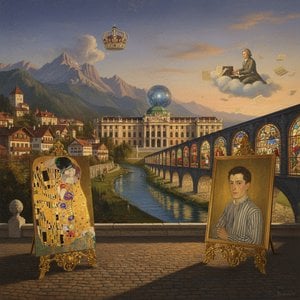
Junius: A Symbolist Masterpiece
Gustav Klimt’s “Junius,” created in 1896 during his formative years as a Symbolist painter, stands as a testament to the artistic fervor of Vienna Secession and Art Nouveau. Measuring 41 x 31 cm, this chalk drawing transcends mere representation; it delves into profound psychological depths and embodies Klimt’s fascination with esoteric imagery—a characteristic hallmark of his oeuvre during that era. The artwork depicts two figures intertwined in an embrace, adorned with crowns symbolizing power and spiritual enlightenment – a motif recurrent throughout Klimt's celebrated works like “The Kiss.”
Symbolic Layers: Crowns and Contemplation
The prominent crowns are not merely decorative elements but potent symbols reflecting the elevated status of the subjects and their connection to realms beyond the tangible. Their downward gaze—one figure looking downwards—suggests introspection, a contemplative stance that invites viewers to ponder on themes of inner reflection and spiritual yearning. Klimt skillfully employs these visual cues to elevate “Junius” beyond a simple depiction of human interaction, transforming it into an exploration of existential questions. The artist’s meticulous attention to detail – the intricate textures of fabric and skin—further reinforces this symbolic dimension.
Influences Shaping Klimt's Vision
Klimt’s artistic trajectory was significantly shaped by movements like Symbolism and Art Nouveau, blending their aesthetic principles into a singular visual language. Symbolist artists sought to express inner emotions and spiritual truths through evocative imagery and allegory, prioritizing mood and emotion over literal accuracy. Similarly, Art Nouveau championed organic forms and flowing lines—elements subtly present in “Junius,” mirroring the stylistic trends of the time. Klimt’s masterful technique – blending chalk with subtle shading – contributes to the painting's ethereal quality and enhances its expressive power.
A Legacy Preserved: The Museum Georg Schäfer
“Junius” finds its home within The Museum Georg Schäfer in Germany, safeguarding a remarkable collection of 19th-century German paintings—a treasure trove for art historians and enthusiasts alike. These institutions play an indispensable role in ensuring the longevity of artistic masterpieces, allowing future generations to appreciate Klimt’s genius and the enduring beauty of Symbolist art. The museum's dedicated conservation efforts guarantee that “Junius” continues to inspire awe and contemplation for years to come.
Experience Klimt's Art: Reproductions Available
For those seeking to immerse themselves in Klimt’s artistic universe or explore similar stylistic explorations—such as Julio Ruelas’ vibrant Mexican symbolism—WahooArt.com offers exceptional reproductions crafted with meticulous care. Discover the captivating allure of “Junius” and countless other iconic artworks, brought to life in stunning detail through hand-painted oil paintings. Visit WahooArt.com today:
The Museum Georg Schäfer, Germany &
Julio Ruelas. Let WahooArt.com transform your space with the timeless beauty of original art reproductions!
Fragen & Antworten
Wie lässt sich der urheberrechtliche Status von "Junius" von Gustav Klimt erklären?
"Junius" von Gustav Klimt ist gemeinfrei – das Urheberrecht ist abgelaufen. Die Schutzfrist des Urheberrechts beginnt mit dem Tod des Künstlers im Jahr 1918.
Sind die Farben von "Junius" von Gustav Klimt leuchtend oder eher dezent?
"Junius" von Gustav Klimt zeichnet sich durch eine Sättigung von Dezente Farbsättigung und eine Intensität von Ausgewogen aus.
Für welches Format wird die Platzierung von „Junius“ im Format Hochformat empfohlen?
Format (Hochformat) und der empfohlene Raum (Hotel-Lobbys) sind die beiden Platzierungshinweise für "Junius" von Gustav Klimt.



 Vorschau anzeigen
 Zum Druck wechseln
 Versenden
 Teilen
 Details anzeigen
 Leitfaden

 Herunterladen
 Ähnliche Objekte
 Röntgenaufnahme
 Diashow
 Q&A
Q&A Statistiken


 Weiterlesen






































 Die Glasoption ist nur für Größen unter 110 cm verfügbar.