


 Öl auf TafelRenaissance
 1480
1480 83.0 x 66.0 cm
 Accademia Carrara
Handgemaltes Ölgemälde auf Leinwand in Ihrer Wunschgröße und mit Rahmen, auf Bestellung von unseren Künstlern angefertigt. ( Druck bestellen Bild kaufen)





























Wählen Sie aus unseren vordefinierten Formaten, die den ursprünglichen Proportionen des Kunstwerks entsprechen.

Sie können Ihre eigenen Maße eingeben, um einen bestimmten Rahmen oder Platz auszufüllen. Wenn die gewählte Größe nicht den Proportionen des Originalbildes entspricht, werden wir das Kunstwerk entweder beschneiden oder das Gemälde durch zusätzliche, handgemalte Elemente erweitern. Ein digitales Mockup wird Ihnen zur Genehmigung zugesandt, bevor die Produktion beginnt.
Bitte beachten Sie, dass die Bildschirmvorschau nicht die tatsächliche Beschneidung oder Erweiterung widerspiegelt. Nur das Mockup zeigt die endgültige Komposition exakt an.
Obwohl Sondermaße verfügbar sind, empfehlen wir, eine Größe aus der vordefinierten Liste zu wählen, um die ursprünglichen Proportionen beizubehalten.
Weltweiter Versand () in nur 3 bis 4 Wochen statt der üblichen 5 Wochen. (7 September). Keine Kompromisse bei der Qualität.


Madonna and Child
Format der Reproduktion
The world of Renaissance art is replete with depictions of the Virgin Mary cradling her infant son, yet Giovanni Bellini's "Madonna and Child," painted around 1480, stands apart not merely as another devotional image, but as a profound exploration of light, color, and spiritual presence. This oil-on-panel masterpiece, now residing in the Metropolitan Museum of Art, offers a glimpse into the evolving artistic landscape of Venice during a period of immense cultural and intellectual ferment – a time when the old world of Byzantine iconography was yielding to the burgeoning innovations of the Italian Renaissance.
Bellini’s genius lay not in slavish imitation but in a masterful synthesis of influences. He inherited the rich, jewel-toned palette and monumental scale of his predecessor, Jacopo Bellini, while simultaneously absorbing the revolutionary techniques introduced by Antonello da Messina – particularly the use of oil paints to achieve unprecedented levels of luminosity and detail. This combination resulted in an image that is both deeply rooted in tradition and strikingly modern for its time.
The painting’s composition immediately draws the eye towards the central figures, Mary and Jesus, arranged within a carefully constructed pyramidal structure. Bellini eschews the rigid formality often associated with earlier religious art, opting instead for a more relaxed and intimate portrayal. The Virgin is not depicted as an ethereal goddess but as a woman of substance, her face bearing a quiet dignity and a hint of melancholy—a subtle acknowledgment of the sacrifice that awaits her son. Jesus, too, is rendered with remarkable realism, his chubby fingers reaching out to grasp a small, golden apple nestled at the base of the composition.
The symbolism woven throughout the painting is both intricate and deeply resonant. The blue veil draped over Mary’s head signifies purity and devotion, while the apple—a deliberate reference to the biblical story of Adam and Eve—represents innocence and the potential for both good and evil. Beyond these immediate symbols, the landscape that recedes into the distance acts as a powerful metaphor: a transition from darkness and uncertainty towards a radiant dawn – mirroring the promise of redemption offered by Christ’s birth.
Bellini's mastery of oil paint is truly breathtaking. He employs a technique known as “glowing,” layering thin glazes of color to create an effect of luminous depth and atmospheric perspective. The light, originating from the upper left corner, washes over the figures and landscape with a soft, diffused glow, transforming the scene into a dreamlike vision. Notice how he uses subtle gradations of tone – from the deep blues and browns of the background to the shimmering gold of Jesus’s halo – to create a sense of three-dimensionality and realism.
Furthermore, Bellini's use of perspective is remarkably sophisticated for his time. The landscape, rendered with careful attention to detail, appears to recede into the distance, creating a believable illusion of space. This mastery of technique not only elevates the painting’s visual impact but also reflects Bellini’s deep understanding of artistic principles and his willingness to experiment with new approaches.
"Madonna and Child" is more than just a beautiful painting; it's a pivotal work in the history of art. Bellini’s innovations profoundly influenced subsequent generations of Venetian painters, including Giorgione and Titian, shaping the course of Renaissance art for decades to come. Today, this masterpiece continues to captivate audiences with its exquisite beauty, profound symbolism, and enduring emotional power. It stands as a testament to Bellini's genius and his remarkable ability to capture the essence of faith, love, and hope in a single image.
For those seeking to experience the timeless allure of this iconic artwork, meticulously crafted oil painting reproductions are available at WahooArt, offering a stunning opportunity to bring a piece of Venetian history into your home or collection.


1433 - 1516 , Italien
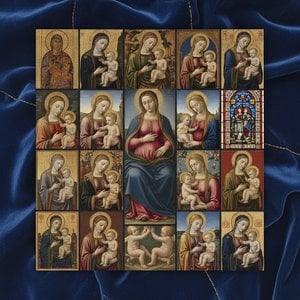
Embark on a sophisticated journey through art history with our curated guide to the most iconic Madonna and Child masterpieces. Discover the profound beauty, theological depth, and enduring legacy of these sacred Renaissance treasures.

Embark on a journey through the Venetian Renaissance. Discover how masters like Giorgione and Titian revolutionized art through luminous color and light. Explore the profound legacy of the Venetian School and its enduring influence on the world of fine art.

Discover the profound allure of oil on canvas. Explore the mastery of impasto textures, the science of pigment longevity, and expert guides to selecting museum-quality reproductions that elevate your collection with timeless elegance and tactile depth.

Discover the enduring legacy of oil on board painting. Explore how historical techniques, rich impasto textures, and structural durability create timeless masterpieces that bridge Renaissance grandeur with modern art collecting excellence.

Discover the enduring allure of oil on canvas. Explore how master techniques like impasto and glazing create the depth, texture, and emotional resonance found in the world's greatest masterpieces. An essential guide for fine art enthusiasts and discerning collectors.

 Vorschau anzeigen
 Versenden
 Teilen
 Details anzeigen

 Herunterladen
 Ähnliche Objekte
 Röntgenaufnahme
 Diashow
 Weiterlesen







 Die Glasoption ist nur für Größen unter 110 cm verfügbar.


