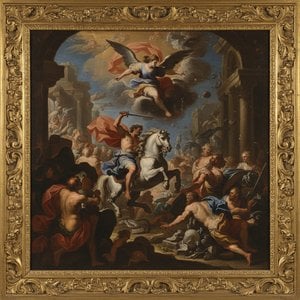
A Dramatic Rescue: Giorgio Vasari's "Perseus and Andromeda"
Giorgio Vasari’s “Perseus and Andromeda,” completed in 1570, is more than just a depiction of a classical myth; it’s a visceral embodiment of the Baroque spirit – a tempestuous drama rendered with meticulous detail and imbued with potent symbolism. Measuring 117 x 100 cm, this oil-on-canvas masterpiece transports the viewer directly into the heart of a heroic rescue, a narrative steeped in themes of divine intervention, courage, and ultimately, redemption. The scene unfolds within a dramatically lit coastal setting, dominated by a colossal rock formation that serves as both a stage for the unfolding action and a powerful visual anchor.
- The Myth Unveiled: The painting portrays the legendary tale of Andromeda, chained to a rock as a sacrifice to appease a monstrous sea creature. Perseus, guided by the gods, arrives to rescue her, battling the beast with heroic strength and ultimately severing its head.
- Baroque Flourishes: Vasari’s style is firmly rooted in the Baroque movement, characterized by dynamic composition, theatrical lighting, and an emphasis on emotional intensity. The swirling waves, the muscular forms of Perseus and Andromeda, and the imposing presence of Poseidon all contribute to a sense of dramatic movement and heightened realism.
Technique and Materials: A Master’s Hand
Vasari's mastery is immediately apparent in his skillful application of oil paint on canvas. The technique showcases a layered approach, utilizing visible brushstrokes to build up texture and create a palpable sense of depth. The smooth blending of colors – primarily earthy tones of browns, ochres, and greens punctuated by vibrant blues and reds – contributes to the illusion of three-dimensionality. The artist’s meticulous attention to detail is evident in the rendering of the rocky landscape, the flowing drapery, and the expressive faces of the figures. The use of atmospheric perspective subtly recedes into the distance, further enhancing the painting's spatial depth.
- Oil on Canvas: The medium itself – oil paint applied to canvas – allowed for the rich colors and luminous effects characteristic of Baroque art.
- Layered Brushwork: Vasari’s technique involved building up color and form through multiple layers of thin glazes, creating a sense of depth and realism.
Symbolism and Emotional Impact
Beyond the immediate narrative, “Perseus and Andromeda” is rich in symbolic meaning. The sea monster represents chaos and destruction, while Andromeda’s vulnerability underscores the need for divine protection. Poseidon's intervention symbolizes power and salvation, highlighting the role of the gods in human affairs. Vasari expertly captures the emotional intensity of the scene – the desperation of Andromeda, the heroic determination of Perseus, and the raw power of Poseidon – creating a profoundly moving experience for the viewer. The dramatic lighting further amplifies this effect, casting strong contrasts between light and shadow to emphasize key figures and heighten the sense of drama.
Historical Context and Artistic Significance
Completed in 1570, “Perseus and Andromeda” reflects the artistic currents of its time – a period marked by a renewed interest in classical antiquity and a burgeoning Baroque style. Giorgio Vasari’s work stands as a testament to his versatility and his commitment to celebrating the achievements of past masters. This painting exemplifies the Renaissance fascination with mythology and heroism, while simultaneously pushing the boundaries of artistic expression through its dynamic composition and dramatic use of light and color. Its enduring appeal lies in its ability to evoke powerful emotions and transport viewers to another time and place.



 In echtem Maßstab anzeigen
 Zum Druck wechseln
 Versenden als Grußkarte
 Teilen
 Details anzeigen
 Leitfaden

 Herunterladen
 Ähnliche Objekte
 Röntgenaufnahme
 Diashow
 Besucherstatistiken


 Mehr anzeigen






































 Die Glasoption ist nur für Größen unter 110 cm verfügbar.