A Pioneer's Light: Exploring the World of Georges Seurat
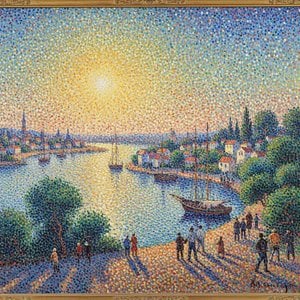
The image before us offers a direct window into the mind of Georges Pierre Seurat, a name synonymous with innovation and meticulous observation in late 19th-century art. This reproduction captures not just an artist’s description, but the very essence of his revolutionary approach – a testament to his unwavering belief in scientific principles applied to the creation of beauty. Born in Paris in 1859, Seurat's life was marked by a profound intellectual curiosity and a desire to understand the fundamental nature of light and color. His brief career, tragically cut short at just 31, nevertheless left an indelible mark on the art world, forever altering our perception of painting and paving the way for modern abstraction.
The Birth of Pointillism
Seurat’s most significant contribution was undoubtedly his development of Pointillism – a technique that eschewed broad brushstrokes in favor of applying tiny, distinct dots of pure color to the canvas. This seemingly simple method, rooted in scientific studies of optics and color theory, was anything but accidental. Seurat meticulously researched the way the human eye perceives color, believing that by juxtaposing small areas of complementary hues, he could create a shimmering effect of light and atmosphere far more vibrant and realistic than traditional Impressionistic techniques allowed. The resulting images possess an almost ethereal quality, a luminous precision achieved through painstaking application.
A Study in Beige: Technique and Texture
The reproduced text itself offers clues to understanding Seurat’s process. The muted beige and brown tones of the background – reminiscent of aged paper or fabric – subtly echo the palette he employed, emphasizing the granular texture created by his pointillist method. Notice the structured grid-like pattern formed by the lines of text; this mirrors the underlying structure of Seurat's compositions, where individual dots were carefully arranged to create a harmonious whole. The tight cropping focuses our attention on the intellectual rigor behind his work, highlighting the deliberate and methodical nature of his artistic practice.
Symbolism and Emotional Impact
While often perceived as purely technical, Seurat’s paintings are imbued with a quiet emotional depth. His subjects – often urban scenes or portraits – are rendered with an almost detached objectivity, yet they possess a remarkable sense of atmosphere and mood. The luminous quality of his work evokes a feeling of serenity and contemplation, inviting the viewer to slow down and appreciate the subtle beauty of the world around them. Seurat’s legacy extends beyond mere technique; it represents a profound shift in artistic thinking – a move towards scientific observation, intellectual rigor, and an unwavering pursuit of optical truth. This reproduction offers a unique opportunity to connect with one of art history's most innovative figures and experience the captivating power of his luminous precision.



 Zum Druck wechseln
 Versenden als Grußkarte
 Teilen
 Details anzeigen
 Leitfaden öffnen

 Herunterladen
 Ähnliche Objekte
 Diashow
 Besucherstatistiken

 Mehr anzeigen






































 Die Glasoption ist nur für Größen unter 110 cm verfügbar.