


 Öl auf LeinwandWandkunstPointillist Style
 1882Frühmittelalter
 32.0 x 40.0 cm
 Musée d'art moderne de Troyes
Handgemaltes Ölgemälde auf Leinwand in Ihrer Wunschgröße und mit Rahmen, auf Bestellung von unseren Künstlern angefertigt. ( Druck bestellen Bild kaufen)





























Wählen Sie aus unseren vordefinierten Formaten, die den ursprünglichen Proportionen des Kunstwerks entsprechen.

Sie können Ihre eigenen Maße eingeben, um einen bestimmten Rahmen oder Platz auszufüllen. Wenn die gewählte Größe nicht den Proportionen des Originalbildes entspricht, werden wir das Kunstwerk entweder beschneiden oder das Gemälde durch zusätzliche, handgemalte Elemente erweitern. Ein digitales Mockup wird Ihnen zur Genehmigung zugesandt, bevor die Produktion beginnt.
Bitte beachten Sie, dass die Bildschirmvorschau nicht die tatsächliche Beschneidung oder Erweiterung widerspiegelt. Nur das Mockup zeigt die endgültige Komposition exakt an.
Obwohl Sondermaße verfügbar sind, empfehlen wir, eine Größe aus der vordefinierten Liste zu wählen, um die ursprünglichen Proportionen beizubehalten.
Weltweiter Versand () in nur 3 bis 4 Wochen statt der üblichen 5 Wochen. (6 September). Keine Kompromisse bei der Qualität.


Suburb
Format der Reproduktion
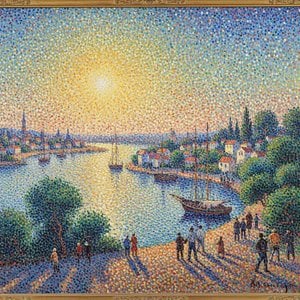
Georges Pierre Seurat’s *Suburb*, painted in 1882, is more than just a depiction of a provincial village; it's a meticulously constructed meditation on modernity and the burgeoning relationship between humanity and industry. This small canvas, measuring only 32 x 40 cm, offers an intimate yet profoundly unsettling view into a France undergoing rapid transformation – a nation grappling with the rise of factories and the changing rhythms of rural life. Seurat, a true pioneer of “luminous precision,” sought to capture not merely what he *saw*, but how the eye *perceived* light and color, a principle that defines his revolutionary Pointillist technique.
At first glance, *Suburb* might appear deceptively simple. However, beneath the surface lies an astonishingly complex system of tiny, independent dots – meticulously applied in a vibrant palette of colors. This is Pointillism, a technique developed by Seurat himself, based on his studies of optics and color theory. Rather than blending colors directly on the canvas, he built up layers of pure hues, allowing the viewer’s eye to optically mix them when viewed from a distance. The effect is remarkably luminous and creates an almost shimmering quality, particularly noticeable in the depiction of sunlight filtering through the buildings and illuminating the figures within. The seemingly random arrangement of dots actually represents a carefully calculated composition, designed to evoke specific emotional responses and create a sense of depth and atmosphere.
The scene itself is imbued with symbolic weight. The prominent factory in the background immediately establishes the painting’s central theme – industrialization and its impact on traditional rural life. The two horses, one positioned to the left and the other closer to the center, could represent the old ways of farming versus the new demands of industry. The figures scattered throughout the village are not idealized portraits; they appear weary, engaged in mundane tasks, reflecting a sense of displacement and perhaps even unease. Seurat’s choice of subject matter reflects a broader societal anxiety prevalent at the time – a questioning of progress and its potential consequences. It's important to note that Seurat was deeply interested in scientific observation and sought to understand the world through rational analysis, which is reflected in his precise rendering of even the most ordinary details.
*Suburb* isn’t simply a record of a place; it's an exploration of perception itself. Seurat wasn’t interested in creating a realistic representation, but rather in capturing the *impression* of light and color as experienced by the eye. The painting evokes a sense of quiet melancholy, a subtle tension between beauty and decay, tradition and modernity. The carefully chosen colors – predominantly blues, greens, and ochres – contribute to this atmosphere, suggesting both the warmth of the sun and the coolness of industrial smoke. When viewed closely, the individual dots become almost hypnotic, drawing the viewer into Seurat’s meticulously constructed world. The reproduction offered by WahooArt.com allows you to experience this captivating technique firsthand, bringing a piece of art history into your own space.
Consider a high-quality reproduction of *Suburb* to add a touch of intellectual elegance and subtle emotional depth to your interior design. It’s a powerful reminder of the transformative period in art history that Seurat helped shape – a testament to the enduring power of observation, technique, and the human desire to understand the world around us.


1859 - 1891 , Frankreich

Explore the vibrant evolution of Post-Impressionism. From Seurat's revolutionary Pointillism to the emotional depth of masters, discover how this movement redefined modern art history through color, structure, and unparalleled creative expression.

Explore the scientific brilliance of Seurat and Signac. Discover how Pointillism revolutionized color through optical mixing and light, offering a profound look into the Neo-Impressionist movement for true art connoisseurs and collectors.
Discover the mesmerizing world of Pointillism. Explore the revolutionary techniques of Georges Seurat, the science of optical color mixing, and the enduring legacy of Neo-Impressionism in this expert guide for classical art enthusiasts.

Master the nuances of Impressionism vs. Post-Impressionism with our expert guide. Explore the revolutionary shift from Monet’s fleeting light to Van Gogh’s emotional depth. Discover how these iconic movements continue to inspire fine art collectors and modern interiors today.
Embark on a sophisticated journey into the luminous world of Neo-Impressionism. Uncover the scientific brilliance of Pointillism, from Georges Seurat’s revolutionary color theory to the mesmerizing magic of the dot. An expert exploration for true art history enthusiasts.

 Vorschau anzeigen
 Versenden
 Teilen
 Details anzeigen

 Herunterladen
 Ähnliche Objekte
 Röntgenaufnahme
 Diashow
 Weiterlesen







 Die Glasoption ist nur für Größen unter 110 cm verfügbar.


