Vorschau anzeigen In AR ansehen Handgemalte Reproduktion bestellen Zum digitalen Bild wechseln Versenden
Details anzeigen Leitfaden Zu Favoriten hinzufügen Herunterladen Ähnliche Objekte Röntgenaufnahme Diashow Statistiken

Leg

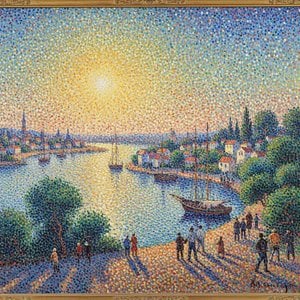
Georges Pierre Seurat (1859-1991), born in Paris, revolutionized painting with Pointillism—a technique applying tiny dots of color to create luminous images based on optical perception. His masterpiece "Leg" exemplifies this groundbreaking approach.

Erkunden Sie Georges Seurat (1859-1891), Pionier des Pointillismus und Neo-Impressionismus. Entdecken Sie 'A Sunday on La Grande Jatte' und seine revolutionäre Farbbtheorie, die das moderne Leben einfängt. Kaufen Sie handbemalte Reproduktionen!

Giclée / Kunstdruck

Giclée- oder Leinwanddruck in Museumsqualität mit schneller Produktion und flexiblen Veredelungsoptionen. ( Handgemalte Reproduktion bestellen Zum digitalen Bild wechseln)

Corner sample of the P118B picture frame: formgepresstes Polystyrol, 5 cm wide and 3 cm thick
P118B €10
Corner sample of the P118H picture frame: formgepresstes Polystyrol, 5 cm wide and 3 cm thick
P118H €10
Corner sample of the P118W picture frame: formgepresstes Polystyrol, 5 cm wide and 3 cm thick
P118W €10
Corner sample of the P438Z picture frame: formgepresstes Polystyrol, 5.5 cm wide and 3.5 cm thick
P438Z €10
Corner sample of the P508JH picture frame: formgepresstes Polystyrol, 7 cm wide and 3.5 cm thick
P508JH €12
Corner sample of the P508YH picture frame: formgepresstes Polystyrol, 7 cm wide and 3.5 cm thick
P508YH €12
Corner sample of the P805H picture frame: formgepresstes Polystyrol, 5 cm wide and 3.5 cm thick
P805H €10
Corner sample of the P805Z picture frame: formgepresstes Polystyrol, 5 cm wide and 3.5 cm thick
P805Z €10
Corner sample of the P919BZ picture frame: formgepresstes Polystyrol, 7 cm wide and 3.5 cm thick
P919BZ €10
Corner sample of the P919G picture frame: formgepresstes Polystyrol, 7 cm wide and 3.5 cm thick
P919G €10
Corner sample of the P919XJ picture frame: formgepresstes Polystyrol, 7 cm wide and 3.5 cm thick
P919XJ €10
Corner sample of the P959ZH picture frame: formgepresstes Polystyrol, 5 cm wide and 3 cm thick
P959ZH €10
Corner sample of the P968JZ picture frame: formgepresstes Polystyrol, 6 cm wide and 4 cm thick
P968JZ €12
Corner sample of the W106C picture frame: Massivholz, 5 cm wide and 3 cm thick
W106C €8
Corner sample of the W218G picture frame: Massivholz, 5 cm wide and 3 cm thick
W218G €10
Corner sample of the W218JH picture frame: Massivholz, 5 cm wide and 3 cm thick
W218JH €8
Corner sample of the W218Y picture frame: Massivholz, 5 cm wide and 3 cm thick
W218Y €10
Corner sample of the W307PJ picture frame: Massivholz, 6 cm wide and 3 cm thick
W307PJ €10
Corner sample of the W316G picture frame: Massivholz, 6 cm wide and 3 cm thick
W316G €10
Corner sample of the W316PJ picture frame: Massivholz, 6 cm wide and 3 cm thick
W316PJ €8
Corner sample of the W316Y picture frame: Massivholz, 6 cm wide and 3 cm thick
W316Y €10
Corner sample of the W398PJ picture frame: Massivholz, 5 cm wide and 3 cm thick
W398PJ €8
Corner sample of the W4111J picture frame: Massivholz, 6.5 cm wide and 3.5 cm thick
W4111J €10
Corner sample of the W500HY picture frame: Massivholz, 7 cm wide and 5 cm thick
W500HY €15
Corner sample of the W500JH picture frame: Massivholz, 7 cm wide and 5 cm thick
W500JH €15
Corner sample of the W692G picture frame: Massivholz, 8 cm wide and 4 cm thick
W692G €12
Corner sample of the W849H picture frame: Massivholz, 5 cm wide and 3 cm thick
W849H €8
Corner sample of the W940BG picture frame: Massivholz, 7.5 cm wide and 4.5 cm thick
W940BG €15
Corner sample of the W953PJ picture frame: Massivholz, 6 cm wide and 3.5 cm thick
W953PJ €8

Standardformat
individuell anpassbar
CM
INCH

Wählen Sie aus unseren vordefinierten Formaten, die den ursprünglichen Proportionen des Kunstwerks entsprechen.

Breite
Höhe

Geben Sie die benötigte Breite und Höhe an, damit der Druck perfekt in Ihren Rahmen oder an Ihre Wand passt. Ein Druck kann nur beschnitten, aber niemals größer als das Originalbild angefertigt werden; daher verliert ein Format mit anderen Proportionen einen Teil des Bildes. Wir senden Ihnen ein digitales Mockup zur Freigabe, bevor wir den Druck ausführen. Das auf dieser Seite gezeigte Bild zeigt nicht den tatsächlichen Beschnitt – dies ist nur im Mockup ersichtlich.

Weltweiter Versand () innerhalb von 2 Wochen statt der üblichen 4/5 Wochen. (26 Oktober)

Kostenloser weltweiter Expressversand
Hochwertige Leinenleinwand
Umfassender Versicherungsschutz beim Versand
Zollgebühren-Rückerstattungsgarantie
Garantie für exakte Farbtreue
100 Tage Rückgaberecht (nur bei Mängeln)
100% Geld-zurück-Garantie
Mengenrabatt verfügbar

Gesamtpreis

€ 60

Leg

Giclée / Kunstdruck

Format der Reproduktion

-

Endpreis

€ 60

Eckdaten

  • Movement: Pointillism
  • Influences: Impressionism
  • Medium: Oil on canvas
  • Location: Private Collection
  • Title: Leg

Kunst-Quiz

Jede Frage hat nur eine richtige Antwort.

Frage 1:
What artistic technique is Georges Seurat known for pioneering?
Frage 2:
The painting depicts a person's leg with bare feet resting on what surface?
Frage 3:
What is the predominant color scheme used in "Leg"?
Frage 4:
Why was Georges Seurat considered a revolutionary figure in art?
Frage 5:
What is the significance of Seurat's meticulous attention to detail in capturing light and shadow?

A Symphony of Dots: The Luminous Precision of Seurat's Leg

In the vibrant, bustling atmosphere of late nineteenth-century Paris, a quiet revolution was unfolding, one not of loud proclamations, but of microscopic precision. While the Impressionists were busy capturing the fleeting, ephemeral dance of light with rapid and emotional brushstrokes, Georges Pierre Seurat sought a deeper, more permanent truth. His masterpiece, "Leg," stands as a profound testament to this pursuit. This intimate study, currently preserved in the hallowed halls of the Musée d’Orsay, invites the viewer into a world where science and art converge. The painting depicts a nude male leg resting upon a surface, yet through Seurat's visionary lens, it becomes much more than a mere anatomical study; it is an exploration of how light itself inhabits form.

To gaze upon "Leg" is to witness the birth of Pointillism, a technique that demands a different kind of looking. Rather than blending pigments on a palette to create smooth transitions, Seurat applied tiny, rhythmic pulses of pure color side-by-side. This method, often referred to as Chromoluminarism, relies on the viewer's own retina to perform the final act of creation. As your eyes move across the canvas, these individual dots of pigment undergo a magical synthesis, merging in the mind to create an illusion of shimmering luminosity and soft, tactile texture. The result is an ethereal quality that traditional blending simply cannot achieve—a sense that the subject is not merely painted, but is actually vibrating with light.

The Architecture of Light and Form

Seurat’s approach was far from accidental; it was a disciplined, almost mathematical endeavor. Influenced by contemporary optical theories, he meticulously mapped out the contours of the leg and torso using a precise grid system. This structural rigor allowed him to capture the subtle weight of the limb and the delicate interplay of shadow and highlight with unprecedented accuracy. In "Leg," the way the light catches the curve of the knee and fades into the soft shadows of the foot demonstrates a masterful command over tonal variation. For the collector or the interior designer, this piece offers a unique aesthetic tension: it possesses the structural stability of classical art while maintaining the modern, atmospheric energy of the avant-garde.

Beyond its technical brilliance, the painting carries an emotional resonance that is both tranquil and profound. There is a stillness in the composition, a moment of suspended animation that allows for deep contemplation. The absence of a complex background focuses all attention on the interplay of light upon skin, evoking a sense of vulnerability and grace. For those seeking to bring a piece of art history into a contemporary living space, a high-quality reproduction of "Leg" serves as a sophisticated focal point. It does not merely decorate a wall; it introduces a conversation about perception, inviting guests to slow down and rediscover the beauty in the smallest, most meticulously placed details.

Fragen & Antworten

Wie intensiv sind die Farben von "Leg" von Georges Pierre Seurat?

"Leg" von Georges Pierre Seurat besticht durch eine Balanced Farbintensität.

Welcher Raum eignet sich aufgrund der Farben von "Leg" von Georges Pierre Seurat am besten?

Die Neutrals-Farben von "Leg" von Georges Pierre Seurat passen perfekt zum empfohlenen Raum: einem Living Room.

Für welche Verwendung wird "Leg" von Georges Pierre Seurat empfohlen?

Eine Reproduktion von "Leg" von Georges Pierre Seurat wird für Accent empfohlen. Dieser Vorschlag ergibt sich aus dem Motiv, der Stimmung und den Farben des Werkes.


Künstlerbiografie

Georges Seurat: Ein Pionier des Neoimpressionismus

Frühes Leben und Ausbildung

  • Geboren: 2. Dezember 1859 in Paris, Frankreich.
  • Seurats Familie zog kurz nach seiner Geburt auf den Boulevard de Magenta um.
  • Sein Vater, Antoine Chrysostome Seurat, war ein ehemaliger Jurist, der durch Immobilienhandel reich wurde.
  • Er begann seine künstlerische Ausbildung an der École Municipale de Sculpture et Dessin, in der Nähe seines Zuhauses, unter dem Bildhauer Justin Lequien.
  • Im Jahr 1878 meldete er sich an der renommierten École des Beaux-Arts an und studierte bei Henri Lehmann.

Künstlerische Entwicklung und Einflüsse

  • Seurats künstlerliche Persönlichkeit war eine einzigartige Mischung aus Sensibilität und logischer Abstraktion. Er verband zarte Empfindsamkeit mit mathematischer Präzision.
  • Einflüsse: Obwohl spezifische Einflüsse diskutiert werden, studierte er die Farbbtheorien von Wissenschaftlern wie Michel Eugène Chevreul und Ogden Rood.
  • Er experimentierte zunächst mit traditionellen Zeichentechniken, bevor er seinen charakteristischen Stil entwickelte.
  • Seine frühen Werke zeigen ein Interesse an akademischer Malerei, ging aber allmählich zu einem innovativeren Ansatz über.

Chromoluminarismus und Pointillismus

  • Seurat entwickelte die Techniken des Chromoluminarismus (die Wissenschaft der Farbe) und des Pointillismus, indem er kleine, deutliche Punkte reiner Farbe auf eine Leinwand auftrug.
  • Er verwendete Conté-Kreide für detaillierte Zeichnungen auf rauer Papiersubstanz als Teil seines Prozesses.
  • Ziel des Pointillismus: Die Idee war, dass das Auge des Betrachters diese Farben optisch miteinander mischen und so einen lebendigen und leuchtenden Effekt erzeugt.

Wichtige Leistungen und bemerkenswerte Werke

  • Ein Sonntagnachmittag auf der Île de la Grande Jatte (1884-1886): Sein berühmtestes Werk, das den Beginn des Neoimpressionismus markiert. Es veranschaulicht seine Pointillist-Technik und seinen methodischen Ansatz.
  • Alfalfa, Saint-Denis (1886-1887): Demonstriert seine Anwendung der Farbbtheorie auf eine ländliche Landschaft.
  • Landschaft bei Saint-Ouen (1882-1883): Ein frühes Beispiel, das seinen sich entwickelnden Stil und sein Interesse an Licht und Atmosphäre zeigt.
  • Der Eiffelturm (1889): Eine Darstellung des ikonischen Pariser Wahrzeichens, dargestellt mit Pointillist-Techniken.
  • Bäderer in Asnières (1884): Ein weiteres bedeutendes Werk, das Freizeit und modernen Lebensstil mit seinem unverwechselbaren Stil erforscht.

Historische Bedeutung und Vermächtnis

  • Seureats Werk beeinflusste die Entwicklung der modernen Kunst nachhaltig, insbesondere durch seinen Schwerpunkt auf subjektivem Ausdruck und die Erforschung neuer Techniken.
  • Legte den Grundstein: Er legte den Grundstein für Bewegungen wie Fauvismus, Kubismus und Expressionismus.
  • Sein wissenschaftlicher Ansatz in der Malerei stellte traditionelle künstlerische Konventionen in Frage.
  • Trotz seines kurzen Lebens (er starb im Alter von 31 Jahren) hinterließ Seurat einen unauslöschlichen Eindruck in der Kunstgeschichte und inspirierte Generationen von Künstlern mit seiner innovativen Vision.
Georges Pierre Seurat

Georges Pierre Seurat

1859 - 1891 , Frankreich

Kurzinfos

  • Beeinflusste Künstler:
    • Fauvismus
    • Kubismus
  • Bemerkenswerte Werke:
    • Ein Sonntagnachmittag...
    • Bäufer in Asnières
    • Der Eiffelturm
  • Einflüsse:
    • Michel Eugène Chevreul
    • Ogden Rood
  • Geburtsdatum: 2. Dezember 1859
  • Geburtsort: Paris, Frankreich
  • Künstlerische Bewegung: Neo-Impressionismus
  • Nationalität: Französisch
  • Sterbedatum: 1891
  • Vollständiger Name: Georges Pierre Seurat
Entdecken Sie Kunstwerke, die nach Themen, Stilen und Merkmalen sortiert sind.