A Symphony of Light and Color: The Luminous World of Georges Seurat
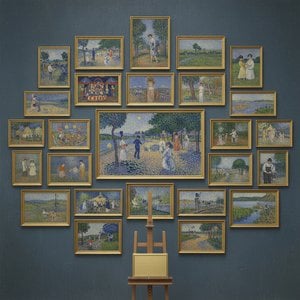
In the late 19th century, a quiet revolution began to flicker across the canvases of France, driven by a man who sought to replace the fleeting, subjective brushstrokes of Impressionism with something far more permanent and scientifically profound. Georges Pierre Seurat, a visionary whose career was tragically brief yet immensely impactful, did not merely want to paint what he saw; he wanted to reconstruct the very physics of light itself. In his masterpiece, Five Men, we witness the pinnacle of this ambition. The painting presents a tranquil tableau of leisure, where five figures lounge along a sun-drenched shoreline, their presence anchored by the rhythmic ebb and flow of the water nearby. It is a scene that captures the essence of a summer afternoon, yet beneath its peaceful surface lies a rigorous, mathematical devotion to optical truth.
To gaze upon Five Men is to experience the magic of Pointillism, or more accurately, Chromoluminarism. Rather than blending pigments on a palette to create smooth transitions, Seurat applied countless tiny, distinct dots of pure color directly onto the canvas. This technique relies on the science of optics—specifically the principle that the human eye, when presented with juxtaposed points of different hues, will perform its own internal alchemy, synthesizing these dots into a vibrant, shimmering whole. As you stand before a high-quality reproduction of this work, the air seems to vibrate with a delicate, rhythmic dance of light. The technique demands an incredible level of patience and precision, transforming the act of painting from mere expression into a controlled experiment in luminosity.
The Art of Stillness: Composition and Emotional Resonance
Beyond its technical brilliance, Five Men possesses a profound narrative depth that speaks to the universal human desire for repose. Seurat skillfully arranges his subjects in varying postures, creating a sophisticated interplay between stillness and movement. Some figures stand near the water's edge, caught in moments of quiet contemplation, while others are nestled further back, integrated into the landscape itself. This careful composition guides the viewer’s eye through the scene, mimicking the natural wandering of a gaze during a moment of rest. There is a sense of structured harmony here; the figures are not merely placed randomly but are part of a larger, geometric order that reflects Seurat's fascination with logical abstraction.
For the discerning collector or interior designer, this artwork offers much more than visual beauty; it provides an atmosphere of sophisticated tranquility. The painting’s ability to evoke the warmth of the sun and the coolness of the sea makes it a versatile centerpiece for any curated space. Whether placed in a modern gallery setting or a classic study, Five Men brings with it an enduring emotional impact—a sense of timelessness that transcends the era of its creation. It serves as a reminder of the beauty found in the meticulous, the scientific, and the serene, making it an exquisite choice for those who seek to surround themselves with art that is both intellectually stimulating and deeply restorative.



 Vorschau anzeigen
 Zu Druck wechseln
 Versenden
 Teilen
 Details anzeigen

 Herunterladen
 Ähnliche Objekte
 Röntgenaufnahme
 Diashow
 Statistiken

 Weiterlesen






































 Die Glasoption ist nur für Größen unter 110 cm verfügbar.