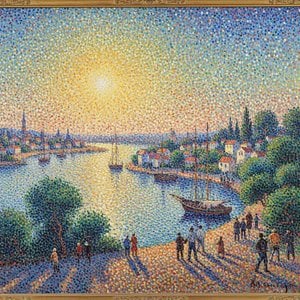
Georges Seurat’s “La Parade”: A Nocturne of Urban Spectacle
Georges Pierre Seurat, a pivotal figure in the transition from Impressionism to modern art, gifted us with an extraordinary vision – a world rendered not through fleeting impressions but through meticulously calculated observation and scientific precision. His masterpiece, "La Parade" (1887-88), housed within the Metropolitan Museum of Art in New York, offers a profound glimpse into his revolutionary technique: Pointillism. This painting isn’t merely a depiction of a Parisian circus scene; it's an exploration of light, color, and the very nature of perception – a testament to Seurat’s intellectual rigor and artistic genius.
The scene unfolds beneath a dusky sky, dominated by the artificial glow of gas lamps illuminating a modest circus parade. A line of musicians, rigidly posed on a raised platform, performs for a sparse audience gathered below. The composition is strikingly formal, almost geometric in its structure – a deliberate departure from the loose brushstrokes and atmospheric effects characteristic of Impressionism. Seurat eschewed the spontaneous capture of a moment in favor of constructing an image through the precise application of countless tiny dots of color, each meticulously chosen to create a specific hue and tone.
The Alchemy of Pointillism
Seurat’s innovation lay not just in the technique itself but in its underlying philosophy. He believed that color should be understood as an optical phenomenon – that the human eye blends colors together when viewed from a distance, creating a richer, more vibrant experience than could be achieved by mixing pigments on a palette. This theory informed his Pointillist approach, where individual dots of pure color are strategically placed to stimulate this blending process within the viewer’s retina. The result is an astonishing luminosity and depth – a shimmering effect that seems to defy the limitations of paint itself.
Notice how Seurat utilizes complementary colors—blues and reds, greens and oranges—to create visual contrast and heighten the sense of movement. The darker tones in the foreground are deliberately muted, drawing the eye towards the brighter, more energetic figures in the background. This careful orchestration of color is not simply decorative; it’s a deliberate attempt to mimic the way light interacts with surfaces and creates an illusion of three-dimensionality on the canvas.
A Study in Urban Alienation
"La Parade" isn't a celebration of entertainment, but rather a subtle commentary on modern life. The figures are largely static and detached, seemingly lost in their own thoughts or simply observing the spectacle with a certain distance. The scene evokes a sense of urban alienation – a feeling of being surrounded by people yet profoundly alone. This is further emphasized by the painting’s nocturnal setting, which transforms the familiar world of the circus into something slightly unsettling and dreamlike.
Furthermore, Seurat's choice to depict a working-class entertainment venue—a small traveling circus—adds another layer of complexity to the work. It suggests a critique of social hierarchies and a fascination with the everyday experiences of ordinary people. The parade itself becomes a metaphor for the fleeting nature of pleasure and the transient beauty of the urban landscape.
Bringing “La Parade” Home: A High-Quality Reproduction
At WahooArt, we are proud to offer meticulously crafted hand-painted reproductions of Seurat’s "La Parade." Our skilled artists utilize traditional oil painting techniques, faithfully recreating the artist's nuanced color palette and intricate Pointillist detail. Each reproduction captures not only the visual beauty of the original but also its emotional depth and intellectual complexity.
Whether you are an art enthusiast, a collector seeking to expand your collection, or simply someone looking for a stunning piece of artwork to enhance your interior space, a hand-painted reproduction of "La Parade" is a remarkable investment. It’s a tangible connection to one of the most innovative and influential artists of the 19th century – a testament to Seurat's enduring legacy and his revolutionary approach to painting.



 In echtem Maßstab anzeigen
 Handgemalte Reproduktion kaufen
 Versenden als Grußkarte
 Teilen
 Details anzeigen
 Leitfaden

 Herunterladen
 Ähnliche Objekte
 Röntgenaufnahme
 Diashow
 Besucherstatistiken

 Mehr anzeigen






































 Die Glasoption ist nur für Größen unter 110 cm verfügbar.