A Symphony of Form and Texture
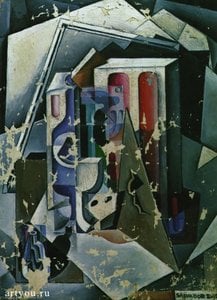
In the evocative realm of Georges Braque’s "Untitled (2439)," we encounter a profound moment in the evolution of modernism, where the boundaries of reality begin to dissolve into pure expression. This masterpiece serves as a cornerstone of the Fauvist movement, a period that dared to liberate color from its traditional role of mere description. Rather than attempting to replicate the soft, fleeting light of Impressionism, Braque directs our gaze toward the structural essence of his subjects. The composition presents an intimate, almost domestic arrangement—a bird perched with quiet dignity on the left, a cup resting gracefully on the right, and the humble presence of a knife, spoon, and bowl scattered throughout. Yet, these are not mere objects; they are sculptural entities, rendered through bold, simplified geometric forms that challenge the viewer to see the world not as it appears, but as it is felt.
The technique employed in this work is nothing short of visceral. Braque utilizes a heavy impasto, applying pigment in thick, palpable layers that transform the canvas into a tactile landscape. This deliberate manipulation of materiality ensures that the artwork possesses a physical weight, inviting the eye to wander over the ridges and valleys of dried paint. While the provided monochrome perspective strips away the jarring chromatic intensity typical of Fauvism, it reveals the true genius of Braque’s structural composition. Without the distraction of hue, the interplay of light and shadow across the textured surfaces becomes the primary protagonist, highlighting a masterful command over balance and spatial tension. It is an invitation to engage with the painting as a physical object, bridging the gap between visual perception and tactile sensation.
The Legacy of the Avant-Garde
To understand "Untitled (2439)," one must look back to the burgeoning avant-garde atmosphere of early 20th-century France. Emerging from a background rooted in the practical craft of house painting and decoration, Braque brought a unique sensibility to the École des Beaux-Arts—a blend of technical precision and experimental courage. This piece stands as a testament to that era's rebellion against academic rigidity. By prioritizing emotional truth over representational accuracy, Braque helped pave the way for Cubism and much of the abstraction that would follow. The painting captures a pivotal historical shift where the artist’s hand becomes more important than the subject’s likeness.
For the discerning collector or interior designer, this work offers more than just aesthetic beauty; it provides a sophisticated focal point that commands attention through its structural integrity. Whether placed in a contemporary gallery setting or a curated residential space, the piece exudes an aura of intellectual depth and timelessness. A high-quality reproduction of this work allows one to bring the revolutionary spirit of Braque into the modern home, offering a conversation piece that celebrates the enduring power of texture, form, and the transformative nature of the artist's vision.
Fragen & Antworten
Wie harmonisch sind die Farben von "untitled (2439)" von Georges Braque?
Die Farben von "untitled (2439)" von Georges Braque zeigen eine Strong Color Unity Harmonie. Harmonie beschreibt, wie die Farben zueinander in Beziehung stehen.
Was erklärt die urheberrechtliche Situation von "untitled (2439)" von Georges Braque?
Der Urheberrechtsstatus von "untitled (2439)" – noch urheberrechtlich geschützt – ergibt sich aus dem Todesjahr des Künstlers im Jahr 1963.
In welche Phase von Georges Braques Schaffen lässt sich "untitled (2439)" einordnen?
„untitled (2439)“ entstammt der Fauvist Style von Georges Braque. Diese Einordnung setzt das Werk in Bezug zur künstlerischen Entwicklung des Künstlers.



 In echtem Maßstab anzeigen
 Handgemalte Reproduktion kaufen
 Versenden als Grußkarte
 Teilen
 Details anzeigen
 Leitfaden öffnen

 Herunterladen
 Ähnliche Objekte
 Röntgenaufnahme
 Diashow
 Besucherstatistiken

 Mehr anzeigen






































 Die Glasoption ist nur für Größen unter 110 cm verfügbar.