x
Vorschau anzeigenVorschau anzeigen In AR erlebenIn AR erleben Druck bestellen Druck bestellenBild kaufen Bild kaufen VersendenVersenden
Details anzeigenDetails anzeigen Zu Favoriten hinzufügen Zu Favoriten hinzufügen HerunterladenHerunterladen Ähnliche ObjekteÄhnliche Objekte RöntgenaufnahmeRöntgenaufnahme DiashowDiashow

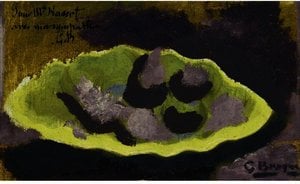
The Green Apples

Georges Braque’s masterful Cubist still life captures the essence of form and texture—green apples arranged in a dynamic circle alongside a lemon—reflecting the groundbreaking artistic innovations of the early 20th century. Explore this iconic piece and bring its timeless beauty into your home.

Erkunden Sie das Leben und Werk von Georges Braque (1882-1963), eine Schlüsselgestalt der Malerei des 20. Jahrhunderts. Pionier des Kubismus an der Seite Picassos, bekannt für Fauvismus, Collagen und innovative geometrische Formen. Entdecken Sie sein Erbe bei WahooArt!

Handgefertigte Ölreproduktion

Handgemaltes Ölgemälde auf Leinwand in Ihrer Wunschgröße und mit Rahmen, auf Bestellung von unseren Künstlern angefertigt. (Druck bestellen Druck bestellenBild kaufen Bild kaufen)

P118B $10
P118H $10
P118W $10
P438Z $10
P508JH $12
P508YH $12
P805H $10
P805Z $10
P919BZ $10
P919G $10
P919XJ $10
P959ZH $10
P968JZ $12
W106C $8
W218G $10
W218JH $8
W218Y $10
W307PJ $10
W316G $10
W316PJ $8
W316Y $10
W398PJ $8
W4111J $10
W500HY $15
W500JH $15
W692G $12
W849H $8
W940BG $15
W953PJ $8

Standardformat
individuell anpassbar
CM
INCH

Wählen Sie aus unseren vordefinierten Formaten, die den ursprünglichen Proportionen des Kunstwerks entsprechen.

Breite
Höhe

Sie können Ihre eigenen Maße eingeben, um einen bestimmten Rahmen oder Platz auszufüllen. Wenn die gewählte Größe nicht den Proportionen des Originalbildes entspricht, werden wir das Kunstwerk entweder beschneiden oder das Gemälde durch zusätzliche, handgemalte Elemente erweitern. Ein digitales Mockup wird Ihnen zur Genehmigung zugesandt, bevor die Produktion beginnt.
Bitte beachten Sie, dass die Bildschirmvorschau nicht die tatsächliche Beschneidung oder Erweiterung widerspiegelt. Nur das Mockup zeigt die endgültige Komposition exakt an.
Obwohl Sondermaße verfügbar sind, empfehlen wir, eine Größe aus der vordefinierten Liste zu wählen, um die ursprünglichen Proportionen beizubehalten.

Beispiele für Anpassungsmöglichkeiten: Gesicht durch Kundenfoto ersetzen; Haustier hinzufügen (z. B. Katze durch Hund ersetzen); eine versteckte Nachricht im Hintergrund einfügen; Hintergrundlandschaft oder -elemente ändern.
Nach der Bestellung wird das WahooArt.com-Team dem Kunden Anweisungen per E-Mail zusenden und eine Mockup-Vorschau bereitstellen.

Weltweiter Versand () in nur 3 bis 4 Wochen statt der üblichen 5 Wochen. (4 September). Keine Kompromisse bei der Qualität.

why_choose_icon
Kostenloser weltweiter Expressversand
why_choose_icon
Hochwertige Leinenleinwand
why_choose_icon
Umfassender Versicherungsschutz beim Versand
why_choose_icon
Zollgebühren-Rückerstattungsgarantie
why_choose_icon
Garantie für exakte Farbtreue
why_choose_icon
60 Tage Rückgaberecht (nur bei Mängeln)
why_choose_icon
100% Geld-zurück-Garantie
why_choose_icon
Mengenrabatt verfügbar

Gesamtpreis

$ 272

reproduction

The Green Apples

Art der Reproduktion

Format der Reproduktion

-

Gesamtpreis

$ 272

Eckdaten

  • Artistic style: Analytical Cubism
  • Artist: Georges Braque
  • Location: Private Collection
  • Medium: Oil on canvas
  • Notable elements or techniques: Geometric abstraction
  • Movement: Cubism

Kunst-Quiz

Jede Frage hat nur eine richtige Antwort.

Frage 1:
Georges Braque is best known for his contribution to which artistic movement?
Frage 2:
The painting depicts a still life featuring what prominent objects?
Frage 3:
What artistic technique is primarily employed in 'The Green Apples' to create a sense of fractured perspective?
Frage 4:
The painting's muted color palette contributes to what overall mood or atmosphere?

A Quiet Revolution in Form: Decoding Braque’s The Green Apples

In the quietude of Georges Braque’s 1912 masterpiece, The Green Apples, one finds far more than a simple arrangement of fruit upon a table. At first glance, the viewer is met with a deceptively humble tableau: a collection of verdant apples resting on a plate, accompanied by a bowl and a subtle hint of a lemon. Yet, to look closer is to enter the very heart of the Cubist revolution. This work serves as a profound exploration of visual perception, where the boundaries between object and space begin to dissolve. Braque does not merely present a still life; he invites us into a meditative study of how light, mass, and geometry intersect to create a new reality.

The technique employed here is a masterclass in the analytical approach that defined Braque’s pivotal period. Moving away from the vibrant, emotive outbursts of his Fauvist beginnings, Braque adopts a muted, sophisticated palette dominated by earthy greens, deep browns, and soft ochres. This deliberate restraint prioritizes tonal harmony over mere spectacle, allowing the viewer to focus on the structural rhythm of the composition. Through the use of fragmentation and multiple simultaneous viewpoints, the artist deconstructs the traditional illusion of depth. The apples are not merely painted; they are reconstructed through geometric abstraction, challenging the eye to piece together a fragmented world that exists beyond a single, static perspective.

Historical Resonance and Symbolic Depth

To understand The Green Apples, one must consider the turbulent era from which it emerged. Painted during the height of the Cubist movement alongside his legendary collaborator Pablo Picasso, this work reflects a broader intellectual shift in early 20th-century Europe. As the world faced the complexities of rapid industrialization and the looming shadows of global conflict, artists like Braque sought to dismantle conventional notions of perspective. The painting acts as a blueprint for modern vision, stripping away the superficiality of representation to find the structural truth beneath. It is an era where the mirror of art was shattered, and Braque was one of the primary architects of its reconstruction.

Beyond its formal brilliance, the composition is rich with subtle symbolic resonance. The circular arrangement of the apples serves as a recurring motif for Braque, suggesting themes of wholeness, continuity, and the cyclical nature of time. This sense of stability is punctuated by the sharp, acidic brightness of the lemon on the left, a small but vital disruption that prevents the tonal balance from becoming too static. Even the partially obscured chair in the background provides an anchor of domesticity, grounding the abstract experimentation in a recognizable, human space. For the collector or designer, this piece offers a sophisticated balance of intellectual rigor and domestic warmth.

An Essential Addition to the Modern Interior

For those seeking to curate a space defined by elegance and contemplation, The Green Apples offers an unparalleled emotional impact. It evokes a mood of quiet meditation—a sanctuary of thought in an increasingly loud world. The painting’s ability to command attention through subtlety rather than volume makes it an ideal centerpiece for high-end interiors, whether placed in a minimalist gallery setting or a richly textured study. Its muted tones and organic forms harmonize effortlessly with contemporary decor, providing a sense of historical depth and artistic prestige.

Owning a high-quality reproduction of this work is more than an aesthetic choice; it is an invitation to engage with the very foundations of modern art. It allows the presence of Braque’s revolutionary spirit to inhabit a room, offering daily inspiration through its complex interplay of light and form. Whether you are an art historian captivated by its Cubist lineage or an interior designer looking for a piece that embodies timeless sophistication, The Green Apples remains a profound testament to the power of seeing the world anew.


Über den Künstler

**frühes Leben und Ausbildung**

Georges Braque, ein prominenter französischer Maler, Kollagist, Bleistrichzeichner, Grafiker und Bildhauer, wurde am 13. Mai 1882 in Argenteuil, Val-d'oise, geboren. Er wuchs in Le Havre auf und erhielt zunächst eine Ausbildung als Hausmaler und Dekorateur wie sein Vater und Großvater. Braques künstlerische Neigungen führten ihn jedoch dazu, von 1897 bis 1899 an der École des Beaux-Arts in Le Havre Malerei zu studieren.

**Künstlerische Entwicklung und Fauvisme**

Im Jahr 1902, nachdem er seine Lehre bei einem Dekorateur in Paris abgeschlossen hatte, besuchte Braque bis 1904 die Académie Humbert. Dieser Zeitraum markierte seine Einführung ins Fauvismus, einen Stil, der durch lebendige Farben und emotionale Reaktionen gekennzeichnet ist. Beeinflusst von den Werken von Henri Matisse und André Derain, übernahm Braque einen fauvistischen Ansatz, wie in seinem Gemälde The Patience (Fauvismus, Öl auf Leinwand).

**Beitrag zum Kubismus**

Braques Zusammenarbeit mit Pablo Picasso von 1908 bis 1912 führte zur Entwicklung des Kubismus. Ihre analytischen kubistischen Werke, wie z.B. Georges Braque: The Patience und Pablo Picasso: Clarinet(analytischer Kubismus, Öl auf Leinwand), gelten heute als Meilensteine der Kunstgeschichte.

**Erbe und bemerkenswerte Werke**

* Houses at L'Estaques: Ein Zeugnis für Braques innovatives Einsatz von Geometrie und simultaner Perspektive. * The Patience(Fauvismus, Öl auf Leinwand): Demonstriert Braques fauvistischen Stil. * Clarinet(analytischer Kubismus, Öl auf Leinwand): Eine kollaborative kubistische Arbeit mit Picasso.

**Museen und Sammlungen**

* Musée d'Orsay: Bietet eine umfangreiche Sammlung impressionistischer und postimpressionistischer Kunst, darunter Werke von Braque. * Musée de l'Orangerie: Zeigt eine breite Palette von Kunstwerken, darunter Werke von Braque und anderen bedeutenden Künstlern.
  • Erfahren Sie mehr über Georges Braques Leben und Werk auf WahooArt.com
  • Entdecken Sie die Sammlung des Musée d'Orsay, die Werke von Braque und anderen Künstlern umfasst, unter Musée d'Orsay - Wikipedia
  • Erfahren Sie mehr über den Fauvismus und seinen Einfluss auf die Entwicklung des Kubismus mit Fauvismus Kunstbewegung auf WahooArt.com
**Georges Braques innovative Stil und seine Zusammenarbeit mit Pablo Picasso inspirieren weiterhin Künstler und Kunstliebhaber.**
Georges Braque

Georges Braque

1882 - 1963 , Frankreich

Kurzinfos

  • Beeinflusste Künstler: ['Pablo Picasso']
  • Bemerkenswerte Werke:
    • Häuser in L'Estaque
    • Die Geduld (Fauvismus)
    • Stillleben mit Pfeife
    • Mandola
  • Einflussreiche Künstler:
    • Henri Matisse
    • André Derain
    • Paul Cézanne
  • Geburtsdatum: 13. Mai 1882
  • Geburtsort: Argenteuil, Frankreich
  • Künstlerischer Stil: Kubismus, Fauvismus
  • Nationalität: Französisch
  • Sterbedatum: 1963
  • Vollständiger Name: Georges Braque
Entdecken Sie Kunstwerke, die nach Themen, Stilen und Merkmalen sortiert sind.