In echtem Maßstab anzeigen In AR an der Wand sehen Handgemalte Reproduktion kaufen Zum digitalen Bild wechseln Versenden als Grußkarte
Details anzeigen Leitfaden öffnen Zu Favoriten hinzufügen Herunterladen Ähnliche Objekte Röntgenaufnahme Diashow Besucherstatistiken

Pedestal Table

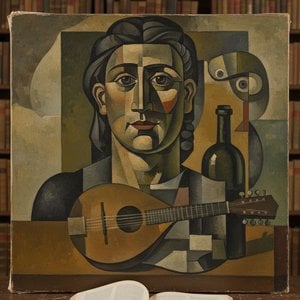
Experience Georges Braque’s ‘Pedestal Table,’ a pivotal 1911 Cubist masterpiece. This hand-painted reproduction captures the artist's innovative use of form and space, showcasing a unique art decoration.

Erkunden Sie das Leben und Werk von Georges Braque (1882-1963), eine Schlüsselgestalt der Malerei des 20. Jahrhunderts. Pionier des Kubismus an der Seite Picassos, bekannt für Fauvismus, Collagen und innovative geometrische Formen. Entdecken Sie sein Erbe bei WahooArt!

Die auf dieser Seite dargestellten Kunstwerke sind urheberrechtlich geschützt, was bedeutet, dass wir keine identische Reproduktion rechtmäßig erstellen oder verkaufen dürfen. Dieser Schutz wird durch internationale Abkommen wie die Berner Übereinkunft und durch nationale Gesetze, einschließlich derer, die von den ... festgelegt wurden US-Urheberrecht – Titel 17.

Diese Methode entspricht vollumfänglich den Urheberrechtsbestimmungen, da sie keine Kopie oder Vervielfältigung des geschützten Kunstwerks darstellt. Stattdessen handelt es sich um eine kreative Neuinterpretation – ein neues Gemälde, das vom Original inspiriert, aber nicht identisch mit ihm ist.

Giclée / Kunstdruck

Giclée- oder Leinwanddruck in Museumsqualität mit schneller Produktion und flexiblen Veredelungsoptionen. ( Handgemalte Reproduktion kaufen Zum digitalen Bild wechseln)

Corner sample of the P118B picture frame: formgepresstes Polystyrol, 5 cm wide and 3 cm thick
P118B €10
Corner sample of the P118H picture frame: formgepresstes Polystyrol, 5 cm wide and 3 cm thick
P118H €10
Corner sample of the P118W picture frame: formgepresstes Polystyrol, 5 cm wide and 3 cm thick
P118W €10
Corner sample of the P438Z picture frame: formgepresstes Polystyrol, 5.5 cm wide and 3.5 cm thick
P438Z €10
Corner sample of the P508JH picture frame: formgepresstes Polystyrol, 7 cm wide and 3.5 cm thick
P508JH €12
Corner sample of the P508YH picture frame: formgepresstes Polystyrol, 7 cm wide and 3.5 cm thick
P508YH €12
Corner sample of the P805H picture frame: formgepresstes Polystyrol, 5 cm wide and 3.5 cm thick
P805H €10
Corner sample of the P805Z picture frame: formgepresstes Polystyrol, 5 cm wide and 3.5 cm thick
P805Z €10
Corner sample of the P919BZ picture frame: formgepresstes Polystyrol, 7 cm wide and 3.5 cm thick
P919BZ €10
Corner sample of the P919G picture frame: formgepresstes Polystyrol, 7 cm wide and 3.5 cm thick
P919G €10
Corner sample of the P919XJ picture frame: formgepresstes Polystyrol, 7 cm wide and 3.5 cm thick
P919XJ €10
Corner sample of the P959ZH picture frame: formgepresstes Polystyrol, 5 cm wide and 3 cm thick
P959ZH €10
Corner sample of the P968JZ picture frame: formgepresstes Polystyrol, 6 cm wide and 4 cm thick
P968JZ €12
Corner sample of the W106C picture frame: Massivholz, 5 cm wide and 3 cm thick
W106C €8
Corner sample of the W218G picture frame: Massivholz, 5 cm wide and 3 cm thick
W218G €10
Corner sample of the W218JH picture frame: Massivholz, 5 cm wide and 3 cm thick
W218JH €8
Corner sample of the W218Y picture frame: Massivholz, 5 cm wide and 3 cm thick
W218Y €10
Corner sample of the W307PJ picture frame: Massivholz, 6 cm wide and 3 cm thick
W307PJ €10
Corner sample of the W316G picture frame: Massivholz, 6 cm wide and 3 cm thick
W316G €10
Corner sample of the W316PJ picture frame: Massivholz, 6 cm wide and 3 cm thick
W316PJ €8
Corner sample of the W316Y picture frame: Massivholz, 6 cm wide and 3 cm thick
W316Y €10
Corner sample of the W398PJ picture frame: Massivholz, 5 cm wide and 3 cm thick
W398PJ €8
Corner sample of the W4111J picture frame: Massivholz, 6.5 cm wide and 3.5 cm thick
W4111J €10
Corner sample of the W500HY picture frame: Massivholz, 7 cm wide and 5 cm thick
W500HY €15
Corner sample of the W500JH picture frame: Massivholz, 7 cm wide and 5 cm thick
W500JH €15
Corner sample of the W692G picture frame: Massivholz, 8 cm wide and 4 cm thick
W692G €12
Corner sample of the W849H picture frame: Massivholz, 5 cm wide and 3 cm thick
W849H €8
Corner sample of the W940BG picture frame: Massivholz, 7.5 cm wide and 4.5 cm thick
W940BG €15
Corner sample of the W953PJ picture frame: Massivholz, 6 cm wide and 3.5 cm thick
W953PJ €8

Standardformat
individuell anpassbar
CM
INCH

Wählen Sie aus unseren vordefinierten Formaten, die den ursprünglichen Proportionen des Kunstwerks entsprechen.

Breite
Höhe

Geben Sie die Breite und die Höhe an, die Sie benötigen, damit der Druck perfekt in Ihren Rahmen oder an Ihre Wand passt. Ein Druck kann nur beschnitten werden und niemals größer als das Originalbild gemacht werden; daher verliert ein Format mit einer anderen Proportion einen Teil des Bildes. Wir senden Ihnen ein digitales Mockup zur Freigabe, bevor wir den Druck ausführen. Das auf dieser Seite gezeigte Bild zeigt nicht den tatsächlichen Beschnitt – dies ist nur im Mockup ersichtlich.

Weltweiter Versand () innerhalb von 2 Wochen statt der üblichen 4/5 Wochen. (22 Oktober)

Kostenloser weltweiter Expressversand
Hochwertige Leinenleinwand
Vollständiger Versicherungsschutz beim Versand
Zollgebühren-Rückerstattungsgarantie
Garantie für exakte Farbtreue
100-tägiges Rückgaberecht (nur bei Mängeln)
100% Geld-zurück-Garantie
Angebot für Mengenrabatt

Gesamtpreis

€ 60

Pedestal Table

Giclée / Kunstdruck

Format der Reproduktion

-

Gesamtpreis

€ 60

Kurzübersicht

  • Artist: Georges Braque
  • Year: 1911
  • Subject or theme: Still life, interior
  • Medium: Painting
  • Dimensions: 116 x 81 cm
  • Notable elements: Horse statue, guitar

Kunst-Quiz

Jede Frage hat nur eine richtige Antwort.

Frage 1:
What artistic movement is most closely associated with Georges Braque’s ‘Pedestal Table’?
Frage 2:
The image depicts a scene featuring a man and a horse statue. What is the primary significance of the pedestal in this composition?
Frage 3:
Based on the description, what style of art is evident in ‘Pedestal Table’?
Frage 4:
In the context of Braque's career, what was his early training primarily focused on?

Georges Braque’s ‘Pedestal Table’: A Fragmented World of Form and Perception

Georges Braque's “Pedestal Table,” painted in 1911, is not merely a depiction of an object; it’s a carefully constructed puzzle for the viewer, a window into the nascent world of Analytical Cubism. This work, housed within the Kunstmuseum Basel, immediately captivates with its fragmented forms and deliberate ambiguity, inviting us to actively participate in reconstructing the scene before us. The painting presents a man seated at a table, a horse statue looming in the background, and a sense of contained chaos—a visual embodiment of the era’s shifting perceptions of reality.

Braque's choice of subject matter – a simple pedestal table – is itself significant. Pedestals, as our research reveals (linked here: Wikipedia Search), traditionally elevate and support objects, providing stability and grounding. However, in Braque’s painting, the pedestal becomes a fractured element, dissected and reassembled into geometric planes. This disruption of traditional spatial relationships is a hallmark of Cubism, reflecting a desire to move beyond single viewpoints and represent an object from multiple perspectives simultaneously. The table itself isn't rendered as a solid, unified form; instead, it’s broken down into interlocking facets, suggesting its inherent instability and the subjective nature of observation.

Analytical Cubism: Deconstructing Reality

Painted during the period of Analytical Cubism – roughly 1908-1912 – “Pedestal Table” exemplifies the movement's core principles. This phase, developed in close collaboration with Pablo Picasso, focused on reducing objects to their fundamental geometric components. Braque’s palette is deliberately muted, dominated by browns, ochres, and grays, creating a sense of somberness and introspection. The artist employs a meticulous technique, applying paint in thin, overlapping layers – a characteristic of Analytical Cubism – to build up the complex network of planes and angles that define each element. The use of monochromatic tones further emphasizes the deconstruction of form, stripping away any illusion of depth or three-dimensionality.

Further insight into Braque’s approach can be found in articles like Georges Braque: Pioneering Cubism & the Evolution of Modern Form, which details his experimentation with color and form during this pivotal period. The artist’s meticulous attention to detail, combined with a radical departure from traditional representation, established Analytical Cubism as a groundbreaking movement that profoundly influenced the course of 20th-century art.

Symbolic Layers and Emotional Resonance

Beyond its formal innovations, “Pedestal Table” invites speculation about its symbolic meaning. The presence of the horse statue, a recurring motif in Braque’s work (linked here: Wikipedia Search), could represent power, strength, or even vulnerability – themes often explored within the context of the era's social and political landscape. The guitar held by the seated figure might symbolize creativity, contemplation, or perhaps a moment of quiet reflection amidst the intellectual ferment of Parisian artistic circles. The inclusion of books and letters suggests an engagement with knowledge, ideas, and communication—elements central to the burgeoning modern world.

Despite its fragmented composition, “Pedestal Table” evokes a sense of contained energy and subtle drama. The interplay of light and shadow, combined with the carefully arranged planes, creates a visual rhythm that draws the eye across the canvas. It’s a painting that rewards careful observation, inviting us to decipher its complex layers of meaning and appreciate Braque's masterful manipulation of form and space. Reproductions of this work, like our high-quality hand-painted versions (viewable here: Pedestal Table, Kunstmuseum Basel and Pedestal Table 1), offer a unique opportunity to experience the power and beauty of this seminal Cubist masterpiece in your own home.

A Collector’s Perspective: Braque's Legacy

Georges Braque (1882-1963) remains one of the most influential figures in modern art. His contributions to Cubism, alongside Picasso, fundamentally altered our understanding of representation and paved the way for subsequent artistic movements. Exploring his oeuvre – from iconic works like “Houses at L’Estaque” (Georges Braque) – reveals a sustained commitment to experimentation, innovation, and a profound engagement with the complexities of the modern world. Investing in a reproduction of "Pedestal Table" is not simply acquiring an image; it’s connecting with a pivotal moment in art history and celebrating the genius of a true visionary.

Fragen & Antworten

Wie stellt "Pedestal Table" von Georges Braque eine Verbindung zwischen Analytical Cubism und dem Heimatland des Künstlers her?

"Pedestal Table" wurde von Georges Braque geschaffen, der in Frankreich geboren wurde, und ist der Analytical Cubism-Bewegung zuzuordnen. Die Herkunft des Künstlers verbindet das Werk mit der Analytical Cubism, wie sie von Künstlern aus Frankreich praktiziert wird.

Wie hoch ist die Leuchtkraft von "Pedestal Table" von Georges Braque?

"Pedestal Table" von Georges Braque weist eine Luminanz von Gentle Luminance auf. Die Luminanz beschreibt, wie viel Licht die Farben scheinbar reflektieren.

Ist "Pedestal Table" von Georges Braque ein Gemälde, eine Zeichnung oder ein Druck?

Im Katalog ist "Pedestal Table" von Georges Braque als WallArt geführt. Die Kategorie hilft dabei, ähnliche Werke zu finden.


Biografie des Künstlers

**frühes Leben und Ausbildung**

Georges Braque, ein prominenter französischer Maler, Kollagist, Bleistrichzeichner, Grafiker und Bildhauer, wurde am 13. Mai 1882 in Argenteuil, Val-d'oise, geboren. Er wuchs in Le Havre auf und erhielt zunächst eine Ausbildung als Hausmaler und Dekorateur wie sein Vater und Großvater. Braques künstlerische Neigungen führten ihn jedoch dazu, von 1897 bis 1899 an der École des Beaux-Arts in Le Havre Malerei zu studieren.

**Künstlerische Entwicklung und Fauvisme**

Im Jahr 1902, nachdem er seine Lehre bei einem Dekorateur in Paris abgeschlossen hatte, besuchte Braque bis 1904 die Académie Humbert. Dieser Zeitraum markierte seine Einführung ins Fauvismus, einen Stil, der durch lebendige Farben und emotionale Reaktionen gekennzeichnet ist. Beeinflusst von den Werken von Henri Matisse und André Derain, übernahm Braque einen fauvistischen Ansatz, wie in seinem Gemälde The Patience (Fauvismus, Öl auf Leinwand).

**Beitrag zum Kubismus**

Braques Zusammenarbeit mit Pablo Picasso von 1908 bis 1912 führte zur Entwicklung des Kubismus. Ihre analytischen kubistischen Werke, wie z.B. Georges Braque: The Patience und Pablo Picasso: Clarinet(analytischer Kubismus, Öl auf Leinwand), gelten heute als Meilensteine der Kunstgeschichte.

**Erbe und bemerkenswerte Werke**

* Houses at L'Estaques: Ein Zeugnis für Braques innovatives Einsatz von Geometrie und simultaner Perspektive. * The Patience(Fauvismus, Öl auf Leinwand): Demonstriert Braques fauvistischen Stil. * Clarinet(analytischer Kubismus, Öl auf Leinwand): Eine kollaborative kubistische Arbeit mit Picasso.

**Museen und Sammlungen**

* Musée d'Orsay: Bietet eine umfangreiche Sammlung impressionistischer und postimpressionistischer Kunst, darunter Werke von Braque. * Musée de l'Orangerie: Zeigt eine breite Palette von Kunstwerken, darunter Werke von Braque und anderen bedeutenden Künstlern.
  • Erfahren Sie mehr über Georges Braques Leben und Werk auf WahooArt.com
  • Entdecken Sie die Sammlung des Musée d'Orsay, die Werke von Braque und anderen Künstlern umfasst, unter Musée d'Orsay - Wikipedia
  • Erfahren Sie mehr über den Fauvismus und seinen Einfluss auf die Entwicklung des Kubismus mit Fauvismus Kunstbewegung auf WahooArt.com
**Georges Braques innovative Stil und seine Zusammenarbeit mit Pablo Picasso inspirieren weiterhin Künstler und Kunstliebhaber.**
Georges Braque

Georges Braque

1882 - 1963 , Frankreich

Eckdaten zum Künstler

  • Beeinflusste Künstler: ['Pablo Picasso']
  • Bemerkenswerte Werke:
    • Häuser in L'Estaque
    • Die Geduld (Fauvismus)
    • Stillleben mit Pfeife
    • Mandola
  • Einflussreiche Künstler:
    • Henri Matisse
    • André Derain
    • Paul Cézanne
  • Geburtsdatum: 13. Mai 1882
  • Geburtsort: Argenteuil, Frankreich
  • Künstlerischer Stil: Kubismus, Fauvismus
  • Nationalität: Französisch
  • Sterbedatum: 1963
  • Vollständiger Name: Georges Braque
Entdecken Sie Kunstwerke, die nach Themen, Stilen und Merkmalen sortiert sind.