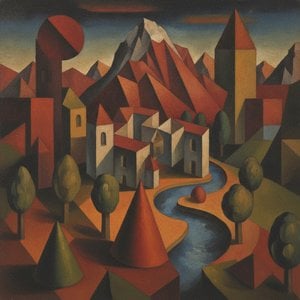
A Surrealist Embrace: Unveiling Georges Braque’s ‘Lying Nude (The Bather IX)’
Georges Braque's “Lying Nude (The Bather IX),” painted in 1932, isn’t merely a depiction of the human form; it’s an immersion into a carefully constructed dreamscape. This watercolor and ink masterpiece, residing within a private collection, stands as a testament to Braque’s masterful synthesis of Cubist fragmentation, Art Deco elegance, and a subtle yet potent vein of Surrealism. The painting immediately captivates with its asymmetrical composition – a deliberate disruption of traditional perspective that draws the eye into a world both familiar and unsettlingly unfamiliar. The central figure, a reclining nude, isn't presented as a classical ideal but rather as an embodiment of quiet contemplation, her posture suggesting a profound connection to the surrounding environment.

Deconstructing Form: The Language of Cubism
Braque’s approach to the nude figure is deeply rooted in the principles of Cubism, a movement he co-founded with Pablo Picasso. Instead of striving for realistic representation, he breaks down the body into geometric shapes – rectangles, triangles, and circles – layering these forms upon one another to create an illusion of depth and volume. This technique isn’t simply decorative; it actively challenges our perception of space and form, forcing us to reconsider how we see the world. The bold lines that define these shapes aren't rigid or assertive but rather possess a gentle fluidity, suggesting a sense of movement and organic growth within the constructed environment.
- Geometric Abstraction: The dominant use of geometric forms creates a stylized and somewhat flattened representation of the figure.
- Multiple Perspectives: Braque employs simultaneous viewpoints, presenting different facets of the nude from various angles simultaneously, mirroring the Cubist exploration of multiple perspectives.
- Fragmented Space: The fragmented nature of the composition disrupts traditional spatial relationships, contributing to the painting’s surreal and dreamlike quality.
A Palette of Earth and Light
The color palette of “Lying Nude (The Bather IX)” is deliberately muted, dominated by earthy browns and yellows – tones that evoke a sense of quiet introspection and timelessness. These warm hues are punctuated by strategic splashes of brighter colors, such as yellow and red, which draw attention to specific areas of the composition and add subtle points of visual interest. The lack of strong shadows or dramatic lighting further enhances the painting’s two-dimensional feel, creating an atmosphere of serene stillness. The flatness of the picture plane contributes to a sense of detachment from reality, inviting viewers into a realm where form and emotion intertwine.
Symbolism and Emotional Resonance
Beyond its formal elements, “Lying Nude (The Bather IX)” is rich in symbolic potential. The stylized animal-like head and features of the figure—a recurring motif in Braque’s work—can be interpreted as representing a state of primal instinct or perhaps even a dreamlike vision. The painting's overall mood is one of quiet contemplation, inviting viewers to reflect on themes of vulnerability, beauty, and the relationship between the human body and its environment. It’s not a celebration of physical form but rather an exploration of the inner landscape—a visual meditation on the complexities of the human experience. The piece resonates with a subtle tension, hinting at both serenity and underlying mystery, making it a captivating work for art collectors and interior designers alike.



 Vorschau anzeigen
 Switch to Print
 Versenden
 Teilen
 Details anzeigen

 Herunterladen
 Ähnliche Objekte
 Röntgenaufnahme
 Diashow
 Stats
Stats

 Weiterlesen






































 Die Glasoption ist nur für Größen unter 110 cm verfügbar.