Kostenlose Kunstberatung

x
Gemälde kaufen Gemälde kaufenBild kaufen Bild kaufen VersendenVersenden
DetailsDetails Zu Favoriten hinzufügen Zu Favoriten hinzufügen HerunterladenHerunterladen Ähnliche ObjekteÄhnliche Objekte RöntgenaufnahmeRöntgenaufnahme Diashow anzeigenDiashow anzeigen

Der Krug

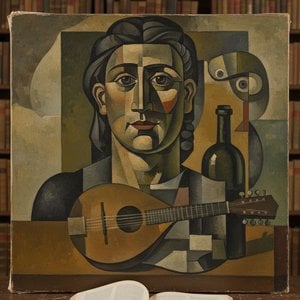
Ein beeindruckendes Stillleben von Georges Braque im Stil der analytischen Kubismus. Entdecken Sie die geometrische Abstraktion und subtile Farbpalette dieses Meisterwerks! Weitere Kunstwerke auf WikiArt.

Erkunden Sie das Leben und Werk von Georges Braque (1882-1963), eine Schlüsselgestalt der Malerei des 20. Jahrhunderts. Pionier des Kubismus an der Seite Picassos, bekannt für Fauvismus, Collagen und innovative geometrische Formen. Entdecken Sie sein Erbe bei WahooArt!

Giclée / Kunstdruck

Giclée- oder Leinwanddruck in Museumsqualität mit schneller Produktion und flexiblen Veredelungsoptionen.

P118B $10
P118H $10
P118W $10
P438Z $10
P508JH $12
P508YH $12
P805H $10
P805Z $10
P919BZ $10
P919G $10
P919XJ $10
P959ZH $10
P968JZ $12
W106C $8
W218G $10
W218JH $8
W218Y $10
W307PJ $10
W316G $10
W316PJ $8
W316Y $10
W398PJ $8
W4111J $10
W500HY $15
W500JH $15
W692G $12
W849H $8
W940BG $15
W953PJ $8

Standard
custom
CM
INCH

Wählen Sie aus unseren vordefinierten Größen, die den ursprünglichen Proportionen des Kunstwerks entsprechen.

Breite
Höhe

Sie können Ihre eigenen Maße eingeben, um ein bestimmtes Format oder einen speziellen Platz einzupassen. Wenn das von Ihnen gewählte Format nicht den Proportionen des Originalbildes entspricht, werden wir das Kunstwerk entweder beschneiden oder das Bild mit einem gespiegelten oder einfarbigen Rand erweitern. Ein digitaler Entwurf wird Ihnen zur Genehmigung zugesandt, bevor die Produktion beginnt.
Bitte beachten Sie, dass die Vorschau auf dem Bildschirm nicht den tatsächlichen Zuschnitt oder die Erweiterung widerspiegelt. Nur der Entwurf zeigt die endgültige Komposition präzise an.
Obwohl Sondermaße verfügbar sind, empfehlen wir die Auswahl eines Maßes aus der vordefinierten Liste, um die ursprünglichen Proportionen zu bewahren.

Weltweiter Versand () innerhalb von 2 Wochen statt der üblichen 4/5 Wochen. (3 Juli)

why_choose_icon
Kostenloser weltweiter Expressversand
why_choose_icon
Hochwertige Leinenleinwand
why_choose_icon
Umfassender Versicherungsschutz beim Versand
why_choose_icon
Zollsteuer-Rückerstattungsgarantie
why_choose_icon
Garantie für echte Farbtreue
why_choose_icon
60-Tage-Rückgaberecht (nur bei Mängeln)
why_choose_icon
100% Geld-zurück-Garantie
why_choose_icon
Mengenrabatt verfügbar

Gesamtpreis

-

reproduction

Der Krug

Giclée / Kunstdruck

Größe der Reproduktion

-

Endpreis aller Optionen

-

Eckdaten auf einen Blick

  • Subject or theme: Still life
  • Medium: Oil on canvas
  • Artistic style: Analytical Cubism
  • Year: 1909
  • Movement: Cubism
  • Location: Private Collection
  • Artist: Georges Braque

Kunst-Quiz

Jede Frage hat nur eine richtige Antwort.

Frage 1:
What artistic movement is ‘The pitcher’ primarily associated with?
Frage 2:
Which artist collaborated closely with Georges Braque on groundbreaking Cubist projects?
Frage 3:
The image description mentions the use of bananas. What is the significance of this inclusion in the artwork?
Frage 4:
What material is the pitcher depicted in ‘The pitcher’?
Frage 5:
Georges Braque's early training instilled in him a blend of what two disciplines?

Beschreibung des Sammlerstücks

Georges Braque’s “The Pitcher”: A Fragment of Analytical Cubism

“The pitcher,” painted in 1909 by Georges Braque, stands as a cornerstone of Analytical Cubism—a movement that irrevocably altered the course of artistic expression. More than just a depiction of an everyday object, it’s a meticulously crafted meditation on perception and representation, reflecting the intellectual ferment of the early 20th century.

  • Subject Matter: The artwork centers around a simple ceramic pitcher resting upon a tabletop. Alongside it are two bananas—a seemingly incongruous pairing that contributes significantly to the piece’s conceptual depth.
  • Style & Technique: Braque employed Analytical Cubism, characterized by its reduction of forms into geometric planes and facets. Unlike Synthetic Cubism which layered textures and colors, Analytical Cubism prioritizes a monochrome palette dominated by earthy tones—primarily ochre and brown—creating an atmosphere of subdued contemplation.
  • Historical Context: Painted during the pivotal years of artistic experimentation following Picasso’s groundbreaking collaboration with Braque, “The pitcher” embodies the spirit of questioning established conventions. The artists were actively dismantling traditional perspective and illusionistic techniques to explore how objects could be perceived simultaneously from multiple viewpoints.

Decoding Geometric Abstraction

The artist's masterful manipulation of form is evident in every plane of the composition. Braque meticulously dissects the pitcher into interlocking cubes, rendering its contours with precise lines that intersect and overlap—a technique directly influenced by Cézanne’s explorations of spatial relationships. This fragmentation isn’t merely stylistic; it symbolizes a deliberate rejection of mimetic representation, aiming instead to capture the essence of the object itself.

  • Color Palette: The muted color scheme reinforces this conceptual focus. The dominant browns and ochres evoke a sense of stillness and solidity, mirroring the geometric precision of the artwork’s structure.
  • Spatial Illusion: Despite its apparent simplicity, “The pitcher” generates a compelling illusion of depth through careful consideration of tonal variations—highlights and shadows subtly delineate the contours of the pitcher and bananas, guiding the viewer's eye across the canvas.

Symbolism Beyond Form

While ostensibly portraying mundane objects, Braque’s choice of subjects—a pitcher and bananas—holds symbolic resonance. The pitcher itself represents nourishment and domesticity, while the bananas – a tropical fruit associated with fertility and abundance – introduce an element of surprise and contrast. Together, they invite contemplation on themes of materiality, perception, and the relationship between object and viewer.

  • Influence: Braque’s work profoundly impacted subsequent generations of artists, establishing Analytical Cubism as a foundational movement in modern art.
  • Emotional Impact: The artwork's quiet elegance and intellectual rigor convey a sense of understated beauty—a testament to Braque’s ability to transform the commonplace into something extraordinary.

A Legacy of Innovation

"The pitcher" remains an enduring emblem of Cubist ingenuity, demonstrating how artists can challenge artistic conventions while simultaneously achieving remarkable visual harmony. Its meticulous execution and conceptual depth continue to inspire admiration among art historians and collectors alike—a timeless masterpiece that exemplifies the transformative power of abstraction.

Ähnliche Kunstwerke


Biografie des Künstlers

**frühes Leben und Ausbildung**

Georges Braque, ein prominenter französischer Maler, Kollagist, Bleistrichzeichner, Grafiker und Bildhauer, wurde am 13. Mai 1882 in Argenteuil, Val-d'oise, geboren. Er wuchs in Le Havre auf und erhielt zunächst eine Ausbildung als Hausmaler und Dekorateur wie sein Vater und Großvater. Braques künstlerische Neigungen führten ihn jedoch dazu, von 1897 bis 1899 an der École des Beaux-Arts in Le Havre Malerei zu studieren.

**Künstlerische Entwicklung und Fauvisme**

Im Jahr 1902, nachdem er seine Lehre bei einem Dekorateur in Paris abgeschlossen hatte, besuchte Braque bis 1904 die Académie Humbert. Dieser Zeitraum markierte seine Einführung ins Fauvismus, einen Stil, der durch lebendige Farben und emotionale Reaktionen gekennzeichnet ist. Beeinflusst von den Werken von Henri Matisse und André Derain, übernahm Braque einen fauvistischen Ansatz, wie in seinem Gemälde The Patience (Fauvismus, Öl auf Leinwand).

**Beitrag zum Kubismus**

Braques Zusammenarbeit mit Pablo Picasso von 1908 bis 1912 führte zur Entwicklung des Kubismus. Ihre analytischen kubistischen Werke, wie z.B. Georges Braque: The Patience und Pablo Picasso: Clarinet(analytischer Kubismus, Öl auf Leinwand), gelten heute als Meilensteine der Kunstgeschichte.

**Erbe und bemerkenswerte Werke**

* Houses at L'Estaques: Ein Zeugnis für Braques innovatives Einsatz von Geometrie und simultaner Perspektive. * The Patience(Fauvismus, Öl auf Leinwand): Demonstriert Braques fauvistischen Stil. * Clarinet(analytischer Kubismus, Öl auf Leinwand): Eine kollaborative kubistische Arbeit mit Picasso.

**Museen und Sammlungen**

* Musée d'Orsay: Bietet eine umfangreiche Sammlung impressionistischer und postimpressionistischer Kunst, darunter Werke von Braque. * Musée de l'Orangerie: Zeigt eine breite Palette von Kunstwerken, darunter Werke von Braque und anderen bedeutenden Künstlern.
  • Erfahren Sie mehr über Georges Braques Leben und Werk auf WahooArt.com
  • Entdecken Sie die Sammlung des Musée d'Orsay, die Werke von Braque und anderen Künstlern umfasst, unter Musée d'Orsay - Wikipedia
  • Erfahren Sie mehr über den Fauvismus und seinen Einfluss auf die Entwicklung des Kubismus mit Fauvismus Kunstbewegung auf WahooArt.com
**Georges Braques innovative Stil und seine Zusammenarbeit mit Pablo Picasso inspirieren weiterhin Künstler und Kunstliebhaber.**
Georges Braque

Georges Braque

1882 - 1963 , Frankreich

Kurzinfos

  • Beeinflusste Künstler: ['Pablo Picasso']
  • Bemerkenswerte Werke:
    • Häuser in L'Estaque
    • Die Geduld (Fauvismus)
    • Stillleben mit Pfeife
    • Mandola
  • Einflussreiche Künstler:
    • Henri Matisse
    • André Derain
    • Paul Cézanne
  • Geburtsdatum: 13. Mai 1882
  • Geburtsort: Argenteuil, Frankreich
  • Künstlerischer Stil: Kubismus, Fauvismus
  • Nationalität: Französisch
  • Sterbedatum: 1963
  • Vollständiger Name: Georges Braque
Entdecken Sie Kunstwerke, die nach Themen, Stilen und Merkmalen sortiert sind.