In echtem Maßstab anzeigen In AR an der Wand sehen Handgemalte Reproduktion kaufen Zum digitalen Bild wechseln Versenden als Grußkarte
Details anzeigen Leitfaden öffnen Zu Favoriten hinzufügen Herunterladen Ähnliche Objekte Röntgenaufnahme Diashow Besucherstatistiken

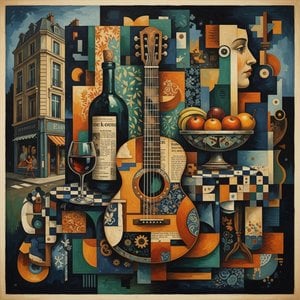
Bottle, Glass, And Pipe

Georges Braque's 'Bottle, Glass & Pipe' (1910) is a seminal Cubist collage—a vibrant exploration of form and perspective through newspaper clippings and wallpaper. Discover the innovative spirit behind this iconic work.

Erkunden Sie das Leben und Werk von Georges Braque (1882-1963), eine Schlüsselgestalt der Malerei des 20. Jahrhunderts. Pionier des Kubismus an der Seite Picassos, bekannt für Fauvismus, Collagen und innovative geometrische Formen. Entdecken Sie sein Erbe bei WahooArt!

Giclée / Kunstdruck

Giclée- oder Leinwanddruck in Museumsqualität mit schneller Produktion und flexiblen Veredelungsoptionen. ( Handgemalte Reproduktion kaufen Zum digitalen Bild wechseln)

P118B $10
P118H $10
P118W $10
P438Z $10
P508JH $12
P508YH $12
P805H $10
P805Z $10
P919BZ $10
P919G $10
P919XJ $10
P959ZH $10
P968JZ $12
W106C $8
W218G $10
W218JH $8
W218Y $10
W307PJ $10
W316G $10
W316PJ $8
W316Y $10
W398PJ $8
W4111J $10
W500HY $15
W500JH $15
W692G $12
W849H $8
W940BG $15
W953PJ $8

Standardformat
individuell anpassbar
CM
INCH

Wählen Sie aus unseren vordefinierten Formaten, die den ursprünglichen Proportionen des Kunstwerks entsprechen.

Breite
Höhe

Sie können Ihre eigenen Maße eingeben, um ein bestimmtes Format oder einen speziellen Platz einzupassen. Wenn das von Ihnen gewählte Format nicht den Proportionen des Originalbildes entspricht, werden wir das Kunstwerk entweder beschneiden oder das Bild mit einem gespiegelten oder einfarbigen Rand erweitern. Ein digitaler Entwurf wird Ihnen zur Genehmigung zugesandt, bevor die Produktion beginnt.
Bitte beachten Sie, dass die Vorschau auf dem Bildschirm nicht den tatsächlichen Zuschnitt oder die Erweiterung widerspiegelt. Nur der Entwurf zeigt die endgültige Komposition präzise an.
Obwohl Sondermaße verfügbar sind, empfehlen wir die Auswahl eines Maßes aus der vordefinierten Liste, um die ursprünglichen Proportionen zu bewahren.

Weltweiter Versand () innerhalb von 2 Wochen statt der üblichen 4/5 Wochen. (26 September)

why_choose_icon
Kostenloser weltweiter Expressversand
why_choose_icon
Hochwertige Leinenleinwand
why_choose_icon
Vollständiger Versicherungsschutz beim Versand
why_choose_icon
Zollgebühren-Rückerstattungsgarantie
why_choose_icon
Garantie für exakte Farbtreue
why_choose_icon
100-tägiges Rückgaberecht (nur bei Mängeln)
why_choose_icon
100% Geld-zurück-Garantie
why_choose_icon
Angebot für Mengenrabatt

Gesamtpreis

$ 68

reproduction

Bottle, Glass, And Pipe

Giclée / Kunstdruck

Format der Reproduktion

-

Gesamtpreis

$ 68

Kurzübersicht

  • Movement: Cubism
  • Subject or theme: Still life objects
  • Artistic style: Fragmented forms
  • Artist: Georges Braque
  • Medium: Collage
  • Title: Bottle, Glass & Pipe

Kunst-Quiz

Jede Frage hat nur eine richtige Antwort.

Frage 1:
Based on the image description, what is the dominant impression conveyed by the arrangement of objects within the bowl?
Frage 2:
Georges Braque is most closely associated with which artistic movement?
Frage 3:
The image description mentions the presence of 'paper' and a 'book'. What does this suggest about the potential subject matter or theme of the artwork?
Frage 4:
Considering Braque's early training as a house painter and decorator, how might this background have influenced his artistic approach?
Frage 5:
The use of collage in ‘Bottle, Newspaper, Pipe, and Glass’ reflects which broader artistic trend?

A Still Life of Disruption: Unpacking Georges Braque's "Bottle, Glass, and Pipe"

Georges Braque’s “Bottle, Glass, and Pipe” (circa 1910-12) isn’t merely a depiction of everyday objects; it’s a carefully orchestrated visual puzzle, a testament to the radical experimentation defining early Cubism. Born in Argenteuil, France, in 1882, Braque's artistic journey began with a grounding in his family’s trade as house painters and decorators – an experience that instilled within him a profound understanding of materials and structure. This practical foundation proved invaluable as he moved beyond traditional representation, dismantling familiar forms to reveal their underlying geometric essence.

The painting immediately confronts the viewer with a deliberately chaotic composition. A dark wooden bowl dominates the center, containing a jumble of items: fragments of paper resembling a book, two cups stacked precariously, and a vase positioned at the lower right corner. It’s a scene brimming with suggestion – a moment frozen in thought, perhaps a study for a larger work or simply an exploration of visual relationships. The deliberate lack of spatial depth, a hallmark of Cubism, forces us to actively engage with the image, reconstructing the scene within our own minds.

The Genesis of Cubism: Fragmentation and Multiple Perspectives

Braque’s development of Cubism was inextricably linked to his collaboration with Pablo Picasso. Initially, both artists were experimenting with ways to represent objects from multiple viewpoints simultaneously – a revolutionary concept at the time. “Bottle, Glass, and Pipe” exemplifies this approach. The bowl itself is broken down into fragmented planes, suggesting its three-dimensional form while simultaneously presenting it as a collection of geometric shapes. The paper fragments, too, are dissected and rearranged, creating an illusion of depth and layering that defies conventional perspective.

This technique wasn’t born in isolation. Braque's early exposure to the work of Paul Cézanne profoundly influenced his thinking. Cézanne’s emphasis on geometric forms and his exploration of multiple viewpoints laid the groundwork for Cubism’s core principles. Braque meticulously studied Cézanne’s paintings, analyzing how he rendered space and form, ultimately adapting these ideas into his own innovative style.

Symbolic Layers: Perfume, Smoke, and the Everyday

Beyond its purely formal concerns, “Bottle, Glass, and Pipe” hints at a deeper symbolic resonance. The inclusion of tobacco – represented by the pipe – evokes themes of contemplation, leisure, and perhaps even melancholy. The presence of perfume, suggested by the violet hues and the delicate glass bottle, adds an element of sensuality and refinement. These seemingly mundane objects are elevated to a level of artistic significance through Braque’s deliberate arrangement and his masterful manipulation of form and color.

Furthermore, the painting's overall sense of disorder can be interpreted as a reflection of the rapidly changing world at the turn of the 20th century – a period marked by industrialization, urbanization, and social upheaval. Braque’s fragmented composition mirrors this feeling of disorientation and uncertainty, capturing the spirit of modernity with remarkable acuity.

A Reproduction for Your Space: Bringing Cubist Innovation Home

WahooArt offers meticulously crafted hand-painted reproductions of “Bottle, Glass, and Pipe,” allowing you to bring this iconic work into your home or office. Our artists replicate Braque’s innovative techniques with the utmost care, ensuring that every detail – from the subtle nuances of color to the precise rendering of fragmented forms – is faithfully reproduced. Whether you're an art enthusiast, a collector, or simply seeking a unique and thought-provoking piece for your interior design, our reproduction provides an authentic representation of this seminal work of modern art.


Biografie des Künstlers

**frühes Leben und Ausbildung**

Georges Braque, ein prominenter französischer Maler, Kollagist, Bleistrichzeichner, Grafiker und Bildhauer, wurde am 13. Mai 1882 in Argenteuil, Val-d'oise, geboren. Er wuchs in Le Havre auf und erhielt zunächst eine Ausbildung als Hausmaler und Dekorateur wie sein Vater und Großvater. Braques künstlerische Neigungen führten ihn jedoch dazu, von 1897 bis 1899 an der École des Beaux-Arts in Le Havre Malerei zu studieren.

**Künstlerische Entwicklung und Fauvisme**

Im Jahr 1902, nachdem er seine Lehre bei einem Dekorateur in Paris abgeschlossen hatte, besuchte Braque bis 1904 die Académie Humbert. Dieser Zeitraum markierte seine Einführung ins Fauvismus, einen Stil, der durch lebendige Farben und emotionale Reaktionen gekennzeichnet ist. Beeinflusst von den Werken von Henri Matisse und André Derain, übernahm Braque einen fauvistischen Ansatz, wie in seinem Gemälde The Patience (Fauvismus, Öl auf Leinwand).

**Beitrag zum Kubismus**

Braques Zusammenarbeit mit Pablo Picasso von 1908 bis 1912 führte zur Entwicklung des Kubismus. Ihre analytischen kubistischen Werke, wie z.B. Georges Braque: The Patience und Pablo Picasso: Clarinet(analytischer Kubismus, Öl auf Leinwand), gelten heute als Meilensteine der Kunstgeschichte.

**Erbe und bemerkenswerte Werke**

* Houses at L'Estaques: Ein Zeugnis für Braques innovatives Einsatz von Geometrie und simultaner Perspektive. * The Patience(Fauvismus, Öl auf Leinwand): Demonstriert Braques fauvistischen Stil. * Clarinet(analytischer Kubismus, Öl auf Leinwand): Eine kollaborative kubistische Arbeit mit Picasso.

**Museen und Sammlungen**

* Musée d'Orsay: Bietet eine umfangreiche Sammlung impressionistischer und postimpressionistischer Kunst, darunter Werke von Braque. * Musée de l'Orangerie: Zeigt eine breite Palette von Kunstwerken, darunter Werke von Braque und anderen bedeutenden Künstlern.
  • Erfahren Sie mehr über Georges Braques Leben und Werk auf WahooArt.com
  • Entdecken Sie die Sammlung des Musée d'Orsay, die Werke von Braque und anderen Künstlern umfasst, unter Musée d'Orsay - Wikipedia
  • Erfahren Sie mehr über den Fauvismus und seinen Einfluss auf die Entwicklung des Kubismus mit Fauvismus Kunstbewegung auf WahooArt.com
**Georges Braques innovative Stil und seine Zusammenarbeit mit Pablo Picasso inspirieren weiterhin Künstler und Kunstliebhaber.**
Georges Braque

Georges Braque

1882 - 1963 , Frankreich

Eckdaten zum Künstler

  • Beeinflusste Künstler: ['Pablo Picasso']
  • Bemerkenswerte Werke:
    • Häuser in L'Estaque
    • Die Geduld (Fauvismus)
    • Stillleben mit Pfeife
    • Mandola
  • Einflussreiche Künstler:
    • Henri Matisse
    • André Derain
    • Paul Cézanne
  • Geburtsdatum: 13. Mai 1882
  • Geburtsort: Argenteuil, Frankreich
  • Künstlerischer Stil: Kubismus, Fauvismus
  • Nationalität: Französisch
  • Sterbedatum: 1963
  • Vollständiger Name: Georges Braque
Entdecken Sie Kunstwerke, die nach Themen, Stilen und Merkmalen sortiert sind.