x
Vorschau anzeigenVorschau anzeigen In AR erlebenIn AR erleben Handgemalte Reproduktion bestellen Handgemalte Reproduktion bestellenBild kaufen Bild kaufen VersendenVersenden
Details anzeigenDetails anzeigen Zu Favoriten hinzufügen Zu Favoriten hinzufügen HerunterladenHerunterladen Ähnliche ObjekteÄhnliche Objekte RöntgenaufnahmeRöntgenaufnahme DiashowDiashow

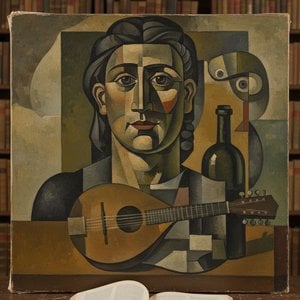
A Black Pedestal

Explore Georges Braque's 'The Pedestal' (1938), a stunning example of Analytical Cubism. This fragmented still life features musical instruments in muted tones, offering a unique blend of abstraction and contemplation. Hand-painted reproductions avai

Erkunden Sie das Leben und Werk von Georges Braque (1882-1963), eine Schlüsselgestalt der Malerei des 20. Jahrhunderts. Pionier des Kubismus an der Seite Picassos, bekannt für Fauvismus, Collagen und innovative geometrische Formen. Entdecken Sie sein Erbe bei WahooArt!

Giclée / Kunstdruck

Giclée- oder Leinwanddruck in Museumsqualität mit schneller Produktion und flexiblen Veredelungsoptionen. (Handgemalte Reproduktion bestellen Handgemalte Reproduktion bestellenBild kaufen Bild kaufen)

P118B $10
P118H $10
P118W $10
P438Z $10
P508JH $12
P508YH $12
P805H $10
P805Z $10
P919BZ $10
P919G $10
P919XJ $10
P959ZH $10
P968JZ $12
W106C $8
W218G $10
W218JH $8
W218Y $10
W307PJ $10
W316G $10
W316PJ $8
W316Y $10
W398PJ $8
W4111J $10
W500HY $15
W500JH $15
W692G $12
W849H $8
W940BG $15
W953PJ $8

Standardformat
individuell anpassbar
CM
INCH

Wählen Sie aus unseren vordefinierten Formaten, die den ursprünglichen Proportionen des Kunstwerks entsprechen.

Breite
Höhe

Sie können Ihre eigenen Maße eingeben, um ein bestimmtes Format oder einen speziellen Platz einzupassen. Wenn das von Ihnen gewählte Format nicht den Proportionen des Originalbildes entspricht, werden wir das Kunstwerk entweder beschneiden oder das Bild mit einem gespiegelten oder einfarbigen Rand erweitern. Ein digitaler Entwurf wird Ihnen zur Genehmigung zugesandt, bevor die Produktion beginnt.
Bitte beachten Sie, dass die Vorschau auf dem Bildschirm nicht den tatsächlichen Zuschnitt oder die Erweiterung widerspiegelt. Nur der Entwurf zeigt die endgültige Komposition präzise an.
Obwohl Sondermaße verfügbar sind, empfehlen wir die Auswahl eines Maßes aus der vordefinierten Liste, um die ursprünglichen Proportionen zu bewahren.

Weltweiter Versand () innerhalb von 2 Wochen statt der üblichen 4/5 Wochen. (31 August)

why_choose_icon
Kostenloser weltweiter Expressversand
why_choose_icon
Hochwertige Leinenleinwand
why_choose_icon
Umfassender Versicherungsschutz beim Versand
why_choose_icon
Zollgebühren-Rückerstattungsgarantie
why_choose_icon
Garantie für exakte Farbtreue
why_choose_icon
60 Tage Rückgaberecht (nur bei Mängeln)
why_choose_icon
100% Geld-zurück-Garantie
why_choose_icon
Mengenrabatt verfügbar

Gesamtpreis

$ 68

reproduction

A Black Pedestal

Giclée / Kunstdruck

Format der Reproduktion

-

Gesamtpreis

$ 68

Eckdaten

  • Subject or theme: Still Life
  • Movement: Cubism
  • Notable elements or techniques: Fragmented geometric shapes
  • Medium: Oil on Canvas
  • Year: 1919
  • Artistic style: Analytical Cubism
  • Influences: Paul Cézanne

Kunst-Quiz

Jede Frage hat nur eine richtige Antwort.

Frage 1:
What artistic movement is Georges Braque’s ‘A Black Pedestal’ primarily associated with?
Frage 2:
The painting depicts a still life featuring musical instruments. What is the dominant stylistic approach employed by Braque in this piece?
Frage 3:
What material was used to create ‘A Black Pedestal’?
Frage 4:
The painting’s composition emphasizes disorder and chaos. What artistic technique contributes to this effect?
Frage 5:
Georges Braque collaborated closely with Pablo Picasso during the Cubist period. How did their artistic styles differ?

The Architecture of Silence: Deconstructing Braque’s Vision

To encounter Georges Braque’s “A Black Pedestal” is to step into a world where the boundaries between object and space begin to dissolve. Painted during a period of profound artistic maturity, this work serves as a masterful window into the heart of Cubism—a movement that sought not to mirror the world, but to reconstruct it through an intellectual lens. At first glance, the composition presents a stark, commanding black pedestal, yet this central anchor supports much more than mere physical weight; it holds a collection of musical instruments—a violin, cello, clarinet, and trumpet—rendered in a way that defies traditional perspective. The painting does not merely show us these objects; it invites us to experience their fragmented essence, pulling the viewer into a rhythmic dance of planes and muted tonal harmonies.

The brilliance of this piece lies in its ability to transform the mundane into the monumental. Braque, whose early life was shaped by the practical precision of his family’s trade as house painters and decorators, brings an unparalleled sensitivity to structure and form. In “A Black Pedestal,” we see the legacy of Analytical Cubism at its most potent. Rather than relying on the fleeting light of Impressionism, Braque employs a meticulous dissection of reality. He breaks down the solid forms of the instruments and the pedestal into constituent geometric planes, creating a sense of depth that is paradoxically flat and multidimensional. This technique forces the eye to wander, reconstructing the scene piece by piece, much like a melody being assembled from individual notes.

A Symphony of Form and Fragmented Reality

Beyond its technical prowess, the artwork carries a profound emotional and symbolic resonance. The choice of musical instruments is far from accidental; music, like Cubism, relies on the relationship between distinct parts to create a cohesive whole. There is a quiet, almost meditative tension within the composition—a sense of "ordered chaos" where the arrangement of a chair, a bowl, or a spoon feels both spontaneous and mathematically precise. The muted color palette, dominated by earthy tones and deep blacks, strips away the distraction of vibrant color to focus our attention on the structural rhythm of the piece. This restraint creates an atmosphere of sophisticated introspection, making it a work that demands slow, contemplative viewing.

For the discerning collector or the interior designer, “A Black Pedestal” offers more than just aesthetic beauty; it provides a focal point of intellectual depth. Its large-scale presence (75 x 129 cm) and commanding subject matter make it an ideal centerpiece for modern, minimalist, or avant-garde interiors. A high-quality reproduction of this masterpiece allows the complex interplay of light and shadow to breathe within a contemporary space, adding a layer of historical gravity and artistic sophistication. It is a piece that does not merely decorate a wall; it initiates a dialogue between the history of modernism and the contemporary soul, reminding us that even in fragmentation, there is a profound and enduring harmony.


Über den Künstler

**frühes Leben und Ausbildung**

Georges Braque, ein prominenter französischer Maler, Kollagist, Bleistrichzeichner, Grafiker und Bildhauer, wurde am 13. Mai 1882 in Argenteuil, Val-d'oise, geboren. Er wuchs in Le Havre auf und erhielt zunächst eine Ausbildung als Hausmaler und Dekorateur wie sein Vater und Großvater. Braques künstlerische Neigungen führten ihn jedoch dazu, von 1897 bis 1899 an der École des Beaux-Arts in Le Havre Malerei zu studieren.

**Künstlerische Entwicklung und Fauvisme**

Im Jahr 1902, nachdem er seine Lehre bei einem Dekorateur in Paris abgeschlossen hatte, besuchte Braque bis 1904 die Académie Humbert. Dieser Zeitraum markierte seine Einführung ins Fauvismus, einen Stil, der durch lebendige Farben und emotionale Reaktionen gekennzeichnet ist. Beeinflusst von den Werken von Henri Matisse und André Derain, übernahm Braque einen fauvistischen Ansatz, wie in seinem Gemälde The Patience (Fauvismus, Öl auf Leinwand).

**Beitrag zum Kubismus**

Braques Zusammenarbeit mit Pablo Picasso von 1908 bis 1912 führte zur Entwicklung des Kubismus. Ihre analytischen kubistischen Werke, wie z.B. Georges Braque: The Patience und Pablo Picasso: Clarinet(analytischer Kubismus, Öl auf Leinwand), gelten heute als Meilensteine der Kunstgeschichte.

**Erbe und bemerkenswerte Werke**

* Houses at L'Estaques: Ein Zeugnis für Braques innovatives Einsatz von Geometrie und simultaner Perspektive. * The Patience(Fauvismus, Öl auf Leinwand): Demonstriert Braques fauvistischen Stil. * Clarinet(analytischer Kubismus, Öl auf Leinwand): Eine kollaborative kubistische Arbeit mit Picasso.

**Museen und Sammlungen**

* Musée d'Orsay: Bietet eine umfangreiche Sammlung impressionistischer und postimpressionistischer Kunst, darunter Werke von Braque. * Musée de l'Orangerie: Zeigt eine breite Palette von Kunstwerken, darunter Werke von Braque und anderen bedeutenden Künstlern.
  • Erfahren Sie mehr über Georges Braques Leben und Werk auf WahooArt.com
  • Entdecken Sie die Sammlung des Musée d'Orsay, die Werke von Braque und anderen Künstlern umfasst, unter Musée d'Orsay - Wikipedia
  • Erfahren Sie mehr über den Fauvismus und seinen Einfluss auf die Entwicklung des Kubismus mit Fauvismus Kunstbewegung auf WahooArt.com
**Georges Braques innovative Stil und seine Zusammenarbeit mit Pablo Picasso inspirieren weiterhin Künstler und Kunstliebhaber.**
Georges Braque

Georges Braque

1882 - 1963 , Frankreich

Kurzinfos

  • Beeinflusste Künstler: ['Pablo Picasso']
  • Bemerkenswerte Werke:
    • Häuser in L'Estaque
    • Die Geduld (Fauvismus)
    • Stillleben mit Pfeife
    • Mandola
  • Einflussreiche Künstler:
    • Henri Matisse
    • André Derain
    • Paul Cézanne
  • Geburtsdatum: 13. Mai 1882
  • Geburtsort: Argenteuil, Frankreich
  • Künstlerischer Stil: Kubismus, Fauvismus
  • Nationalität: Französisch
  • Sterbedatum: 1963
  • Vollständiger Name: Georges Braque
Entdecken Sie Kunstwerke, die nach Themen, Stilen und Merkmalen sortiert sind.