Vorschau anzeigen In AR ansehen Handgemalte Reproduktion bestellen Zum digitalen Bild wechseln Versenden
Details anzeigen Leitfaden Zu Favoriten hinzufügen Herunterladen Ähnliche Objekte Röntgenaufnahme Diashow Q&A Statistiken

Die Lehre der Virginal

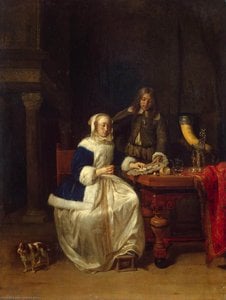
Gabriel Metsu's "Die Lehre der Virginal" fängt ein intimes Musiklehrgeschehen im Goldenen Zeitalter Niederlande ein. Entdecken Sie Detailreichtum, Licht und Symbolik in diesem Meisterwerk.

Entdecken Sie Gabriël Metsu (1629-1667), holländischen Maler des Goldenen Zeitalters! Genreszenen, Porträts & Inneneinrichtung unter Rembrandt- & Vermeer-Einfluss. Einblicke in den Alltag!

Giclée / Kunstdruck

Giclée- oder Leinwanddruck in Museumsqualität mit schneller Produktion und flexiblen Veredelungsoptionen. ( Handgemalte Reproduktion bestellen Zum digitalen Bild wechseln)

Corner sample of the P118B picture frame: formgepresstes Polystyrol, 5 cm wide and 3 cm thick
P118B €10
Corner sample of the P118H picture frame: formgepresstes Polystyrol, 5 cm wide and 3 cm thick
P118H €10
Corner sample of the P118W picture frame: formgepresstes Polystyrol, 5 cm wide and 3 cm thick
P118W €10
Corner sample of the P438Z picture frame: formgepresstes Polystyrol, 5.5 cm wide and 3.5 cm thick
P438Z €10
Corner sample of the P508JH picture frame: formgepresstes Polystyrol, 7 cm wide and 3.5 cm thick
P508JH €12
Corner sample of the P508YH picture frame: formgepresstes Polystyrol, 7 cm wide and 3.5 cm thick
P508YH €12
Corner sample of the P805H picture frame: formgepresstes Polystyrol, 5 cm wide and 3.5 cm thick
P805H €10
Corner sample of the P805Z picture frame: formgepresstes Polystyrol, 5 cm wide and 3.5 cm thick
P805Z €10
Corner sample of the P919BZ picture frame: formgepresstes Polystyrol, 7 cm wide and 3.5 cm thick
P919BZ €10
Corner sample of the P919G picture frame: formgepresstes Polystyrol, 7 cm wide and 3.5 cm thick
P919G €10
Corner sample of the P919XJ picture frame: formgepresstes Polystyrol, 7 cm wide and 3.5 cm thick
P919XJ €10
Corner sample of the P959ZH picture frame: formgepresstes Polystyrol, 5 cm wide and 3 cm thick
P959ZH €10
Corner sample of the P968JZ picture frame: formgepresstes Polystyrol, 6 cm wide and 4 cm thick
P968JZ €12
Corner sample of the W106C picture frame: Massivholz, 5 cm wide and 3 cm thick
W106C €8
Corner sample of the W218G picture frame: Massivholz, 5 cm wide and 3 cm thick
W218G €10
Corner sample of the W218JH picture frame: Massivholz, 5 cm wide and 3 cm thick
W218JH €8
Corner sample of the W218Y picture frame: Massivholz, 5 cm wide and 3 cm thick
W218Y €10
Corner sample of the W307PJ picture frame: Massivholz, 6 cm wide and 3 cm thick
W307PJ €10
Corner sample of the W316G picture frame: Massivholz, 6 cm wide and 3 cm thick
W316G €10
Corner sample of the W316PJ picture frame: Massivholz, 6 cm wide and 3 cm thick
W316PJ €8
Corner sample of the W316Y picture frame: Massivholz, 6 cm wide and 3 cm thick
W316Y €10
Corner sample of the W398PJ picture frame: Massivholz, 5 cm wide and 3 cm thick
W398PJ €8
Corner sample of the W4111J picture frame: Massivholz, 6.5 cm wide and 3.5 cm thick
W4111J €10
Corner sample of the W500HY picture frame: Massivholz, 7 cm wide and 5 cm thick
W500HY €15
Corner sample of the W500JH picture frame: Massivholz, 7 cm wide and 5 cm thick
W500JH €15
Corner sample of the W692G picture frame: Massivholz, 8 cm wide and 4 cm thick
W692G €12
Corner sample of the W849H picture frame: Massivholz, 5 cm wide and 3 cm thick
W849H €8
Corner sample of the W940BG picture frame: Massivholz, 7.5 cm wide and 4.5 cm thick
W940BG €15
Corner sample of the W953PJ picture frame: Massivholz, 6 cm wide and 3.5 cm thick
W953PJ €8

Standardformat
individuell anpassbar
CM
INCH

Wählen Sie aus unseren vordefinierten Formaten, die den ursprünglichen Proportionen des Kunstwerks entsprechen.

Breite
Höhe

Geben Sie die benötigte Breite und Höhe an, damit der Druck perfekt in Ihren Rahmen oder an Ihre Wand passt. Ein Druck kann nur beschnitten, aber niemals größer als das Originalbild angefertigt werden; daher verliert ein Format mit anderen Proportionen einen Teil des Bildes. Wir senden Ihnen ein digitales Mockup zur Freigabe, bevor wir den Druck ausführen. Das auf dieser Seite gezeigte Bild zeigt nicht den tatsächlichen Beschnitt – dies ist nur im Mockup ersichtlich.

Weltweiter Versand () innerhalb von 2 Wochen statt der üblichen 4/5 Wochen. (29 Oktober)

Kostenloser weltweiter Expressversand
Hochwertige Leinenleinwand
Umfassender Versicherungsschutz beim Versand
Zollgebühren-Rückerstattungsgarantie
Garantie für exakte Farbtreue
100 Tage Rückgaberecht (nur bei Mängeln)
100% Geld-zurück-Garantie
Mengenrabatt verfügbar

Gesamtpreis

€ 60

Die Lehre der Virginal

Giclée / Kunstdruck

Format der Reproduktion

-

Endpreis

€ 60

Eckdaten

  • Notable elements: Musikunterricht, Paar
  • Movement: Niederländische Goldene Ära
  • Dimensions: 38,4 × 32,2 cm
  • Subject: Musizieren, Haushaltsszene
  • Influences:
    • Rembrandt
    • Vermeer
  • Medium: Öl auf Holz

Kunst-Quiz

Jede Frage hat nur eine richtige Antwort.

Frage 1:
Welche Epoche kennzeichnet die Malerei von Gabriel Metsu hauptsächlich?
Frage 2:
Welche Instrumentfamilie ist im Bild dargestellt?
Frage 3:
Wie wird das Licht in dem Gemälde hauptsächlich eingesetzt?
Frage 4:
Welches Symbol könnte die Virginal im Gemälde repräsentieren?
Frage 5:
Welche Technik wird hauptsächlich bei der Darstellung der Kleidung verwendet?

Gabriel Metsu’s “La Leçon de Virginal”: A Window into Dutch Domesticity

Gabriel Metsu's "La Leçon de Virginal" – a painting brimming with quiet intimacy and subtle symbolism – offers a captivating glimpse into the refined world of 17th-century Dutch domestic life. Completed around 1665, this work transcends a simple music lesson; it’s a carefully constructed tableau that speaks volumes about social status, education, and the burgeoning romance of the era. Metsu, an artist known for his eclectic approach and meticulous attention to detail, masterfully captures a moment frozen in time within a dimly lit interior, inviting us into a scene both familiar and profoundly evocative.

The painting centers on a young woman receiving instruction from a gentleman at a virginal – a delicate keyboard instrument favored during that period. The composition is deliberately triangular, drawing our eye to the figures as they form the central points of interest. A strategically placed window, draped with rich red curtains, provides a crucial source of light, casting gentle shadows and adding depth to the scene. This interplay of light and shadow isn’t merely decorative; it subtly emphasizes the intimacy of the moment while simultaneously hinting at the secrets held within the room.

A Symphony of Color and Texture

Metsu's palette is remarkably restrained, dominated by muted browns, beiges, whites, and the occasional splash of coral pink. These earthy tones contribute to a sense of understated elegance and create a feeling of quiet contemplation. The fabrics – the woman’s dress, the man’s attire, and the curtains – are rendered with exquisite detail, suggesting luxurious materials like silk or linen. The artist's skillful brushwork creates a tactile quality, inviting us to almost feel the smoothness of the surfaces and the warmth of the light.

Notice particularly the subtle variations in tone within the wood grain of the virginal itself – a testament to Metsu’s dedication to accurately representing the textures of everyday objects. The muted colors aren't cold or sterile; they possess a warm, inviting quality that perfectly complements the scene’s overall atmosphere.

Symbolism and Social Context

"La Leçon de Virginal" is deeply rooted in the social and cultural context of 17th-century Holland. The virginal itself was a symbol of musical accomplishment and social standing, often found in wealthy households as a marker of refinement. The scene represents more than just a music lesson; it embodies the values of education, domesticity, and the cultivation of refined tastes that were highly prized during this period.

Furthermore, the presence of the gentleman – likely a teacher or potential suitor – introduces an element of romantic anticipation. The subtle gestures between the figures—the hand guiding the virginal keys, the offering of a musical score—suggest a burgeoning connection. The inclusion of the window and the view beyond hints at a world outside the confines of the domestic sphere, adding another layer to the painting’s narrative.

Metsu's Unique Style: A Master of Genre Painting

Gabriel Metsu stands apart as an artist known for his eclectic style. He seamlessly blended elements from various genres – history paintings, portraits, still lifes, and genre scenes – creating works that are both meticulously detailed and remarkably intimate. “La Leçon de Virginal” exemplifies this versatility, combining realistic depictions of everyday life with subtle symbolic gestures.

His work reflects the spirit of the Dutch Golden Age, characterized by a focus on realism, attention to detail, and an interest in capturing the nuances of human experience. Metsu’s ability to imbue seemingly simple scenes with profound meaning is what makes “La Leçon de Virginal” such a compelling and enduring masterpiece. It's a painting that invites repeated viewing, revealing new layers of interpretation with each encounter.

Fragen & Antworten

Welche Farbe sticht in "Die Lehre der Virginal" am meisten hervor?

Spachtelgrau (#e9e1b8) ist die dominierende Farbe von "Die Lehre der Virginal" von Gabriel Metsu.

Wie ist die Farbkomposition von "Die Lehre der Virginal" von Gabriel Metsu aufgebaut?

In "Die Lehre der Virginal" trifft ein Aussagekraft Kontrast auf eine Hohe farbliche Harmonie Harmonie.

Welche Druckgröße und welches Format werden für „Die Lehre der Virginal“ empfohlen?

Für „Die Lehre der Virginal“ wird ein Druckformat von Formattyp in der Ausrichtung Hochformat empfohlen.


Künstlerbiografie

Ein Leben voller künstlerischer Erkundungen: Gabriël Metsu

  • Geboren: Leiden, Niederlande (1629)
  • Gestorben: 1667

Frühes Leben und Einflüsse

Gabriël Metsu führte ein Leben, das von künstlerischer Erkundung und Innovation geprägt war. Geboren 1629, war er der Sohn von Jacques Metsu, einem Teppichweber und Maler aus Hainault. Dieser vielfältige Hintergrund beeinflusste wahrscheinlich sein frühes Interesse an verschiedenen künstlerischen Techniken. Der Umzug seiner Familie nach Leiden setzte ihn zahlreichen kulturellen Einflüssen aus.

Künstlerische Karriere: Ein eklektischer Stil

Metsus Karriere war durch eine Ablehnung eines einzigen Stils oder einer Technik gekennzeichnet, was ihm den Titel des „hochgradig eklektischen Künstlers“ einbrachte. Seine Werke umfassten historische Gemälde, Stillleben, Porträts und Genrekunst. Bemerkenswert ist, dass nur 14 seiner 133 bekannten Arbeiten datiert sind, was vieles über seinen kreativen Prozess zu entdecken lässt.

  • Frühe Einflüsse: Rembrandts Einfluss auf Metsus frühe Arbeit zeigt sich in seinem Gebrauch von Licht und Farbe.
  • Amsterdamer Periode (ab 1655): Sein Umzug nach Amsterdam markierte eine Verschiebung hin zu häuslichen Innenräumen und Genreszenen, mit größerem Schwerpunkt auf Detailtreue und Realismus.
  • Ausbildung & Mentorenschaft: Er unterrichtete Michiel van Musscher und Joost van Geel, was sein Engagement für die künstlerische Gemeinschaft widerspiegelt.

Bemerkenswerte Werke und künstlerische Entwicklung

Metsus Gemälde zeigten oft junge Frauen, Marktszenen und alte Menschen und griffen dabei auf beliebte Embleme der Zeit zurück. Sein Stil entwickelte sich im Laufe seiner Karriere weiter und demonstrierte eine Beherrschung verschiedener Techniken.

  • Das kranke Kind (ca. 1664): Dieses Werk spiegelt Metsus Bewunderung für Johannes Vermeers akribische Detailgenauigkeit und Lichtverwendung wider.
  • Porträt der Familie Hinlopen: Ein Meisterwerk, das Genrekunst mit Porträtkunst verbindet und seine Fähigkeit zeigt, sowohl individuellen Charakter als auch häusliches Leben einzufangen.
  • Der verlorene Sohn (ca. 1640): Demonstriert einen Barock-Einfluss mit seiner dramatischen Komposition und reichen Detailgenauigkeit.
  • Wiederkehrende Themen: Metsu stellte häufig Szenen des täglichen Lebens dar, oft mit symbolischer Bedeutung versehen.

Historische Bedeutung und Vermächtnis

Gabriëls Vermächtnis liegt in seiner Vielseitigkeit und seinem Beitrag zum Goldenen Zeitalter der Niederlande. Sein eklektischer Stil beeinflusste nachfolgende Generationen von Künstlern. Heute befinden sich seine Werke in renommierten Museen auf der ganzen Welt.

  • Holländischer Maler des Goldenen Zeitalters: Er gilt als bedeutende Figur innerhalb der lebendigen künstlerischen Landschaft des 17. Jahrhunderts in den Niederlanden.
  • Museumsbestände: Seine Gemälde befinden sich in verschiedenen Museen, darunter das Rijksmuseum in Amsterdam.
  • Fortwährende Wertschätzung: Metsus Kunst fasziniert und inspiriert weiterhin Betrachter mit ihrem Realismus, ihrer Detailgenauigkeit und ihren subtilen Erzählungen.
Gabriel Metsu

Gabriel Metsu

1629 - 1667 , Niederlande

Kurzinfos

  • Bemerkenswerte Werke:
    • Das kranke Kind
    • Familienporträt Hinlopen
    • Hühnerverkäuferin
    • Der Briefleser
    • Der verlorene Sohn
  • Einflussreiche Künstler:
    • Rembrandt van Rijn
    • Johannes Vermeer
  • Geburtsdatum: 1629
  • Geburtsort: Leiden, Niederlande
  • Künstlerische Richtung: Goldenes Zeitalter
  • Nationalität: Niederländisch
  • Sterbedatum: 1667
  • Vollständiger Name: Gabriël Metsu
Entdecken Sie Kunstwerke, die nach Themen, Stilen und Merkmalen sortiert sind.