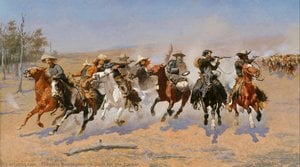
The Grass Fire (1908) by Frederic Remington, hand-painted oil painting reproduction by a master artist
Vorschau anzeigen In AR ansehen Zum Druck wechseln Zum digitalen Bild wechseln Versenden
Details anzeigen Leitfaden Zu Favoriten hinzufügen Herunterladen Ähnliche Objekte Röntgenaufnahme Diashow Q&A Statistiken

The Grass Fire Hand-painted oil painting reproduction

Abmessungen
101.0 x 68.0 cm

Experience Frederic Remington's iconic 'The Grass Fire,' a captivating 1908 painting depicting Native Americans on horseback amidst a thrilling Western adventure, showcasing the artist’s masterful style and capturing the spirit of the vanishing West. Discover this stunning reproduction today.

Frederic Remington (1861-1909): US-amerikanischer Maler des Wilden Westens! Entdecken Sie Cowboys, Native Americans & Kavallerie in dynamischen Gemälden – ein Meister seines Fachs!

Handgefertigte Ölreproduktion

Handgemaltes Ölgemälde auf Leinwand in Ihrer Wunschgröße und mit Rahmen, auf Bestellung von unseren Künstlern angefertigt. ( Zum Druck wechseln Zum digitalen Bild wechseln)

Corner sample of the P118B picture frame: formgepresstes Polystyrol, 5 cm wide and 3 cm thick
P118B €10
Corner sample of the P118H picture frame: formgepresstes Polystyrol, 5 cm wide and 3 cm thick
P118H €10
Corner sample of the P118W picture frame: formgepresstes Polystyrol, 5 cm wide and 3 cm thick
P118W €10
Corner sample of the P438Z picture frame: formgepresstes Polystyrol, 5.5 cm wide and 3.5 cm thick
P438Z €10
Corner sample of the P508JH picture frame: formgepresstes Polystyrol, 7 cm wide and 3.5 cm thick
P508JH €12
Corner sample of the P508YH picture frame: formgepresstes Polystyrol, 7 cm wide and 3.5 cm thick
P508YH €12
Corner sample of the P805H picture frame: formgepresstes Polystyrol, 5 cm wide and 3.5 cm thick
P805H €10
Corner sample of the P805Z picture frame: formgepresstes Polystyrol, 5 cm wide and 3.5 cm thick
P805Z €10
Corner sample of the P919BZ picture frame: formgepresstes Polystyrol, 7 cm wide and 3.5 cm thick
P919BZ €10
Corner sample of the P919G picture frame: formgepresstes Polystyrol, 7 cm wide and 3.5 cm thick
P919G €10
Corner sample of the P919XJ picture frame: formgepresstes Polystyrol, 7 cm wide and 3.5 cm thick
P919XJ €10
Corner sample of the P959ZH picture frame: formgepresstes Polystyrol, 5 cm wide and 3 cm thick
P959ZH €10
Corner sample of the P968JZ picture frame: formgepresstes Polystyrol, 6 cm wide and 4 cm thick
P968JZ €12
Corner sample of the W106C picture frame: Massivholz, 5 cm wide and 3 cm thick
W106C €8
Corner sample of the W218G picture frame: Massivholz, 5 cm wide and 3 cm thick
W218G €10
Corner sample of the W218JH picture frame: Massivholz, 5 cm wide and 3 cm thick
W218JH €8
Corner sample of the W218Y picture frame: Massivholz, 5 cm wide and 3 cm thick
W218Y €10
Corner sample of the W307PJ picture frame: Massivholz, 6 cm wide and 3 cm thick
W307PJ €10
Corner sample of the W316G picture frame: Massivholz, 6 cm wide and 3 cm thick
W316G €10
Corner sample of the W316PJ picture frame: Massivholz, 6 cm wide and 3 cm thick
W316PJ €8
Corner sample of the W316Y picture frame: Massivholz, 6 cm wide and 3 cm thick
W316Y €10
Corner sample of the W398PJ picture frame: Massivholz, 5 cm wide and 3 cm thick
W398PJ €8
Corner sample of the W4111J picture frame: Massivholz, 6.5 cm wide and 3.5 cm thick
W4111J €10
Corner sample of the W500HY picture frame: Massivholz, 7 cm wide and 5 cm thick
W500HY €15
Corner sample of the W500JH picture frame: Massivholz, 7 cm wide and 5 cm thick
W500JH €15
Corner sample of the W692G picture frame: Massivholz, 8 cm wide and 4 cm thick
W692G €12
Corner sample of the W849H picture frame: Massivholz, 5 cm wide and 3 cm thick
W849H €8
Corner sample of the W940BG picture frame: Massivholz, 7.5 cm wide and 4.5 cm thick
W940BG €15
Corner sample of the W953PJ picture frame: Massivholz, 6 cm wide and 3.5 cm thick
W953PJ €8

Standardformat
individuell anpassbar
CM
INCH

Wählen Sie aus unseren vordefinierten Formaten, die den ursprünglichen Proportionen des Kunstwerks entsprechen.

Breite
Höhe

Geben Sie die Breite und die Höhe an, die Sie für Ihren Rahmen oder Ihre Wand benötigen. Da dieses Werk handgemalt ist, kann der Künstler bei einer anderen Form etwas mehr um das Bild herum malen oder etwas abschneiden – Sie entscheiden. Wir senden Ihnen ein digitales Mockup zur Freigabe, bevor mit dem Malen begonnen wird. Das auf dieser Seite gezeigte Bild stellt nicht das tatsächliche Ergebnis dar – dies tut nur das Mockup.

Beispiele für Anpassungsmöglichkeiten: Gesicht durch Kundenfoto ersetzen; Haustier hinzufügen (z. B. Katze durch Hund ersetzen); eine versteckte Nachricht im Hintergrund einfügen; Hintergrundlandschaft oder -elemente ändern.
Nach der Bestellung wird das WahooArt.com-Team dem Kunden Anweisungen per E-Mail zusenden und eine Mockup-Vorschau bereitstellen.

Weltweiter Versand () in nur 3 bis 4 Wochen statt der üblichen 5 Wochen. (31 Oktober). Keine Kompromisse bei der Qualität.

Kostenloser weltweiter Expressversand
Hochwertige Leinenleinwand
Umfassender Versicherungsschutz beim Versand
Zollgebühren-Rückerstattungsgarantie
Garantie für exakte Farbtreue
100 Tage Rückgaberecht (nur bei Mängeln)
100% Geld-zurück-Garantie
Mengenrabatt verfügbar

Gesamtpreis

€ 242

The Grass Fire

Art der Reproduktion

Format der Reproduktion

-

Endpreis

€ 242

A Chronicle of the Wild West: Frederic Remington’s “The Grass Fire”

Frederic Remington's "The Grass Fire," painted in 1908, is more than just a depiction of Native Americans on horseback; it’s a poignant snapshot of a vanishing era and a testament to an artist’s profound engagement with the American West. Measuring 101 x 68 cm, this artwork captures a moment of raw energy and quiet resilience as a group of riders navigate a landscape consumed by wildfire – a visual metaphor for both destruction and renewal. Remington, born in Canton, New York, in 1861, wasn’t simply observing the West; he was actively constructing its image through meticulous study and a deep understanding of the narratives surrounding it. His upbringing, steeped in military tradition and fueled by a romanticized vision of frontier life, profoundly shaped his artistic output.

  • Subject Matter: The painting’s central focus is on Native American horsemen, a recurring theme in Remington's work reflecting the era’s fascination with the “vanishing West.”
  • Composition: The dynamic arrangement of riders and horses creates a sense of movement and urgency, drawing the viewer into the heart of the scene. The inclusion of a dog adds an element of companionship and highlights the close relationship between humans and animals in this environment.
  • Historical Context: Created at the turn of the 20th century, “The Grass Fire” emerged during a period of significant change in the American West – the decline of Native American tribes and the rise of industrialization. Remington’s work is often viewed as both documenting this transition and contributing to its romanticized portrayal.

Technique and Style: A Masterclass in Realism

Remington's artistic style is characterized by a robust realism, heavily influenced by his experience as a military artist. “The Grass Fire” exemplifies this approach through detailed depictions of the horses’ musculature, the rugged terrain, and the weathered faces of the riders. His brushwork is deliberately textured, conveying a sense of immediacy and capturing the harshness of the environment. The use of color – predominantly earthy tones punctuated by flashes of red from the fire – further enhances the painting's dramatic impact. Remington employed oil paints on canvas, utilizing layering techniques to build up depth and create a palpable sense of volume within the scene.

  • Brushwork: Remington’s signature impasto technique—thickly applied paint—adds significant texture and visual interest to the artwork.
  • Color Palette: The muted color scheme reflects the natural environment of the American West, emphasizing the drama of the fire against a backdrop of browns, grays, and ochres.

Symbolism and Narrative

Beyond its immediate depiction of Native Americans on horseback, “The Grass Fire” carries significant symbolic weight. The burning landscape can be interpreted as representing both destruction – the loss of traditional ways of life – and renewal – a potential for rebirth and adaptation. The kneeling figure, possibly tending to an injury, introduces an element of vulnerability and humanity into the scene, reminding us of the personal cost of survival in this unforgiving environment. Remington’s work frequently engaged with themes of courage, resilience, and the enduring spirit of the American West.

Emotional Impact and Artistic Significance

"The Grass Fire" resonates deeply due to its evocative portrayal of a pivotal moment in American history. It captures not just a visual scene but also a powerful emotional response – a sense of awe, respect, and perhaps even melancholy for a way of life that was rapidly disappearing. As one of Frederic Remington’s most iconic works, “The Grass Fire” remains a significant contribution to the canon of American art, offering a valuable glimpse into the complexities of the West and cementing Remington's legacy as a chronicler of its vanishing beauty.

Fragen & Antworten

Welche Atmosphäre würde eine Reproduktion von "The Grass Fire" von Frederic Remington in einen Raum bringen?

"The Grass Fire" von Frederic Remington strahlt eine Nostalgisch Atmosphäre aus und wird für ein Wohnbereich empfohlen. Die Stimmung beschreibt das Gefühl, das das Werk in den umgebenden Raum bringt.

Wer hat "The Grass Fire" geschaffen und wann?

Frederic Remington schuf „The Grass Fire“ im Jahr 1908.

Wo finde ich Statistiken zu "The Grass Fire" von Frederic Remington?

Für „The Grass Fire“ gibt es eine Besucherzahlen-Seite. Sie zeigt die monatlichen Aufrufe des Kunstwerks sowie weiterer Werke des Künstlers mit einer Aufschlüsselung nach Land und Sprache an.


Künstlerbiografie

Frühe Jahre und Ausbildung

  • Geburt und Familie: Frederic Sackrider Remington wurde am 4. Oktober 1861 in Canton, New York, geboren. Seine Familie hatte französisch-baskische Wurzeln.
  • Militärische Prägung: Sein Vater, Colonel Seth Pierrepont Remington, ein Hardwarehändler und Bürgerkriegsveteran, beeinflusste sein frühes Leben maßgeblich. Die Exposition gegenüber militärischen Themen sollte später seine Kunst prägen.
  • Frühe Ausbildung: Er besuchte das Vermont Episcopal Institute, eine Militärschule, wo er mit dem Zeichnen begann. Später wechselte er an eine andere Militärakademie, verfolgte aber schließlich aufgrund mangelnder Konzentration die Kunst statt einer militärischen Karriere.

Künstlerische Laufbahn und Stil

  • Frühe Illustrationen: Remingtons erste veröffentlichte Illustration war eine Karikatur für das Yale Courant, die ein frühes Talent für die Darstellung von Actionszenen demonstrierte.
  • Fokus auf den Westen: Eine entscheidende Reise nach Montana im Jahr 1881 weckte seine Faszination für den amerikanischen Westen, der zum zentralen Thema seiner künstlerischen Karriere wurde.
  • Themenwahl: Seine Werke zeigten prominent Cowboys, Native Americans und die US Cavalry und fingen den Geist und die Herausforderungen des Frontier-Lebens ein.
  • Künstlerischer Stil: Remington entwickelte einen unverwechselbaren Stil, der sich durch dynamische Kompositionen, energiegeladene Pinselstriche und einen Fokus auf Realismus gepaart mit dramatischem Flair auszeichnete. Er nutzte oft schnelle Skizzen, um Bewegung und Emotion einzufangen.

Wichtige Werke und Errungenschaften

  • Bemerkenswerte Gemälde: Mehrere Werke stechen als bedeutende Beispiele seines Talents hervor:
    • My Ranch – Zeigt Remingtons einzigartige Perspektive auf den Westen.
    • Waiting in the Moonlight – Demonstriert seine Fähigkeit, das Wesen des amerikanischen Westens durch eindringliche Bilder einzufangen.
    • Ridden Down (1905) - Eine kraftvolle Darstellung eines Kavallerieangriffs.
    • The Long-Horn Cattle Sign (1908) – Fängt die Lebendigkeit des Cowboy-Lebens ein.
  • Illustrationen und Skulpturen: Neben der Malerei war Remington auch ein produktiver Illustrator für Zeitschriften wie Harper’s Weekly und Collier’s. Er schuf auch Skulpturen, die seine künstlerische Vielseitigkeit weiter demonstrierten.
  • Anerkennung: Seine Arbeit erlangte zu Lebzeiten weite Anerkennung und etablierte ihn als führende Figur in der Kunst des amerikanischen Westens.

Vermächtnis und Einfluss

  • Einfluss auf die Western-Kunst: Frederic Remingtons Beiträge zur Darstellung des amerikanischen Westens sind unbestreitbar. Er half, das Genre zu definieren und Bilder von Cowboys, Native Americans und Frontier-Leben populär zu machen.
  • Einfluss auf andere Künstler: Seine Arbeit inspirierte zahlreiche Künstler, darunter N.C. Wyeth und Zane Grey.
  • Frederic Remington Art Museum: Das Frederic Remington Art Museum in Ogdensburg, New York, bewahrt sein Erbe durch eine umfangreiche Sammlung von Gemälden, Skizzen und Skulpturen.
  • Historische Bedeutung: Remingtons Kunst bietet wertvolle Einblicke in die Geschichte, Kultur und Mythologie des amerikanischen Westens während einer Zeit bedeutender Veränderungen und Konflikte. Seine Darstellungen bieten einen Einblick in eine entscheidende Ära der amerikanischen Geschichte, auch wenn sie manchmal romantisiert sind.

Späte Jahre und Tod

  • Fortsetzung der künstlerischen Produktion: Remington produzierte bis zu seinem Tod weiterhin produktiv Kunstwerke.
  • Gesundheitsverschlechterung: Im Jahr 1909 litt er an Blinddarmentzündung, während er sich auf einer Mission in Florida befand.
  • Tod: Frederic Remington starb am 26. Oktober 1909 in Bronxville, New York, im Alter von 48 Jahren. Sein Erbe als bedeutender amerikanischer Künstler inspiriert und fesselt das Publikum bis heute.
Frederic Remington

Frederic Remington

1861 - 1909 , Vereinigte Staaten von Amerika

Kurzinfos

  • Beeinflusste Künstler:
    • N. C. Wyeth
    • Zane Grey
  • Bemerkenswerte Werke:
    • My Ranch
    • Waiting in the Moonlight
    • Ridden Down
    • The Long-Horn Cattle Sign
    • The Trooper
    • The Smoke Signal
  • Geburtsdatum: 4. Oktober 1861
  • Geburtsort: Canton, Vereinigte Staaten
  • Künstlerische Richtung: Realismus Malerei
  • Nationalität: Amerikanisch
  • Todatum: 26. Dezember 1909
  • Vollständiger Name: Frederic Sackrider Remington
Entdecken Sie Kunstwerke, die nach Themen, Stilen und Merkmalen sortiert sind.