Vorschau anzeigen In AR ansehen Handgemalte Reproduktion bestellen Zum digitalen Bild wechseln Versenden
Details anzeigen Leitfaden Zu Favoriten hinzufügen Herunterladen Ähnliche Objekte Röntgenaufnahme Diashow Statistiken

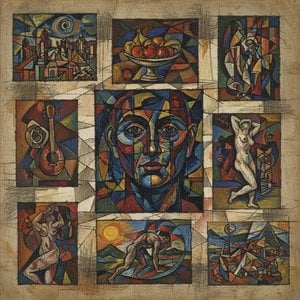
Kleine Komposition II

Franz Marc's 'Kleine Komposition II': Ein faszinierendes Beispiel des Kubismus und Expressionismus. Entdecken Sie die leuchtenden Farben und geometrischen Formen dieses Meisterwerks!

Entdecken Sie Franz Marc (1880-1916), Pionier des Expressionismus & Mitbegründer der 'Blauen Reiter'. Ikonische Tierbilder, leuchtende Farben & spirituelle Themen erwarten Sie! Erfahren Sie mehr über sein Vermächtnis!

Giclée / Kunstdruck

Giclée- oder Leinwanddruck in Museumsqualität mit schneller Produktion und flexiblen Veredelungsoptionen. ( Handgemalte Reproduktion bestellen Zum digitalen Bild wechseln)

Corner sample of the P118B picture frame: formgepresstes Polystyrol, 5 cm wide and 3 cm thick
P118B €10
Corner sample of the P118H picture frame: formgepresstes Polystyrol, 5 cm wide and 3 cm thick
P118H €10
Corner sample of the P118W picture frame: formgepresstes Polystyrol, 5 cm wide and 3 cm thick
P118W €10
Corner sample of the P438Z picture frame: formgepresstes Polystyrol, 5.5 cm wide and 3.5 cm thick
P438Z €10
Corner sample of the P508JH picture frame: formgepresstes Polystyrol, 7 cm wide and 3.5 cm thick
P508JH €12
Corner sample of the P508YH picture frame: formgepresstes Polystyrol, 7 cm wide and 3.5 cm thick
P508YH €12
Corner sample of the P805H picture frame: formgepresstes Polystyrol, 5 cm wide and 3.5 cm thick
P805H €10
Corner sample of the P805Z picture frame: formgepresstes Polystyrol, 5 cm wide and 3.5 cm thick
P805Z €10
Corner sample of the P919BZ picture frame: formgepresstes Polystyrol, 7 cm wide and 3.5 cm thick
P919BZ €10
Corner sample of the P919G picture frame: formgepresstes Polystyrol, 7 cm wide and 3.5 cm thick
P919G €10
Corner sample of the P919XJ picture frame: formgepresstes Polystyrol, 7 cm wide and 3.5 cm thick
P919XJ €10
Corner sample of the P959ZH picture frame: formgepresstes Polystyrol, 5 cm wide and 3 cm thick
P959ZH €10
Corner sample of the P968JZ picture frame: formgepresstes Polystyrol, 6 cm wide and 4 cm thick
P968JZ €12
Corner sample of the W106C picture frame: Massivholz, 5 cm wide and 3 cm thick
W106C €8
Corner sample of the W218G picture frame: Massivholz, 5 cm wide and 3 cm thick
W218G €10
Corner sample of the W218JH picture frame: Massivholz, 5 cm wide and 3 cm thick
W218JH €8
Corner sample of the W218Y picture frame: Massivholz, 5 cm wide and 3 cm thick
W218Y €10
Corner sample of the W307PJ picture frame: Massivholz, 6 cm wide and 3 cm thick
W307PJ €10
Corner sample of the W316G picture frame: Massivholz, 6 cm wide and 3 cm thick
W316G €10
Corner sample of the W316PJ picture frame: Massivholz, 6 cm wide and 3 cm thick
W316PJ €8
Corner sample of the W316Y picture frame: Massivholz, 6 cm wide and 3 cm thick
W316Y €10
Corner sample of the W398PJ picture frame: Massivholz, 5 cm wide and 3 cm thick
W398PJ €8
Corner sample of the W4111J picture frame: Massivholz, 6.5 cm wide and 3.5 cm thick
W4111J €10
Corner sample of the W500HY picture frame: Massivholz, 7 cm wide and 5 cm thick
W500HY €15
Corner sample of the W500JH picture frame: Massivholz, 7 cm wide and 5 cm thick
W500JH €15
Corner sample of the W692G picture frame: Massivholz, 8 cm wide and 4 cm thick
W692G €12
Corner sample of the W849H picture frame: Massivholz, 5 cm wide and 3 cm thick
W849H €8
Corner sample of the W940BG picture frame: Massivholz, 7.5 cm wide and 4.5 cm thick
W940BG €15
Corner sample of the W953PJ picture frame: Massivholz, 6 cm wide and 3.5 cm thick
W953PJ €8

Standardformat
individuell anpassbar
CM
INCH

Wählen Sie aus unseren vordefinierten Formaten, die den ursprünglichen Proportionen des Kunstwerks entsprechen.

Breite
Höhe

Geben Sie die benötigte Breite und Höhe an, damit der Druck perfekt in Ihren Rahmen oder an Ihre Wand passt. Ein Druck kann nur beschnitten, aber niemals größer als das Originalbild angefertigt werden; daher verliert ein Format mit anderen Proportionen einen Teil des Bildes. Wir senden Ihnen ein digitales Mockup zur Freigabe, bevor wir den Druck ausführen. Das auf dieser Seite gezeigte Bild zeigt nicht den tatsächlichen Beschnitt – dies ist nur im Mockup ersichtlich.

Weltweiter Versand () innerhalb von 2 Wochen statt der üblichen 4/5 Wochen. (27 Oktober)

Kostenloser weltweiter Expressversand
Hochwertige Leinenleinwand
Umfassender Versicherungsschutz beim Versand
Zollgebühren-Rückerstattungsgarantie
Garantie für exakte Farbtreue
100 Tage Rückgaberecht (nur bei Mängeln)
100% Geld-zurück-Garantie
Mengenrabatt verfügbar

Gesamtpreis

€ 60

Kleine Komposition II

Giclée / Kunstdruck

Format der Reproduktion

-

Endpreis

€ 60

Eckdaten

  • Year: 1914
  • Influences: Der Blaue Reiter
  • Subject: Komposition, Formen
  • Dimensions: 59,5 x 46 cm
  • Artistic style: Kubismus, Abstrakt
  • Location: Museum Penzberg

Kunst-Quiz

Jede Frage hat nur eine richtige Antwort.

Frage 1:
Welche der folgenden Aussagen beschreibt am besten den Stil von Franz Mars "Small Composition II"?
Frage 2:
Welche der folgenden Farben dominiert die Farbpalette von "Small Composition II"?
Frage 3:
Welche der folgenden Formen findet sich im Bild?
Frage 4:
Welche Gruppe war Franz Marc während seiner künstlerischen Karriere mitglied?
Frage 5:
Wo wird "Small Composition II" heute ausgestellt?

Franz Marc’s “Small Composition II”: A Journey into Color and Spirit

Franz Marc's "Small Composition II," painted in 1914, isn't merely a depiction of shapes; it’s an intimate glimpse into the artist’s profoundly spiritual worldview. This captivating oil on canvas, housed within the Sprengel Museum in Hannover, stands as a pivotal example of German Expressionism and a fascinating exploration of cubist principles. Marc, deeply influenced by his time with Der Blaue Reiter – a circle dedicated to seeking artistic truth through color and emotion – used this work to distill complex ideas into a remarkably concise visual language. The painting’s power lies not in precise representation but in the evocative resonance of its forms and hues, inviting viewers on a journey into the artist's inner world.

Deconstructing the Composition: Geometry and Symbolism

At first glance, “Small Composition II” presents a seemingly simple arrangement: a sturdy house shape anchoring the left side of the canvas, a dynamic triangle asserting itself in the center, and a luminous circle culminating on the right. However, these geometric forms are far from arbitrary. Marc masterfully employs them as symbolic anchors, representing not just physical structures but also fundamental aspects of existence – stability, dynamism, and wholeness. The intertwining of these shapes with organic elements—a reaching tree branch and a heart-shaped object—further enriches the composition’s layered meaning. The deliberate division of the building into two distinct parts suggests duality, perhaps representing opposing forces or states of being within the human experience.

A Cubist Vision Infused with Expressionistic Emotion

While undeniably influenced by the burgeoning cubist movement – characterized by its fragmentation and multiple perspectives – Marc’s approach transcends mere geometric abstraction. He retains a strong sense of color and emotional intensity, hallmarks of Expressionism. The vibrant palette—a rich tapestry of reds, greens, and yellows—isn't used to mimic reality but to convey feeling. Notice the boldness of the colors, their almost tactile quality, as if inviting the viewer to step into the painting’s world. Marc’s simplification of forms isn’t reductive; it’s a deliberate choice to focus on essential qualities, stripping away extraneous detail and highlighting the underlying spirit of each element.

Context and Legacy: A Pioneer of Modern Art

"Small Composition II" reflects Marc's deep engagement with spirituality and his belief in art’s capacity to communicate profound truths. His work, alongside that of Kandinsky and others within Der Blaue Reiter, pushed the boundaries of artistic expression, moving beyond mere representation towards a more subjective and emotionally charged approach. Marc’s exploration of color theory and form has had a lasting impact on generations of artists, influencing movements from Surrealism to Abstract Expressionism. The painting's influence can be seen in the works of Paul Klee, who similarly experimented with expressionistic techniques and symbolic imagery. Reproductions of this masterpiece offer art enthusiasts a unique opportunity to experience Marc’s visionary style firsthand, bringing his evocative world into their own spaces.

WahooArt.com offers meticulously crafted oil painting reproductions of “Small Composition II,” ensuring that the vibrancy and emotional depth of Marc's original work are faithfully preserved. These high-quality reproductions allow collectors to appreciate this iconic piece of modern art in a tangible way, celebrating both its artistic merit and the enduring legacy of Franz Marc.

Fragen & Antworten

Welches Gefühl vermittelt "Kleine Komposition II" von Franz Marc?

Die festgehaltene Stimmung von "Kleine Komposition II" von Franz Marc ist Gelassen, und ihr emotionaler Tonfall ist Spirituell.

Unter welchen anderen Namen ist Franz Marc bekannt?

Franz Marc ist auch unter den Namen Franz Moritz Wilhelm Marc bekannt.

Wo kann ich eine digitale Datei von "Kleine Komposition II" von Franz Marc erwerben?

"Kleine Komposition II" ist als hochauflösender digitaler Bild-Download direkt über die Seite Digitales Kunstwerk erhältlich.


Künstlerbiografie

Franz Marc: Ein Pionier des Deutschen Expressionismus

Frühes Leben und Ausbildung

  • Franz Moritz Wilhelm Marc wurde am 8. Februar 1880 in München, Deutschland, geboren.
  • Sein Vater, Wilhelm Marc, war Landschaftsmaler und beeinflusste seinen Sohn zunächst durch seine künstlerischen Neigungen.
  • Marc erwog kurz Theologie, bevor er sich der Kunst widmete und nach dem Besuch der Universität München an der Akademie der Bildenden Künste in München studierte.
  • Zu den frühen Studien gehörten das Kopieren von Meistern und die Erforschung verschiedener künstlerischer Techniken.

Künstlerische Entwicklung und Einflüsse

  • Anfangs wurden Marcs Werke von Impressionismus und akademischen Malstilen beeinflusst.
  • Ein entscheidender Moment war seine Besuche in Paris, wo er die Werke von Vincent van Gogh entdeckte und seine Verwendung von Farbe und emotionaler Ausdruck maßgeblich prägte.
  • Er experimentierte mit verschiedenen künstlerischen Gruppen wie der Neuen Künstlervereinigung München, bevor er Der Blaue Reiter gemeinsam gründete.
  • Auch Robert Delaunays Werk beeinflusste Marcs Erkundung abstrakter Formen und lebendiger Farben.

Der Blaue Reiter und Schlüsselwerke

  • Im Jahr 1911 gründete Marc gemeinsam mit Wassily Kandinsky Der Blaue Reiter (Der Blaue Reiter), eine Zeitschrift und Künstlergruppe, die für den deutschen Expressionismus von zentraler Bedeutung wurde.
  • Diese Gruppe suchte nach spiritueller Bedeutung in der Kunst und lehnte traditionelle künstlerische Konventionen ab.
  • Bekannte Werke aus dieser Zeit sind:
    • Der Tiger (1912) – zeigend seinen sich entwickelnden Stil und seine symbolische Verwendung von Tieren.
    • Rehdamee (1912) - demonstrierend eine wachsende Konzentration auf Tierdarstellungen.
    • Der Turm der blauen Pferde, Die Füchse und das Schicksal der Tiere (1913) – repräsentierend die Culmination seiner künstlerischen Vision.

Themen und Künstlerischer Stil

  • Marcs Kunst ist durch ihre lebendigen Farben, vereinfachte Formen und symbolische Darstellung von Tieren gekennzeichnet.
  • Er glaubte, dass Tiere eine Reinheit und eine spirituelle Verbindung zur Natur besaßen, die der Mensch verloren hatte.
  • Seine Verwendung von Farbe diente nicht nur der Beschreibung, sondern auch dem Ausdruck, Emotionen und innere Zustände zu vermitteln.
  • Er versuchte, die Essenz seiner Motive darzustellen, anstatt realistische Darstellungen.

Erster Weltkrieg und tragisches Ende

  • Mit dem Ausbruch des Ersten Weltkriegs im Jahr 1914 wurde Marc in die deutsche Armee eingezogen.
  • Trotz seines Versuchs, aufgrund seiner künstlerischen Tätigkeit von der Dienstpflicht freigestellt zu werden, diente er als Kavallerieoffizier.
  • Er starb am 4. März 1916 im Verlauf der Schlacht an der Verdun tragisch.
  • Sein Tod beendete eine vielversprechende Karriere, festigte aber gleichzeitig seinen Platz in der Kunstgeschichte.

Vermächtnis und historische Bedeutung

  • Marcs Werk bleibt hoch einflussreich für seine expressive Verwendung von Farbe, symbolische Bilder und spirituelle Tiefe.
  • Er gilt als eine Schlüsselgestalt bei der Entwicklung des Deutschen Expressionismus und als Vorläufer der abstrakten Kunst.
  • Seine Gemälde werden in großen Museen auf der ganzen Welt ausgestellt, darunter das Lenbachhaus in München, das eine umfangreiche Sammlung seiner Werke beherbergt.
  • Marcs künstlerische Vision inspiriert weiterhin Künstler und fesselt das Publikum bis heute.
Franz Marc

Franz Marc

1880 - 1916 , Deutschland

Kurzinfos

  • Beeinflusste Kunstrichtungen: ['Abstrakte Kunst']
  • Beeinflusste Künstler: ['Vincent van Gogh']
  • Bekannte Werke:
    • Der Tiger (1912)
    • Rehdamee (1912)
    • Turm der blauen Pferde (1913)
    • Die Füchse und das Schicksal
  • Geburtsdatum: 08. Februar 1880
  • Geburtsort: München, Deutschland
  • Künstlerische Richtung: Deutscher Expressionismus
  • Nationalität: Deutsch
  • Todatum: 4. März 1916
  • Vollständiger Name: Franz Marc
Entdecken Sie Kunstwerke, die nach Themen, Stilen und Merkmalen sortiert sind.