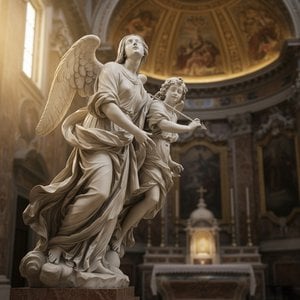
St Andrew: A Monumental Testament of Baroque Faith
François Duquesnoy’s sculpture of Saint Andrew stands as an emblem of the High Renaissance's transition into the Baroque era, embodying both intellectual rigor and profound spiritual fervor. Created in 1629 for St. Peter’s Basilica in Vatican City—a commission that solidified Duquesnoy’s reputation as Rome’s foremost sculptor—the statue transcends mere representation; it aspires to convey a palpable sense of devotion and contemplation.
The Artist's Vision: Classicism Revisited
Born in Nettuno, Italy, François Duquesnoy (1597-1643) emerged from the Flemish artistic tradition, inheriting a fascination for classical ideals while simultaneously embracing the expressive dynamism championed by artists like Alessandro Algardi. Unlike Bernini’s theatrical grandeur, Duquesnoy's approach prioritized restraint and idealized form—a deliberate counterpoint to the prevailing Baroque aesthetic. His meticulous study of ancient sculpture, famously culminating in an audacious climb over Marcus Aurelius’ equestrian statue to grasp its construction principles, underscores his unwavering commitment to mastering the techniques of antiquity.
A Symbol of Martyrdom: Composition and Technique
The statue depicts Saint Andrew with one arm raised, clutching a large cross—a potent symbol of his crucifixion and subsequent martyrdom. Duquesnoy skillfully employs marble, selecting a material renowned for its luminosity and ability to capture subtle nuances of form. The drapery surrounding Andrew is rendered with meticulous detail, conveying movement and texture through folds that cascade gracefully over his shoulder, revealing glimpses of his torso. This careful attention to craftsmanship reflects the Baroque preoccupation with illusionistic effects—a technique designed to heighten emotional impact and immerse viewers in a realm of sublime beauty.
Contextual Significance: St Peter’s Basilica and the Papal Patronage
St Andrew's placement within St. Peter’s Basilica is itself significant, positioned opposite Bernini’s Saint Longinus—a deliberate juxtaposition intended to provoke contemplation on faith and suffering. The commission stemmed from Cardinal Biscia, protector of the Baker’s guild, who recognized Duquesnoy’s genius and secured his patronage. The statue's unveiling in 1630 coincided with a period of intense religious fervor within Rome, mirroring the broader Baroque impulse to elevate spirituality through artistic grandeur. Above Andrew’s head is Latin text proclaiming “SACROSANCTVS ROMANVS IMPERATORVS COLVMNVS,” emphasizing St Peter’s Basilica's role as a bastion of papal authority and devotion.
Beyond Representation: Emotional Resonance
Ultimately, Duquesnoy’s St Andrew transcends mere depiction; it seeks to evoke an emotional response in the viewer. The statue’s serene posture—the gaze fixed upwards—communicates a profound sense of acceptance and spiritual transcendence. It stands as a testament to the enduring power of art to inspire contemplation and convey the deepest truths of faith, cementing Duquesnoy's legacy as one of Rome’s most influential sculptors.



 In echtem Maßstab anzeigen
 Handgemalte Reproduktion kaufen
 Versenden als Grußkarte
 Teilen
 Details anzeigen
 Leitfaden

 Herunterladen
 Ähnliche Objekte
 Röntgenaufnahme
 Diashow
 Besucherstatistiken


 Mehr anzeigen






































 Die Glasoption ist nur für Größen unter 110 cm verfügbar.