Vorschau anzeigen In AR ansehen Zum Druck wechseln Zum digitalen Bild wechseln Versenden
Details anzeigen Leitfaden Zu Favoriten hinzufügen Herunterladen Ähnliche Objekte Röntgenaufnahme Diashow Statistiken

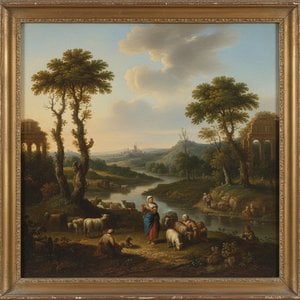
Imaginary Landscape

Explore Francisque Millet's 'Imaginary Landscape,' a serene Belgian Baroque masterpiece inspired by Poussin and Dughet, depicting figures strolling amidst mountains and classical architecture.

Francisque Millet (1642-1679): Flämisch-Französischer Barockmaler von ruhigen italienischen Landschaften und Figuren, beeinflusst von Poussin. Entdecken Sie sein Erbe & seine Werke!

Handgefertigte Ölreproduktion

Handgemaltes Ölgemälde auf Leinwand in Ihrer Wunschgröße und mit Rahmen, auf Bestellung von unseren Künstlern angefertigt. ( Zum Druck wechseln Zum digitalen Bild wechseln)

Corner sample of the P118B picture frame: formgepresstes Polystyrol, 5 cm wide and 3 cm thick
P118B €10
Corner sample of the P118H picture frame: formgepresstes Polystyrol, 5 cm wide and 3 cm thick
P118H €10
Corner sample of the P118W picture frame: formgepresstes Polystyrol, 5 cm wide and 3 cm thick
P118W €10
Corner sample of the P438Z picture frame: formgepresstes Polystyrol, 5.5 cm wide and 3.5 cm thick
P438Z €10
Corner sample of the P508JH picture frame: formgepresstes Polystyrol, 7 cm wide and 3.5 cm thick
P508JH €12
Corner sample of the P508YH picture frame: formgepresstes Polystyrol, 7 cm wide and 3.5 cm thick
P508YH €12
Corner sample of the P805H picture frame: formgepresstes Polystyrol, 5 cm wide and 3.5 cm thick
P805H €10
Corner sample of the P805Z picture frame: formgepresstes Polystyrol, 5 cm wide and 3.5 cm thick
P805Z €10
Corner sample of the P919BZ picture frame: formgepresstes Polystyrol, 7 cm wide and 3.5 cm thick
P919BZ €10
Corner sample of the P919G picture frame: formgepresstes Polystyrol, 7 cm wide and 3.5 cm thick
P919G €10
Corner sample of the P919XJ picture frame: formgepresstes Polystyrol, 7 cm wide and 3.5 cm thick
P919XJ €10
Corner sample of the P959ZH picture frame: formgepresstes Polystyrol, 5 cm wide and 3 cm thick
P959ZH €10
Corner sample of the P968JZ picture frame: formgepresstes Polystyrol, 6 cm wide and 4 cm thick
P968JZ €12
Corner sample of the W106C picture frame: Massivholz, 5 cm wide and 3 cm thick
W106C €8
Corner sample of the W218G picture frame: Massivholz, 5 cm wide and 3 cm thick
W218G €10
Corner sample of the W218JH picture frame: Massivholz, 5 cm wide and 3 cm thick
W218JH €8
Corner sample of the W218Y picture frame: Massivholz, 5 cm wide and 3 cm thick
W218Y €10
Corner sample of the W307PJ picture frame: Massivholz, 6 cm wide and 3 cm thick
W307PJ €10
Corner sample of the W316G picture frame: Massivholz, 6 cm wide and 3 cm thick
W316G €10
Corner sample of the W316PJ picture frame: Massivholz, 6 cm wide and 3 cm thick
W316PJ €8
Corner sample of the W316Y picture frame: Massivholz, 6 cm wide and 3 cm thick
W316Y €10
Corner sample of the W398PJ picture frame: Massivholz, 5 cm wide and 3 cm thick
W398PJ €8
Corner sample of the W4111J picture frame: Massivholz, 6.5 cm wide and 3.5 cm thick
W4111J €10
Corner sample of the W500HY picture frame: Massivholz, 7 cm wide and 5 cm thick
W500HY €15
Corner sample of the W500JH picture frame: Massivholz, 7 cm wide and 5 cm thick
W500JH €15
Corner sample of the W692G picture frame: Massivholz, 8 cm wide and 4 cm thick
W692G €12
Corner sample of the W849H picture frame: Massivholz, 5 cm wide and 3 cm thick
W849H €8
Corner sample of the W940BG picture frame: Massivholz, 7.5 cm wide and 4.5 cm thick
W940BG €15
Corner sample of the W953PJ picture frame: Massivholz, 6 cm wide and 3.5 cm thick
W953PJ €8

Standardformat
individuell anpassbar
CM
INCH

Wählen Sie aus unseren vordefinierten Formaten, die den ursprünglichen Proportionen des Kunstwerks entsprechen.

Breite
Höhe

Geben Sie die Breite und die Höhe an, die Sie für Ihren Rahmen oder Ihre Wand benötigen. Da dieses Werk handgemalt ist, kann der Künstler bei einer anderen Form etwas mehr um das Bild herum malen oder etwas abschneiden – Sie entscheiden. Wir senden Ihnen ein digitales Mockup zur Freigabe, bevor mit dem Malen begonnen wird. Das auf dieser Seite gezeigte Bild stellt nicht das tatsächliche Ergebnis dar – dies tut nur das Mockup.

Beispiele für Anpassungsmöglichkeiten: Gesicht durch Kundenfoto ersetzen; Haustier hinzufügen (z. B. Katze durch Hund ersetzen); eine versteckte Nachricht im Hintergrund einfügen; Hintergrundlandschaft oder -elemente ändern.
Nach der Bestellung wird das WahooArt.com-Team dem Kunden Anweisungen per E-Mail zusenden und eine Mockup-Vorschau bereitstellen.

Weltweiter Versand () in nur 3 bis 4 Wochen statt der üblichen 5 Wochen. (26 Oktober). Keine Kompromisse bei der Qualität.

Kostenloser weltweiter Expressversand
Hochwertige Leinenleinwand
Umfassender Versicherungsschutz beim Versand
Zollgebühren-Rückerstattungsgarantie
Garantie für exakte Farbtreue
100 Tage Rückgaberecht (nur bei Mängeln)
100% Geld-zurück-Garantie
Mengenrabatt verfügbar

Gesamtpreis

€ 239

Imaginary Landscape

Art der Reproduktion

Format der Reproduktion

-

Endpreis

€ 239

Eckdaten

  • Artist: Francisque Millet
  • Influences:
    • Nicolas Poussin
    • Gaspard Dughet
  • Medium: Oil on Canvas
  • Year: 1660
  • Notable elements or techniques: Detailed depiction of classical architecture and vegetation.

Kunst-Quiz

Jede Frage hat nur eine richtige Antwort.

Frage 1:
What artistic style is Francisque Millet’s ‘Imaginary Landscape’ primarily influenced by?
Frage 2:
Who served as Francisque Millet's mentor during his artistic training?
Frage 3:
What prominent artist’s brother-in-law did Laurentius Frank collaborate with, influencing Millet's artistic vision?
Frage 4:
The painting depicts a scene inspired by what geographical location?
Frage 5:
What is notable about Francisque Millet’s ability as described by Abraham Genoels?

A Serene Vision of Antiquity: Exploring Francisque Millet’s Imaginary Landscape

Francisque Millet's "Imaginary Landscape," painted in 1660, stands as a testament to the enduring influence of Italianate landscape painting during Louis XIV’s reign. More than just a depiction of scenery, it embodies a profound philosophical statement about humanity’s relationship with nature and its yearning for idealized beauty—a sentiment deeply rooted in the artistic currents sweeping across Europe at the time.
  • Subject Matter: The canvas portrays a tranquil valley bathed in soft sunlight, dominated by a majestic oak tree – a symbol of strength and longevity – beneath which two figures stroll leisurely. A distant bridge adds depth to the composition, hinting at connection and aspiration.
  • Style & Influences: Millet’s style is unmistakably indebted to Nicolas Poussin and Gaspard Dughet, masters of Italianate landscape whose works championed a harmonious blend of observation and imagination. Like his predecessors, Millet sought not merely to represent the external world but to convey an inner state of contemplation and spiritual elevation.
  • Technique: Executed in oil paint on canvas, Millet employed meticulous brushwork—characteristic of the Flemish tradition—to achieve remarkable tonal gradations and textural nuances. The artist skillfully captured the dappled light filtering through the foliage, creating a palpable sense of atmosphere that transports the viewer to a timeless realm of pastoral serenity.
The painting’s historical context is crucial to understanding its significance. Louis XIV's court embraced classical ideals as a means of asserting royal authority and glorifying France’s grandeur. Millet’s landscape reflects this preoccupation with antiquity, presenting a vision of paradise—a carefully constructed illusion designed to inspire awe and reaffirm faith in divine order. The oak tree itself is laden with symbolism; it represents resilience, nobility, and the enduring presence of God's grace – concepts central to Jansenist theology, which profoundly shaped intellectual life during Millet’s era.
  • Symbolism: Beyond its visual beauty, “Imaginary Landscape” speaks volumes about humanist concerns. The figures embody human dignity and tranquility, suggesting a harmonious coexistence with the natural world—a counterpoint to the anxieties of the turbulent political landscape of Louis XIV's France.
Ultimately, Millet’s masterpiece resonates with an emotional depth that transcends its formal conventions. It invites contemplation on themes of beauty, faith, and human aspiration. Its luminous palette and masterful brushwork evoke a feeling of profound peace—a reminder that even amidst worldly concerns, glimpses of idealized perfection can be found in the simplest of landscapes. Reproductions of “Imaginary Landscape” continue to captivate collectors and inspire interior designers seeking to infuse their spaces with an aura of timeless elegance and spiritual serenity.

Fragen & Antworten

Kann "Imaginary Landscape" heruntergeladen werden?

Das Bild von "Imaginary Landscape" von Francisque Millet kann auf der Download-Seite des Kunstwerks heruntergeladen werden: hochauflösender digitaler Bild-Download.

Wie hell ist "Imaginary Landscape" insgesamt?

Was die wahrgenommene Helligkeit betrifft, so ist "Imaginary Landscape" von Francisque Millet balanced.

Welche Form und welche Maße hat "Imaginary Landscape" von Francisque Millet?

"Imaginary Landscape" von Francisque Millet hat die Proportionen eines Landscape-Werks mit einer Größe von 57 x 66 cm.


Künstlerbiografie

Francisque Millet: Leben und Erbe

Frühes Leben und Ausbildung

  • Francisque Millet (auch bekannt als Jean-François Milée) wurde 1642 in Antwerpen, Belgien, geboren. Er war der Sohn eines französischen Elfenbeinmeisters, der sich in der Region niedergelassen hatte.
  • Er begann seine künstlerische Ausbildung bei Laurentius Frank, einem Cousin von Abraham Genoels.
  • Außergewöhnliches Talent: Genoels bemerkte Millets außergewöhnliche Fähigkeit, Kunstwerke ohne ständiges Rückbezug auf das Original schnell und genau aus dem Gedächtnis zu kopieren.
  • Im Alter von achtzehn Jahren heiratete er die Tochter seines Meisters und festigte damit seine Position innerhalb der künstlerischen Gemeinschaft.

Künstlerische Entwicklung und Einflüsse

  • Italienische Landschaften: Millet spezialisierte sich auf italienisch angehauchte Landschaften mit Figuren, einem Stil, der stark von Nicolas Poussin und seinem Schwager, Gaspard Dughet, beeinflusst war.
  • Seine Werke zeigten oft ruhige Szenen, die von der römischen Landschaft inspiriert waren, mit klassischer Architektur, üppiger Vegetation und pastoralen Figuren.
  • Reisen und Einflüsse: Er reiste weite Teile Frankreichs, Englands und Hollands durch und erwarb sich so verschiedene künstlerische Stile und den Zugang zu Mäzenen. Allerdings war er dafür bekannt, dass er mehr ausgab, als er einnahm.

Wichtige Werke und Stil

  • Millet produzierte einen beträchtlichen Bestand an Werken, darunter Landschaften mit religiösen Themen wie “Landschaft mit Christus und seinen Jüngern” sowie mythologische Szenen wie “Merkur und Battus”.
  • Charakteristische Merkmale: Seine Gemälde zeichneten sich durch ihre ausgewogenen Kompositionen, atmosphärische Perspektive und akribische Detailgenauigkeit aus.
  • Er integrierte Figuren geschickt in seine Landschaften und schuf so harmonische und optisch ansprechende Szenen.
  • Zu den bemerkenswerten Werken gehören “Imaginary Landscape”, “Italienische Szene mit einem Schrein” und “Klassische Landschaft”.

Spätes Leben und Tod

  • Millets Leben wurde 1679 im Alter von 36 Jahren tragisch verkürzt.
  • Plötzliche Krankheit: Er erlag einem plötzlichen hohen Fieber, das zu Wahnsinn führte, und starb kurz darauf.
  • Er wurde in der Kirche St Nicolas-des-Champs in Paris beigesetzt.

Familienerscheinung und historische Bedeutung

  • Jean-François Millet II: Sein Sohn, ebenfalls Jean François Millet (1666–1723), folgte in seinen Fußstapfen und wurde 1709 Mitglied der Akademie für Malerei.
  • Der jüngere Millet konsultierte Künstler wie Watteau, um die Figuren in seinen Landschaften zu verbessern.
  • Einfluss auf spätere Künstler: Obwohl er von späteren Künstlern mit demselben Namen überstrahlt wurde, ebnete Francisque Millets Werk den Weg für nachfolgende Generationen Landschaftsmaler.
  • Mark Twain ließ sich sogar von Millets Leben (und der Verwirrung um seinen Namen) inspirieren, um das farcische Theaterstück “Is He Dead?” zu schreiben.
  • Millets Beitrag liegt in seiner geschickten Ausführung italienisch angehauchter Landschaften und seiner Fähigkeit, klassische Einflüsse mit barocken Sensibilitäten zu verbinden.
Francisque Millet

Francisque Millet

1642 - 1679 , Belgien

Kurzinfos

  • Artistic Movement Or Style: Barockmalerei
  • Artists Who Influenced This Artist:
    • Nicolas Poussin
    • Gaspard Dughet
  • Date Of Birth: 27. April 1642
  • Date Of Death: 3. Juni 1679
  • Full Name: Francisque Millet
  • Nationality: Flämisch-Französisch
  • Notable Artworks:
    • Landschaft mit Christus und seinen Jüngern
    • Imaginary Landscape
    • Klassische Landschaft
  • Place Of Birth: Antwerpen, Belgien
Entdecken Sie Kunstwerke, die nach Themen, Stilen und Merkmalen sortiert sind.