Erwerben Sie ein hochauflösendes, optimiertes digitales Bild, das der Online-Vorschau weit überlegen ist.
Jede Datei wird von unseren hauseigenen Spezialisten mit modernsten Werkzeugen und fachmännischer manueller Retusche sorgfältig vorbereitet. Wir stellen sicher, dass jedes Bild eine außergewöhnliche Klarheit, präzise Farbgenauigkeit und feinste Details aufweist.
Die endgültige Datei wird innerhalb von 72 Stunden per E-Mail zugestellt und ist für den sofortigen Einsatz in professionellen, redaktionellen und Druckumgebungen optimiert. Es handelt sich um dieselbe Qualität, der führende Designstudios, Verlage und Galerien vertrauen.
Laden Sie eine hochauflösende Datei für die persönliche Präsentation, den Druck und kreative Projekte herunter. ( Druck bestellen Handgemalte Reproduktion bestellen)
Wenn Sie sich für WahooArt.com entscheiden, erhalten Sie nicht nur ein Bild – Sie erhalten ein professionell aufbereitetes digitales Kunstwerk, das mit höchster Präzision erstellt und durch eine Zufriedenheitsgarantie abgesichert wird. Hier ist alles, was automatisch mit Ihrer Bestellung geliefert wird:

Ihre hochauflösende digitale Bilddatei wird Ihnen innerhalb von 72 Stunden nach der Bestellung per E-Mail zugestellt – bereit zur sofortigen Verwendung.

Ihre Kunstwerke werden professionell mithilfe fortschrittlicher KI-Tools und manueller Bearbeitung optimiert, um maximale Detailtreue, Klarheit und Farbgenauigkeit zu gewährleisten.

Datei versehentlich gelöscht oder verloren? Keine Sorge – wir senden sie Ihnen jederzeit kostenlos erneut zu.

Genießen Sie Ihr Kunstwerk sofort ohne Zollgebühren, Einfuhrabgaben oder Versandkosten – digitale Downloads sind immer steuerfrei.

Wir garantieren, dass Ihr digitales Bild mithilfe professioneller Werkzeuge und Farbmanagement die Originalfarben so präzise wie möglich wiedergibt.

Sollten Sie mit Ihrem digitalen Bild nicht zufrieden sein, werden wir es überarbeiten oder Ihnen innerhalb von 100 Tagen 100% erstatten – ohne Wenn und Aber.

Nicht zufrieden? Erhalten Sie innerhalb von 100 Tagen nach Erhalt Ihrer digitalen Datei eine vollständige Rückerstattung – ohne Angabe von Gründen.

3 Bilder kaufen, 10% sparen – 5 Bilder kaufen, 15% sparen – Ab 10 Bildern 20% sparen. Ideal für kreative Projekte, Galerien und Agenturen.
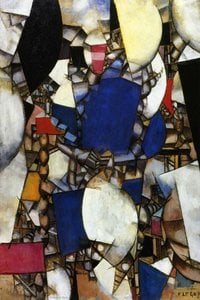
Fernand Léger's “The Man in the Tavern” is a vibrant and dynamic exploration of modern life, painted sometime between 1917-1924. This captivating work exemplifies Léger’s distinctive ‘Tubism,’ a compelling offshoot of Cubism that celebrates the beauty of machinery and the energy of the industrial age.
The painting presents an intimate scene within a bustling tavern. At least five figures are depicted, engaged in convivial conversation around a table laden with glasses, bottles, and other objects suggestive of refreshment and camaraderie. Léger deliberately fragments and geometrizes the composition; forms break down into cylindrical shapes and planes of color – hallmarks of his aesthetic. A centrally placed chair anchors the scene, immediately drawing the viewer’s eye, while another to the right subtly guides our gaze. Most strikingly, a motorcycle appears in the background—an unusual yet deliberate inclusion that speaks volumes about Léger's fascination with modern technology and its integration into everyday existence.
Léger’s “Tubism” is immediately apparent. Unlike the analytical fragmentation of early Cubism, his approach favors simplified, almost architectural forms. He employs bold colors—often primary hues—and strong contrasts to create a sense of solidity and monumentality. The brushwork isn't delicate; instead, it’s assertive and precise, emphasizing the constructed nature of the image. This technique reflects Léger’s belief in the beauty of the machine age and his desire to create an art that was accessible and relevant to modern society.
“The Man in the Tavern” emerges from a pivotal moment in art history. Following his experiences during World War I, Léger sought to reconcile the horrors of war with a celebration of life and progress. He rejected purely abstract forms, instead focusing on representing the world around him—factories, machines, and people—in a new visual language. This painting embodies that shift; it’s not merely a depiction of a tavern scene but a symbolic representation of modern social interaction within an increasingly industrialized world. Léger's work foreshadowed Pop Art by celebrating popular culture and everyday objects.
The painting evokes a sense of bustling energy and camaraderie, yet there’s also a subtle undercurrent of detachment. The fragmented forms and simplified figures create a slightly alienating effect, perhaps reflecting the anonymity that can accompany modern life. However, the vibrant colors and dynamic composition ultimately convey a feeling of optimism and vitality. It's a scene that feels both familiar and strangely new – a testament to Léger’s ability to capture the complexities of the modern human experience.
“The Man in the Tavern” would be a stunning focal point in various settings:
To best showcase the painting, consider a neutral wall color that allows the vibrant hues to pop. Strategic lighting will highlight the texture and dimensionality of Léger’s brushwork. Framing in a simple, modern frame – perhaps black or silver – would further enhance its contemporary appeal. This artwork is more than just a visual statement; it's an investment in a piece of art history that embodies the spirit of modernity.

1881 - 1955 , Frankreich

 Vorschau anzeigen
 Versenden
 Teilen
 Details anzeigen

 Herunterladen
 Ähnliche Objekte
 Röntgenaufnahme
 Diashow

 Weiterlesen