Jetzt verkaufen
x
Vorschau anzeigenVorschau anzeigen In AR erlebenIn AR erleben Handgemalte Reproduktion bestellen Handgemalte Reproduktion bestellenBild kaufen Bild kaufen VersendenVersenden
Details anzeigenDetails anzeigen Zu Favoriten hinzufügen Zu Favoriten hinzufügen HerunterladenHerunterladen Ähnliche ObjekteÄhnliche Objekte RöntgenaufnahmeRöntgenaufnahme DiashowDiashow

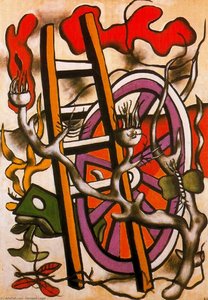
The green tree

Fernand Léger's 'The Green Tree,' painted in 1932, exemplifies Tubism—a revolutionary style characterized by simplified geometric forms and vibrant colors that capture the dynamism of the machine age. This iconic piece showcases Léger’s masterful blend of abstraction and observation.

Erkunden Sie die Kunst von Fernand Léger (1881-1955), einem Pionier des Kubismus und der 'Tubism'. Entdecken Sie seine mutigen, figurativen Gemälde, die das moderne Leben, Maschinen und die menschliche Form feiern. Ein Vorläufer des Pop Art!

Giclée / Kunstdruck

Giclée- oder Leinwanddruck in Museumsqualität mit schneller Produktion und flexiblen Veredelungsoptionen. (Handgemalte Reproduktion bestellen Handgemalte Reproduktion bestellenBild kaufen Bild kaufen)

P118B $10
P118H $10
P118W $10
P438Z $10
P508JH $12
P508YH $12
P805H $10
P805Z $10
P919BZ $10
P919G $10
P919XJ $10
P959ZH $10
P968JZ $12
W106C $8
W218G $10
W218JH $8
W218Y $10
W307PJ $10
W316G $10
W316PJ $8
W316Y $10
W398PJ $8
W4111J $10
W500HY $15
W500JH $15
W692G $12
W849H $8
W940BG $15
W953PJ $8

Standard
custom
CM
INCH

Wählen Sie aus unseren vordefinierten Formaten, die den ursprünglichen Proportionen des Kunstwerks entsprechen.

Breite
Höhe

Sie können Ihre eigenen Maße eingeben, um ein bestimmtes Format oder einen speziellen Platz einzupassen. Wenn das von Ihnen gewählte Format nicht den Proportionen des Originalbildes entspricht, werden wir das Kunstwerk entweder beschneiden oder das Bild mit einem gespiegelten oder einfarbigen Rand erweitern. Ein digitaler Entwurf wird Ihnen zur Genehmigung zugesandt, bevor die Produktion beginnt.
Bitte beachten Sie, dass die Vorschau auf dem Bildschirm nicht den tatsächlichen Zuschnitt oder die Erweiterung widerspiegelt. Nur der Entwurf zeigt die endgültige Komposition präzise an.
Obwohl Sondermaße verfügbar sind, empfehlen wir die Auswahl eines Maßes aus der vordefinierten Liste, um die ursprünglichen Proportionen zu bewahren.

Weltweiter Versand () innerhalb von 2 Wochen statt der üblichen 4/5 Wochen. (14 August)

why_choose_icon
Kostenloser weltweiter Expressversand
why_choose_icon
Hochwertige Leinenleinwand
why_choose_icon
Umfassender Versicherungsschutz beim Versand
why_choose_icon
Zollgebühren-Rückerstattungsgarantie
why_choose_icon
Garantie für exakte Farbtreue
why_choose_icon
60 Tage Rückgaberecht (nur bei Mängeln)
why_choose_icon
100% Geld-zurück-Garantie
why_choose_icon
Mengenrabatt verfügbar

Gesamtpreis

$ 68

reproduction

The green tree

Giclée / Kunstdruck

Format der Reproduktion

-

Gesamtpreis

$ 68

Eckdaten

  • Artistic style: Cubist
  • Location: Kunstmuseum Den Haag
  • Artist: Fernand Léger
  • Notable elements or techniques: Geometric abstraction; Simplified forms
  • Year: 1932
  • Dimensions: 60 × 92 cm
  • Subject or theme: Nature; Tree

Kunst-Quiz

Jede Frage hat nur eine richtige Antwort.

Frage 1:
What artistic movement is Fernand Léger associated with?
Frage 2:
The painting prominently features geometric shapes and simplified forms. What does this reflect about Léger's artistic vision?
Frage 3:
What color dominates the central element of “The Green Tree”?
Frage 4:
In what year was "The Green Tree" created?
Frage 5:
Fernand Léger is considered a forerunner to which later artistic movement?

Sammlerstück-Beschreibung

A Symphony of Geometry: Rediscovering Fernand Léger’s The Green Tree

In the vibrant landscape of early twentieth-century modernism, few works capture the rhythmic pulse of life quite like Fernand Léger’s “The Green Tree.” Painted in 1932, this masterpiece serves as a profound testament to the artist's unique ability to bridge the gap between the organic world and the industrial age. At first glance, the viewer is greeted by a striking arrangement of verdant hues and bold, geometric shapes that seem to vibrate against the canvas. This is not merely a depiction of nature; it is an exploration of Tubism, a radical stylistic evolution where Léger utilized cylindrical forms and overlapping planes to suggest the constant motion and structural logic of a world in transition.

The composition is anchored by a central, luminous yellow circle that acts as a sun-like focal point, injecting a sense of warmth and vitality into the cool, rhythmic greens of the foliage. This brilliant orb disrupts the geometric grid, much like a spark of light within a factory, reminding us of Léster's fascination with the incandescent glow of modernity. Interspersed throughout the scene are subtle blue circles that dance across the periphery, creating a sense of depth and atmospheric tension. The way these primary colors interact—the deep greens, the piercing yellows, and the tranquil blues—creates a visual melody that is both intellectually stimulating and emotionally uplifting.

The Machine Age Meets the Natural World

To understand the soul of “The Green Tree,” one must look toward the historical context of the 1930s, an era defined by rapid industrialization and the rise of the machine aesthetic. Léger, who famously sought to “paint like a machine,” did not see technology as a cold or dehumanizing force, but rather as a source of new beauty and structural precision. In this work, he achieves a breathtaking synthesis: he applies the rigid, disciplined language of industrial design to the fluid, unpredictable forms of a tree. The leaves are transformed into rhythmic, overlapping discs, and the branches become structured elements of a larger, mechanical architecture.

This technique creates an extraordinary emotional impact, offering a sense of stability and order that is deeply comforting yet visually exhilarating. For the collector or interior designer, this painting offers a sophisticated balance; it possesses the bold, avant-garde edge required for contemporary statement pieces, while its organic subject matter ensures a harmonious integration into a variety of living spaces. It is a piece that invites contemplation, encouraging the viewer to find the hidden geometry in the natural world and the inherent beauty in the precision of modern life.

A Timeless Vision for Modern Interiors

Choosing a reproduction of “The Green Tree” is more than an aesthetic decision; it is an invitation to bring a piece of art history into the home. The painting’s ability to evoke both the pastoral tranquility of Léger's youth in Normandy and the high-energy dynamism of Parisian modernism makes it a versatile cornerstone for any curated collection. Whether placed in a minimalist gallery-style room or as a vibrant accent in a classic study, the artwork commands attention through its masterful use of color and form.

For those seeking to inspire guests or find personal solace, this work provides a window into a time when art was redefining reality itself. The interplay of light, the rhythmic repetition of shapes, and the profound sense of movement ensure that “The Green Tree” remains as relevant and captivating today as it was nearly a century ago. It stands as a permanent celebration of life's enduring energy, captured through the lens of a master who saw the heartbeat of the machine within the very leaves of the forest.


Über den Künstler

frühes Leben und Ausbildung

Fernand Légér, ein französischer Maler, Bildhauer und Filmemacher, wurde am 4. Februar 1881 in Argentan, Orne, Niedergermanien geboren. Sein Vater züchtete Rinder, und Légér erhielt zunächst eine Ausbildung als Architekt von 1897 bis 1899. Er zog dann im Jahr 1900 nach Paris und unterstützte sich dort als Architektenzeichner.

Künstlerische Entwicklung

Légers frühe Werke wurden vom Impressionismus beeinflusst, wie in Le Jardin de ma Mère (Mein Muttergarten) (1905) zu sehen ist. Nach dem Besuch der Schule für dekorative Künste und der Académie Julian begann er ab seinem 25. Lebensjahr ernsthaft als Maler zu arbeiten. Sein Stil entwickelte sich zu einer persönlichen Form des Kubismus, der von Kritikern als "Tubism" bezeichnet wurde, da er sich auf zylindrische Formen konzentrierte.

Kubismus und die Puteaux-Gruppe

Im Jahr 1910 stellte Légér im Salon d’Automne zusammen mit Jean Metzinger und Henri Le Fauconnier aus. Er schloss sich der Puteaux-Gruppe an, auch bekannt als die Section d’Or (die Goldene Proportion), zusammen mit anderen Künstlern wie Francis Picabia und Marcel Duchamp.

Krieg und seine Auswirkungen auf Légers Werk

Légers Erfahrungen im Ersten Weltkrieg hatten einen erheblichen Einfluss auf sein Werk. Während seiner Zeit an der Front produzierte er Skizzen von Artilleriegeschützen, Flugzeugen und Soldaten. Sein Gemälde Soldat mit Pfeife (1916) spiegelt diese Zeit wider.

Spätere Werke und Vermächtnis

Légers Nachkriegszeitliche Arbeiten, die von glatten, maschinellen Formen geprägt waren, verknüpften ihn mit der Tradition der französischen figurativen Malerei. Seine "animierten Landschaften" von 1921 zeigten Figuren und Tiere in harmonischen, stromlinienförmigen Formen. Schlüsselwerke: Museen, die Légers Werk ausstellen:
Fernand Léger

Fernand Léger

1881 - 1955 , Frankreich

Kurzinfos

  • Beeinflusste Kunstrichtungen: ['Pop Art']
  • Beeinflusste Künstler: ['Paul Cézanne']
  • Bemerkenswerte Werke:
    • Die Sitzende Frau
    • Maschinenelement
    • Der Große Umzug
    • Die Stadt
  • Geburtsdatum: 04. Februar 1881
  • Geburtsort: Argentan, Frankreich
  • Künstlerische Richtung: Kubismus, Tubismus
  • Nationalität: Französisch
  • Sterbedatum: 1955
  • Vollständiger Name: Fernand Léger
  • Von Kunstbewegungen Beeinflusst: ['Cézannismus']
  • Von Künstlern Beeinflusst: ['Impressionismus']
Entdecken Sie Kunstwerke, die nach Themen, Stilen und Merkmalen sortiert sind.