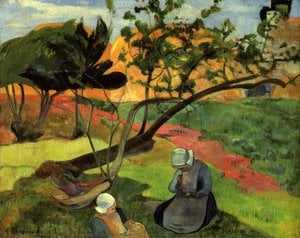
Die Darstellung von Gauguins "Der Holzhacker"
Paul Gauguin's
The Clog-Maker stands as a cornerstone of Post-Impressionism and embodies Gauguin’s singular vision for capturing the essence of rural life with profound emotional resonance. Painted in 1888 during his formative years in Tahiti, this artwork transcends mere depiction; it's an invitation into Gauguin’s world—a world steeped in vibrant color, simplified forms, and a deliberate rejection of academic conventions. The painting immediately captivates the viewer with its bold palette dominated by earthy hues – ochre yellows, burnt siennas, and muted greens – reflecting the landscape of Tahiti and mirroring Gauguin's desire to express raw emotion rather than meticulous observation.
- Subject Matter: The scene portrays a solitary man diligently chopping wood beside a rustic table, capturing a quintessential moment of rural labor and contemplation.
- Style: Gauguin’s distinctive Synthetist style—a departure from Impressionism's focus on fleeting light—prioritizes flattened planes of color and stylized forms to convey mood and feeling.
- Technique: Employing thick impasto brushstrokes, Gauguin builds up layers of pigment onto the canvas, creating a tactile surface that enhances the painting’s expressive power. This technique contributes significantly to the artwork's dramatic impact.
The composition is carefully balanced, guiding the eye across the scene and emphasizing the central figure—a man whose face is partially obscured, lending him an air of mystery and dignity. Surrounding him are simple objects: two chairs positioned strategically on either side of the table, and a bottle serving as a focal point. These elements aren’t merely decorative; they contribute to the overall atmosphere of quiet solitude and industriousness. Gauguin deliberately avoids realistic detail, opting instead for symbolic representation—a technique characteristic of Symbolist art—to convey deeper meanings about human existence and connection with nature. The muted colors serve not only to depict the Tahitian environment but also to heighten the emotional intensity of the scene.
Kontext und Einflüsse
Gauguin’s artistic journey was profoundly shaped by his involvement in “The Nabis Art Movement,” a group of artists who championed Symbolism and rejected Impressionistic aesthetics. Influenced by Japanese prints—particularly Ukiyo-e—and inspired by the spiritual traditions of Tahiti, Gauguin sought to liberate art from the constraints of Western academic standards. His exploration of primitivism wasn’t merely stylistic; it represented a genuine yearning for authenticity and an attempt to reconnect with primal human experience. The painting reflects this broader artistic preoccupation with capturing the spirit of a culture untouched by European civilization.
Symbolismus und Emotionale Wirkung
Beyond its visual beauty, “The Clog-Maker” resonates with profound symbolic significance. The solitary figure embodies resilience and perseverance—a testament to the human spirit’s ability to endure hardship while maintaining inner peace. The act of chopping wood symbolizes labor, toil, and connection to the natural world – themes central to Gauguin's artistic worldview. Moreover, the muted color palette evokes feelings of tranquility and contemplation, inviting viewers to contemplate the beauty and simplicity of rural life. Gauguin’s masterful use of color and form elevates “The Clog-Maker” beyond a mere depiction of a scene; it becomes an embodiment of emotion and spiritual insight—a timeless masterpiece that continues to inspire artists and collectors alike.
Vergleich mit anderen Werken
Like many of Gauguin's paintings, "The Clog Maker" exemplifies his commitment to conveying emotion through simplified forms and bold color palettes. Consider “Portrait of a Little Boy,” also available at
/art/list/?Filter=8EWPDV-Paul-Gauguin-Portrait-of-a-little-boy, where Gauguin similarly captures the essence of his subject with remarkable sensitivity—a stylistic parallel that underscores his enduring influence on modern art. Similarly, “Two Vases of Flowers and a Fan,” found at
/art/list/?Filter=8EWPJT-Paul-Gauguin-Two-vases-of-flowers-and-a fan, demonstrates Gauguin’s skill in still-life compositions—another facet of his artistic genius that speaks to the enduring power of visual art.



 In echtem Maßstab anzeigen
 Handgemalte Reproduktion kaufen
 Versenden als Grußkarte
 Teilen
 Details anzeigen

 Herunterladen
 Ähnliche Objekte
 Röntgenaufnahme
 Diashow
 Besucherstatistiken

 Mehr anzeigen






































 Die Glasoption ist nur für Größen unter 110 cm verfügbar.