A Vision of Divine Anguish: Exploring El Greco’s *The Agony in the Garden*
Doménikos Theotokópoulos, known as El Greco, delivers a profoundly moving depiction of Christ's internal struggle in *The Agony in the Garden*. Painted in 1590, this masterpiece transcends mere representation; it’s an exploration of faith, fear, and acceptance in the face of unimaginable suffering. This work stands as a pivotal example of his unique artistic voice, blending Byzantine spirituality with Renaissance innovation. It remains one of El Greco's most celebrated compositions, captivating audiences for centuries with its dramatic intensity and spiritual depth.
Subject & Composition: A Moment of Profound Isolation
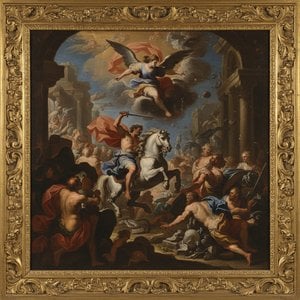
The painting centers on Jesus Christ, kneeling in desolate prayer within the Garden of Gethsemane. He is utterly consumed by anguish, head buried in hands – a gesture of both despair and submission. Surrounding him are angels, most notably one bearing a chalice, symbolizing the bitter cup of suffering he is about to drink. In the background, the approaching figures of Judas and Roman soldiers introduce an ominous tension, foreshadowing Christ’s impending arrest and crucifixion. El Greco masterfully employs diagonal lines throughout the composition, creating a dynamic sense of movement and unrest that mirrors Christ's emotional turmoil. The artist deliberately isolates Christ in this space, emphasizing his vulnerability and highlighting the psychological drama at play.
Style & Technique: A Mannerist Masterpiece
*The Agony in the Garden* is quintessential El Greco. His distinctive style – characterized by elongated figures, dramatic lighting, and vibrant, often unnaturalistic colors – is fully on display. He utilizes a technique of loose brushwork and visible impasto, adding texture and emotional intensity to the scene. This isn’t about realistic depiction; it's about conveying an *inner* reality, a spiritual truth. The flattened perspective, reminiscent of Byzantine iconography, further emphasizes the otherworldly quality of the moment. El Greco abandons traditional Renaissance conventions, prioritizing expressive gesture and psychological nuance over accurate anatomical representation. He achieves this through layering oil paints to build up texture and luminosity – a hallmark of Baroque painting—creating an immersive experience for the viewer.
Historical Context & Influences
El Greco arrived in Toledo, Spain, in 1577 after formative periods in Venice and Rome. He absorbed influences from Italian masters like Titian and Tintoretto – evident in his use of color and dramatic composition – but ultimately forged a style entirely his own. The Counter-Reformation was underway during this period, and religious art served as a powerful tool for reaffirming Catholic doctrine. El Greco’s intensely emotional works resonated with the spiritual fervor of the time, though they were not universally appreciated by his contemporaries. Despite criticism from some critics who deemed him mad, El Greco secured patronage from influential figures like Philip II., solidifying his position as one of Spain's foremost artists.
Symbolism & Interpretation: The Weight of Sacrifice
The symbolism within *The Agony in the Garden* is rich and layered.
- The Chalice: Represents Christ’s acceptance of his fate, the “cup” of suffering he must drink – a poignant reminder of his impending sacrifice.
- The Angels: Offer solace but cannot prevent the inevitable; they embody divine compassion witnessing this pivotal moment.
- The Garden Setting: Gethsemane isn’t merely a location, but a symbolic space of isolation and spiritual struggle – reflecting Christ's profound contemplation before his crucifixion.
- Elongated Figures: Contribute to the sense of otherworldliness and emphasize the spiritual nature of the event; they transcend earthly limitations.
The painting’s enduring power lies in its ability to evoke empathy for Christ’s suffering and prompting reflection on themes of faith, courage, and acceptance. It continues to inspire artists and viewers alike, cementing El Greco's legacy as a visionary artist who captured the essence of human emotion with unparalleled skill. *The Agony in the Garden* stands as a testament to the transformative potential of art—a timeless masterpiece that transcends temporal boundaries.
Fragen & Antworten
Wie harmonieren die Farben von "Die Qual im Garten" miteinander?
"Die Qual im Garten" von El Greco besticht durch eine Disharmonische Farbpalette Farbharmonie.
Inwiefern spiegelt der Stil von "Die Qual im Garten" die Epoche seines Schöpfers wider?
"Die Qual im Garten" gehört der Strömung des Barock an, und sein Schöpfer war in der Ära der Renaissance tätig.
Ist "Die Qual im Garten" von El Greco ein helles oder ein dunkles Kunstwerk?
Was die wahrgenommene Helligkeit betrifft, so ist "Die Qual im Garten" von El Greco Schattenhaft.



 Vorschau anzeigen
 Handgemalte Reproduktion bestellen
 Versenden
 Teilen
 Details anzeigen
 Leitfaden

 Herunterladen
 Ähnliche Objekte
 Röntgenaufnahme
 Diashow
 Statistiken


 Weiterlesen






































 Die Glasoption ist nur für Größen unter 110 cm verfügbar.