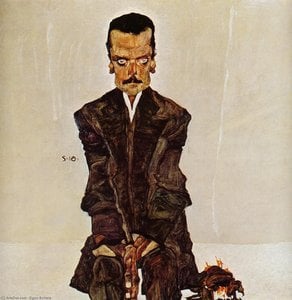
Das Geheimnis der Gestalt: Egon Schieĺes "Stehende Mädchen, Rückansicht"
Egon Schiele’s “Stehende Mädchen, Rückansicht” – Standing Girl, Back View – is not merely a portrait; it's an intensely felt moment captured in watercolor. Painted in 1913, this work embodies the raw emotionality and unsettling beauty that defined Schiele’s unique brand of Expressionism. The image presents a young woman, her back turned to the viewer, enveloped in a simple blue dress, creating an immediate sense of mystery and inviting speculation about her inner world. It's a deliberate choice by the artist – a refusal to offer easy answers, a hallmark of Schiele’s approach that compels us to project our own feelings and interpretations onto the canvas.
Schiele’s technique is immediately striking. The watercolor medium lends itself perfectly to his style: loose, gestural brushstrokes build up layers of color, creating an almost palpable sense of movement and vulnerability. The lines are not clean or precise; instead, they possess a nervous energy, reflecting the artist's own turbulent emotional state. Notice how he uses broken washes – areas where the paint is applied thinly and allowed to bleed into one another – to suggest form and atmosphere. This technique isn’t about meticulous representation but rather about conveying feeling directly, bypassing rational thought.
Ein Fenster in die Welt des Expressionismus
To understand “Stehende Mädchen, Rückansicht,” it's crucial to situate it within the broader context of the Expressionist movement. Emerging at the turn of the 20th century, Expressionism sought to depict not just what was seen but how it *felt*. Artists like Schiele rejected academic conventions and embraced distortion, exaggeration, and intense color to express their subjective experiences – often anxieties, fears, and a sense of alienation. The Prague National Gallery, which houses a significant collection of Schiele’s works, including this piece, serves as a testament to the movement's enduring influence.
Schiele’s personal life profoundly shaped his artistic vision. The premature deaths of his father and sister deeply affected him, fueling an exploration of mortality and the fragility of human existence. This is particularly evident in works like “Stehende Mädchen,” where the subject’s averted gaze suggests a hidden sadness or perhaps even a confrontation with her own vulnerability. The subtle suggestion of stockings beneath the dress hints at a world beyond the immediate image, adding another layer of complexity to the composition.
Symbolik und Emotionale Tiefe
Beyond its technical brilliance and historical context, “Stehende Mädchen” is rich in symbolic potential. The back view itself is a powerful device – it forces us to engage with the subject on an emotional level rather than through visual observation. The blue dress, often associated with mourning or introspection, further contributes to this atmosphere of quiet contemplation. The raised leg, a detail that adds a touch of awkwardness and vulnerability, could be interpreted as a gesture of defiance, a subtle rebellion against societal expectations.
Schiele’s use of color is equally significant. The dominant blue creates a sense of coolness and melancholy, while the darker tones in the shadows suggest hidden depths. The overall effect is one of restrained intensity – a feeling that something profound is just beneath the surface. It's a painting that invites repeated viewing, each encounter revealing new nuances and emotional resonances.
Ein Meisterwerk für Sammler und Liebhaber
WahooArt offers exquisite, hand-painted reproductions of “Stehende Mädchen, Rückansicht,” allowing you to bring this iconic work into your home or office. Our skilled artists meticulously recreate Schiele’s unique style and emotional depth, ensuring that the reproduction captures the essence of the original painting. Whether you are an art collector, a design enthusiast, or simply someone seeking a piece of art with profound emotional impact, a WahooArt reproduction of “Stehende Mädchen, Rückansicht” is a timeless investment.



 Vorschau anzeigen
 Handgemalte Reproduktion bestellen
 Versenden
 Teilen
 Details anzeigen

 Herunterladen
 Ähnliche Objekte
 Röntgenaufnahme
 Diashow
 Statistiken
 Weiterlesen






































 Die Glasoption ist nur für Größen unter 110 cm verfügbar.