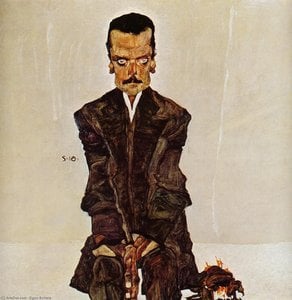
Egon Schiele’s ‘Squatting Woman’: A Study in Vulnerability and Anxiety
Egon Schiele's “Squatting Woman,” created in 1919, is not merely a depiction of a figure; it’s a raw, intensely psychological portrait born from the artist’s profound exploration of human fragility. This black-and-white drawing, executed with a masterful command of line and shadow, immediately confronts the viewer with an image of arresting vulnerability – a woman in a squatting position that speaks volumes about isolation, introspection, and perhaps even a surrender to unseen forces. The work's power resides not in idealized beauty but in its unflinching portrayal of human emotion, firmly rooted within Schiele’s signature Expressionist style.
- Composition & Form: The composition is deliberately unsettling. The woman dominates the frame, positioned slightly off-center to create a dynamic asymmetry that draws the eye relentlessly towards her. Two indistinct figures in the background heighten the sense of claustrophobia and isolation, suggesting a narrative context – perhaps a scene of quiet desperation or a moment of profound contemplation.
- Line & Texture: Schiele’s use of line is utterly crucial. Jagged, energetic lines define the woman's form with an almost violent intensity, conveying a palpable sense of anxiety and tension. The extensive hatching and cross-hatching aren’t simply employed for shading; they build a rich, tactile surface, mimicking the roughness of charcoal on paper and amplifying the work’s immediate impact.
- Symbolic Weight: The squatting posture itself is laden with symbolic weight. Historically associated with vulnerability, introspection, or even submission, it invites interpretation as a moment of profound personal reckoning. It's a pose that demands attention to the internal landscape of the subject.
The Expressionist Palette and Schiele’s Vision
Executed entirely in monochrome – shades of black, grey, and white – “Squatting Woman” exemplifies Schiele’s commitment to stripping away superficial beauty and revealing the raw core of human experience. The stark contrast between dark outlines and lighter areas creates a dramatic effect, emphasizing form and volume while simultaneously contributing to the work's unsettling atmosphere. Schiele deliberately distorted the figure’s proportions – elongated limbs, exaggerated features – aligning with the tenets of Expressionism, where subjective emotion takes precedence over objective representation.
- Technique: The drawing showcases a deliberate and almost brutal technique. Schiele wasn't aiming for smooth elegance; he sought to capture the immediacy of his observation, resulting in a surface that feels both intensely personal and profoundly unsettling.
- Influence: Schiele’s work was heavily influenced by the Symbolist movement, which emphasized emotional expression over realistic representation. This influence is evident in the drawing's dreamlike quality and its focus on psychological states.
A Window into Schiele’s World
Created in 1919, “Squatting Woman” reflects a period of intense personal struggle for Schiele. His early life was marked by tragedy – the death of his father from syphilis at a young age profoundly shaped his artistic vision. This preoccupation with mortality and human vulnerability is powerfully evident in this drawing. The work speaks to themes of sexuality, isolation, and the precariousness of existence—recurring motifs throughout Schiele’s oeuvre. The presence of the background figures adds another layer of complexity, hinting at a narrative or psychological context that invites speculation and deeper engagement.
- Historical Context: The drawing was created during a period of significant social and political upheaval in Europe. World War I had just ended, leaving behind a landscape of devastation and uncertainty. Schiele’s work reflects this atmosphere of anxiety and disillusionment.
- Legacy: Schiele's unflinching honesty and his willingness to confront difficult subjects have cemented his place as one of the most important artists of the 20th century. “Squatting Woman” remains a powerful testament to his genius and his ability to capture the essence of human emotion with remarkable intensity.



 Vorschau anzeigen
 Zu Druck wechseln
 Versenden
 Teilen
 Details anzeigen

 Herunterladen
 Ähnliche Objekte
 Röntgenaufnahme
 Diashow
 Statistiken


 Weiterlesen






































 Die Glasoption ist nur für Größen unter 110 cm verfügbar.