A Portrait of Inner Turmoil: Unpacking Egon Schiele's "Self-Portrait Standing 1910"
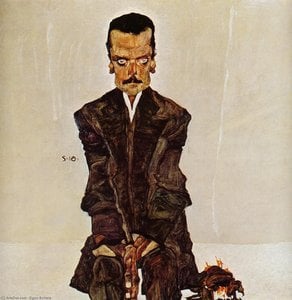
Egon Schiele’s “Self-Portrait Standing 1910” is not merely a depiction of an individual; it’s a raw, visceral expression of the artist’s tormented psyche. Painted during a period of intense personal and artistic struggle, this black and white photograph captures a moment of profound unease – a silent scream frozen on canvas. The image, often described as unsettling, immediately draws the viewer in with its subject's distorted features and precarious posture, hinting at a deep well of suppressed emotion.
The Anatomy of Anxiety: Style and Technique
Schiele’s style is instantly recognizable – characterized by elongated figures, sharp angles, and an almost violent distortion of the human form. In this self-portrait, he employs a technique that borders on caricature, exaggerating features to amplify their emotional impact. The subject's face is particularly arresting: his eyes are wide with what appears to be both fear and rage, while his mouth is contorted in a grimace, suggesting an unspoken threat or perhaps a desperate plea. The single-legged stance adds to the sense of instability and vulnerability, as if the figure is on the verge of collapse. The stark contrast between light and shadow further intensifies this feeling of unease, creating a dramatic and unsettling visual experience.
- Medium: Black and White Photograph (reproduction)
- Style: Expressionism – characterized by emotional intensity and subjective distortion.
- Technique: Sharp lines, exaggerated features, dramatic chiaroscuro (contrast between light and dark).
Echoes of Trauma: Historical Context and Biography
To fully appreciate “Self-Portrait Standing 1910,” it’s crucial to understand the context of Egon Schiele's life. Born in Vienna in 1890, Schiele endured a childhood marked by illness, loss, and instability. His father, a railway station master, succumbed to syphilis when Egon was just fourteen – a tragedy that profoundly shaped his artistic vision, fueling an obsession with mortality and the fragility of human existence. Raised under the watchful eye of his uncle, he developed a fiercely independent spirit, often clashing with authority figures. The early death of his sister Elvira further compounded his sense of loss and vulnerability. These formative experiences—coupled with his own struggles with sexuality and mental health—are palpable in his work, particularly evident in this self-portrait’s unsettling intensity.
Symbolism and Emotional Resonance: A Window into the Soul
The painting is laden with symbolic weight. The subject's nakedness speaks to vulnerability and exposure, while the distorted features suggest a struggle against internal demons. Some art historians interpret the single-legged stance as representing precariousness or imbalance – mirroring Schiele’s own turbulent life. The overall composition evokes a sense of claustrophobia and isolation, reflecting the artist’s feelings of alienation and despair. “Self-Portrait Standing 1910” is not simply a likeness; it's an unflinching portrayal of the human condition at its most vulnerable—a testament to Schiele’s ability to translate profound emotional pain into a powerfully evocative work of art. It invites contemplation on themes of mortality, identity, and the enduring struggle for self-expression.
View a high-quality reproduction of this iconic work



 In echtem Maßstab anzeigen
 Zum Druck wechseln
 Versenden als Grußkarte
 Teilen
 Details anzeigen
 Leitfaden

 Herunterladen
 Ähnliche Objekte
 Röntgenaufnahme
 Diashow
 Besucherstatistiken

 Mehr anzeigen






































 Die Glasoption ist nur für Größen unter 110 cm verfügbar.