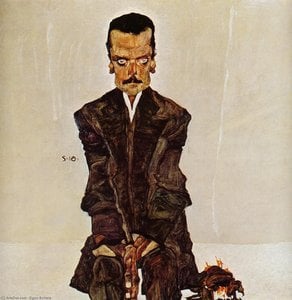
Das ergreifende Drama der Verliebten: Egon Schieĺes "Liebelei"
Egon Schiele’s “Liebelei” – a deceptively simple title for an intensely charged and profoundly unsettling work – emerged in 1915, a year of immense upheaval and personal torment for the artist. This painting isn't merely a depiction of physical intimacy; it is a raw, almost brutal exploration of vulnerability, desire, and the precariousness of human connection, rendered with Schiele’s signature angularity and unsettling psychological depth. The image captures two figures locked in a passionate embrace, their bodies intertwined with an urgency that borders on desperation. The stark contrast between the youthful vitality of the lovers and the shadowed presence of the three observing figures immediately establishes a sense of unease, hinting at the potential for disruption and the fragility of this intensely private moment.
Ein Künstler im Schatten der Tragödie
Born in 1890 in Tulln an der Donau, Austria – a region steeped in both artistic tradition and personal sorrow – Schiele’s life was tragically cut short during the First World War at just twenty-eight. His early years were marked by profound loss; his father succumbed to syphilis when Egon was only fourteen, a devastating event that cast a long shadow over his entire oeuvre. This experience, coupled with the premature death of his sister Elvira, fueled an underlying preoccupation with mortality and the ephemeral nature of existence – themes powerfully evident in “Liebelei.” Schiele’s artistic development was shaped by this constant awareness of loss, leading him to explore subjects often considered taboo or unsettling: illness, sexuality, and the grotesque. His work is characterized by a directness and honesty that can be both captivating and deeply disturbing.
Die Sprache der Linie und des Schattens
Technically, “Liebelei” exemplifies Schiele’s distinctive style – a potent blend of Expressionism and Symbolism. He employed a rapid, almost frantic technique, utilizing short, broken lines to convey movement and emotion. The figures are rendered with an unsettling lack of detail, their forms reduced to essential shapes that emphasize their vulnerability. Schiele masterfully manipulates light and shadow, creating a dramatic chiaroscuro effect that intensifies the emotional impact of the scene. Notice how the strong diagonals of the bodies intersect, drawing the viewer’s eye directly into the heart of the embrace. The background figures are deliberately blurred and indistinct, serving not as observers but as silent witnesses to this intensely private drama – almost like ghosts haunting a fleeting moment.
- Color Palette: Dominated by earthy tones—ochre, brown, and muted reds—contributing to the painting’s somber mood.
- Line Work: Characterized by sharp, angular lines that convey tension and unease.
- Composition: The dynamic arrangement of figures creates a sense of claustrophobia and intimacy.
Symbolik und psychologische Tiefe
Beyond its immediate depiction of physical love, “Liebelei” is laden with symbolic meaning. The three observing figures can be interpreted as representing societal judgment, the anxieties surrounding sexuality, or perhaps even the artist’s own self-doubt and isolation. The act of lovemaking itself becomes a site of vulnerability and exposure, highlighting the inherent risks involved in opening oneself to another person. Schiele doesn't offer a romanticized vision of intimacy; instead, he presents a raw, unflinching portrayal of human desire – both its beauty and its potential for pain. The painting’s unsettling atmosphere invites viewers to contemplate not just the act of love, but also the deeper questions about identity, mortality, and the complexities of the human psyche. It is a work that lingers in the mind long after viewing, prompting reflection on the darker aspects of our shared experience.
WahooArt offers meticulously crafted hand-painted reproductions of “Liebelei,” allowing you to bring this powerful and evocative masterpiece into your home or office. Each reproduction captures the essence of Schiele’s artistic vision with exceptional detail and fidelity, ensuring that you own a truly authentic representation of this iconic work.
Fragen & Antworten
Welche Farbidentität weist "Liebeshandlung" von Egon Schiele auf?
Die Farbidentität von "Liebeshandlung" von Egon Schiele: eine Neutrale Farben-Palette, dominiert von Spachtelgrau (#d7c5a4).
Wie hell ist "Liebeshandlung" insgesamt?
Insgesamt wird „Liebeshandlung“ mit einer Helligkeit von strahlend erfasst. Die wahrgenommene Helligkeit beschreibt, wie hell oder dunkel das Werk erscheint.
Welche Technik wurde für "Liebeshandlung" von Egon Schiele verwendet?
Das Medium von "Liebeshandlung" von Egon Schiele ist Acryl auf Leinwand. Die Reproduktionen zielen darauf ab, das Erscheinungsbild dieser Technik wiederzugeben.
Wer hat "Liebeshandlung" erschaffen?
Der Künstler hinter „Liebeshandlung“ ist Egon Schiele. Das Werk ist unter dem Namen von Egon Schiele katalogisiert.
Wo kann ich eine handgemalte Reproduktion von "Liebeshandlung" von Egon Schiele kaufen?
Handgemalte Repliken von "Liebeshandlung" von Egon Schiele sind auf diese Website erhältlich: eine handgemalte Ölreproduktion auf Leinenleinwand, bestellbar über diese Seite.
In welchem Alter schuf Egon Schiele „Liebeshandlung"?
Egon Schiele schuf „Liebeshandlung“ im Alter von 25. Der Künstler wurde 1890 geboren, und das Werk datiert auf 1915.
In welchem Jahr wurde "Liebeshandlung" geschaffen?
Die Entstehung von "Liebeshandlung" von Egon Schiele wird auf 1915 datiert.



 In echtem Maßstab anzeigen
 Handgemalte Reproduktion kaufen
 Versenden als Grußkarte
 Teilen
 Details anzeigen
 Leitfaden öffnen

 Herunterladen
 Ähnliche Objekte
 Röntgenaufnahme
 Diashow
 Besucherstatistiken


 Mehr anzeigen






































 Die Glasoption ist nur für Größen unter 110 cm verfügbar.