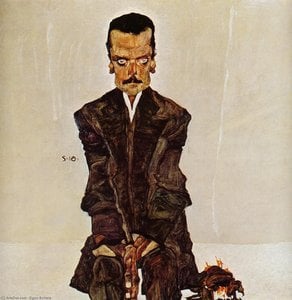
Das melancholische Porträt: Egon Schieĺes "Edith Schiele, Sitzend"
Egon Schiele’s “Edith Schiele, Sitzend” – a poignant watercolor from 1915 – isn't merely a portrait; it’s a distilled essence of emotion, a raw and vulnerable glimpse into the heart of an artist grappling with life, loss, and the complexities of human connection. The painting immediately draws the viewer in with its muted palette—a symphony of browns, greys, and subtle blues—reflecting not just the light of the room but also the quiet sadness that permeates Edith’s posture and expression. Schiele, a master of capturing psychological depth, doesn't offer a flattering likeness; instead, he presents us with an honest portrayal of his wife, imbued with a palpable sense of introspection.
The composition itself is deceptively simple. Edith sits in a relaxed yet slightly constrained pose, her hands clasped before her chest – a gesture that speaks volumes about both vulnerability and self-possession. The scarf draped around her neck adds to the air of quiet contemplation, while her dress, rendered with Schiele’s characteristic loose brushstrokes, suggests a comfortable familiarity rather than ostentation. It's crucial to understand that Schiele wasn’t interested in idealized beauty; he sought instead to reveal the inner life of his subjects, their anxieties and desires laid bare for all to see.
Expressionismus und die Seele des Künstlers
“Edith Schiele, Sitzend” is a quintessential example of Expressionism, a movement that violently rejected the objective representation of reality in favor of subjective emotional experience. Schiele, deeply influenced by artists like Gustav Klimt and Vincent van Gogh, embraced this philosophy wholeheartedly. His work was characterized by bold lines, distorted forms, and an intense use of color – techniques he employed here to amplify Edith’s mood and convey a sense of unease. The painting's almost claustrophobic space further contributes to the feeling of emotional confinement, mirroring perhaps Schiele’s own struggles with isolation and mortality.
The context of 1915 is vital to understanding the work fully. Austria-Hungary was on the brink of war, a period marked by political instability and widespread anxiety. Schiele's personal life was also fraught with difficulty; his father’s death had left an indelible mark, and he battled ongoing health problems throughout his life. This atmosphere of uncertainty undoubtedly informed his artistic output, leading him to explore themes of illness, death, and the fragility of human existence – all powerfully present in this intimate portrait.
Symbolik und die Sprache der Linie
Schiele’s masterful use of line is particularly noteworthy. He employs a dynamic, almost frantic quality, creating a sense of movement and restlessness within the seemingly still image. The lines aren't merely delineating form; they are conveying emotion – the subtle tremor in Edith’s hands, the downward tilt of her head, the shadowed corners of her eyes. The scarf itself can be interpreted as a symbol of protection or perhaps even concealment, hinting at hidden emotions and unspoken anxieties.
Furthermore, consider the artist's signature, discreetly placed in the lower right corner – a small but significant detail that anchors the work within Schiele’s oeuvre. It serves as a reminder that this isn’t just a painting; it’s an intimate record of a personal relationship and a testament to the artist’s unique vision. The watercolor medium itself, with its inherent fluidity and transparency, perfectly complements Schiele's expressive style, allowing him to build up layers of color and texture with remarkable subtlety.
Ein Meisterwerk für Sammler und Liebhaber
“Edith Schiele, Sitzend” remains a profoundly moving work of art, offering a rare glimpse into the soul of one of Austria’s most important Expressionist painters. A high-quality reproduction captures not only the visual details but also the emotional intensity that defines this iconic portrait. Whether you are an avid collector, an interior designer seeking to infuse your space with artistic depth, or simply someone captivated by the power of human emotion expressed through art, a reproduction of Schiele’s “Edith Schiele, Sitzend” is sure to be a treasured addition to any collection.
Fragen & Antworten
Worum geht es in "Edith Schiele, Sitzend"?
Die Motive von "Edith Schiele, Sitzend" sind egon schiele, woman, sadness, scarf, watercolor, austria, 1915, emotion.
Wie wirkt die Helligkeit von "Edith Schiele, Sitzend" von Egon Schiele?
In Bezug auf die wahrgenommene Helligkeit ist "Edith Schiele, Sitzend" von Egon Schiele hell.
Gibt es eine Diashow für "Edith Schiele, Sitzend" von Egon Schiele?
Eine Diashow ist verfügbar: die Seite Diashow von "Edith Schiele, Sitzend" von Egon Schiele.
Wo sollte eine Reproduktion von "Edith Schiele, Sitzend" von Egon Schiele aufgehängt werden?
Das Format Hochformat von "Edith Schiele, Sitzend" von Egon Schiele wird für ein Wohnbereich empfohlen. Format und Raumgestaltung leiten gemeinsam die Platzierung einer Reproduktion.
Wie intensiv sind die Farben von "Edith Schiele, Sitzend"?
Die Farbe von "Edith Schiele, Sitzend" weist eine Sättigung von Ausgewogen sanft und eine Intensität von Ausgewogen auf.
Wie hoch ist die Leuchtkraft von "Edith Schiele, Sitzend" von Egon Schiele?
Die Farben von "Edith Schiele, Sitzend" weisen eine Sanfte Leuchtkraft Luminanz auf.
Welche Bedeutung kommt "Edith Schiele, Sitzend" von Egon Schiele in der Kunstgeschichte zu?
Die kunsthistorische Einordnung von "Edith Schiele, Sitzend" von Egon Schiele ist Expressionist Movement, aus der Epoche der Frühmittelalterlich.
Wie treffen Bewegung und Epoche in "Edith Schiele, Sitzend" von Egon Schiele aufeinander?
"Edith Schiele, Sitzend" gehört der Expressionist Movement-Strömung an, und sein Schöpfer war in der Ära der Moderne tätig.



 In echtem Maßstab anzeigen
 Handgemalte Reproduktion kaufen
 Versenden als Grußkarte
 Teilen
 Details anzeigen
 Leitfaden öffnen

 Herunterladen
 Ähnliche Objekte
 Röntgenaufnahme
 Diashow
 Besucherstatistiken

 Mehr anzeigen






































 Die Glasoption ist nur für Größen unter 110 cm verfügbar.