A Portrait of Disquiet: Egon Schiele’s ‘Arthur Roessler’
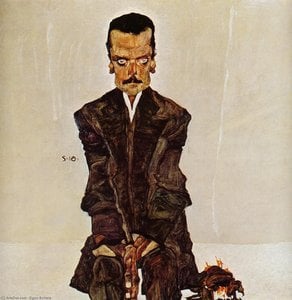
Egon Schiele’s 1910 portrait of Arthur Roessler is not merely a depiction of a man; it is a visceral exploration of psychological tension, rendered with the raw intensity that defines the Expressionist movement. The painting captures Roessler, an Austrian art critic and early champion of Schiele’s work, in a state of palpable unease. He leans against a wall, his body angled away from the viewer, creating a sense of withdrawal and guardedness. The suit and tie suggest societal expectation, perhaps even formality, yet they are utterly at odds with the internal turmoil radiating from Roessler’s face and posture. Schiele doesn’t present us with a celebratory portrait of a patron; instead, he offers an unflinching glimpse into a private moment of vulnerability, a man seemingly burdened by unseen anxieties.
The Brushstroke of Emotion: Technique and Style
Schiele’s technique in ‘Arthur Roessler’ is central to its emotional power. He eschews the smooth, idealized surfaces favored by earlier portraitists, opting instead for visible brushstrokes that seem to claw at the canvas. The color palette is dominated by muted browns and ochres, creating a somber atmosphere that amplifies the sitter’s melancholy. This deliberate restriction of color isn’t accidental; it serves to focus attention on Roessler’s face – specifically his eyes and mustache – which become anchors for the viewer’s gaze. The angularity of the figure, particularly in the hands and limbs, is characteristic of Schiele’s style, a departure from traditional anatomical representation that prioritizes emotional expression over realistic form. The large scale of the painting—99 x 99 cm—further intensifies this effect, enveloping the viewer in Roessler’s disquiet.
A Patron and a Friend: Historical Context
The creation of ‘Arthur Roessler’ occurred at a pivotal moment in Schiele’s career. Having recently broken away from the more conservative teachings of the Academy of Fine Arts Vienna, he was forging his own path, one that embraced subjectivity and psychological depth. Arthur Roessler played a crucial role in this development. He recognized Schiele's talent early on, providing not only financial support but also intellectual encouragement. Roessler’s belief in Schiele allowed him to exhibit his work and gain recognition within the Viennese art scene. However, it is important to note that Schiele wasn’t simply creating a thank-you portrait; he was engaging with Roessler as a complex individual, exploring the hidden layers beneath the surface of social decorum. The painting reflects a period where Schiele was experimenting with portraiture, seeking to capture not just likeness but also the inner life of his subjects.
Symbolism and Interpretation
While seemingly straightforward in its depiction, ‘Arthur Roessler’ is rich in symbolic potential. The very act of portraying a man in such a vulnerable state challenges conventional notions of portraiture, which traditionally aimed to project power and status. The hands, prominently displayed, are often interpreted as representing the creative force or intellectual labor – yet here they appear tense and constricted, suggesting a sense of frustration or limitation. Roessler’s gaze, averted from the viewer, hints at an internal struggle, a reluctance to fully reveal himself. Schiele's work frequently grapples with themes of mortality, sexuality, and alienation; while not explicitly present in this portrait, these undercurrents contribute to its overall sense of unease. The painting invites us to contemplate the complexities of human emotion and the masks we wear to navigate social interactions.
Ultimately, ‘Arthur Roessler’ is a testament to Schiele’s ability to transform a simple portrait into a profound psychological study. It remains a compelling work for its honesty, its technical brilliance, and its enduring relevance in an age still grappling with questions of identity and emotional authenticity.



 Vorschau anzeigen
 Zu Druck wechseln
 Versenden
 Teilen
 Details anzeigen

 Herunterladen
 Ähnliche Objekte
 Röntgenaufnahme
 Diashow
 Statistiken


 Weiterlesen