Edward Hopper's "Hotel Window": A Portrait of Modern Solitude
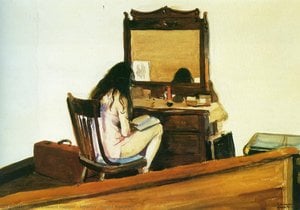
Edward Hopper’s “Hotel Window,” painted in 1956, is more than just a depiction of a room; it’s a profound meditation on the human condition – specifically, the quiet loneliness that can permeate modern life. This iconic black and white oil on canvas captures a moment of poignant stillness, inviting viewers to contemplate the woman seated before the window, lost in her own thoughts. Hopper, a master of capturing atmosphere and psychological depth, expertly utilizes light and shadow to create an intensely evocative scene, solidifying his place as one of America’s most significant 20th-century artists.
Subject Matter and Composition
The painting centers around a solitary woman in a hotel room. She occupies the foreground, positioned near a window with drawn curtains that partially obscure the view outside. The composition is meticulously balanced; the two couches – one directly behind her, the other further back – create a sense of spatial depth while simultaneously reinforcing her isolation. Hopper’s deliberate framing draws attention to her posture and expression, suggesting a deep introspection. The inclusion of a book in her hands subtly hints at intellectual pursuits or perhaps an attempt to distract herself from the silence.
Technique and Style: Hopper's Signature
Hopper’s distinctive style is immediately recognizable through his precise rendering of form and light. He employed a meticulous technique, building up layers of oil paint to achieve a remarkable level of detail in the textures of the furniture and the woman’s clothing. The stark contrast between light and shadow – a hallmark of Hopper's work – dramatically shapes the scene, emphasizing the room’s dimensions and creating an almost theatrical effect. His use of black and white further amplifies this dramatic impact, stripping away any potential distraction from color and focusing solely on form and mood. This approach aligns with the broader Realist movement, but Hopper infused it with a uniquely modern sensibility.
Symbolism and Historical Context
"Hotel Window" was created during a period of significant social change in America – the post-war era saw an increase in urban migration and a growing sense of alienation. Hopper’s work reflects this shift, portraying individuals adrift in anonymous spaces, grappling with questions of identity and purpose. The window itself is a potent symbol: it represents both a barrier between the viewer and the outside world and a portal to contemplation. The woman's posture – absorbed in her book, gazing out at an unseen vista – speaks to the universal human desire for connection and understanding, yet simultaneously highlights the difficulty of finding it in a rapidly changing society. Painted in 1956, this work exemplifies Hopper’s ongoing exploration of themes relevant to the anxieties and uncertainties of the mid-20th century.
Emotional Impact and Artistic Legacy
“Hotel Window” continues to resonate with viewers because of its ability to evoke a powerful sense of melancholy and quiet contemplation. It's a painting that invites us to confront our own feelings of isolation and to consider the complexities of human experience. Hopper’s masterful use of light, shadow, and composition creates an atmosphere of profound stillness, prompting reflection on themes of solitude, identity, and the search for meaning in a modern world. This piece remains a cornerstone of American art history, demonstrating Hopper's unparalleled ability to capture the essence of the human spirit.



 In echtem Maßstab anzeigen
 Handgemalte Reproduktion kaufen
 Versenden als Grußkarte
 Teilen
 Details anzeigen

 Herunterladen
 Ähnliche Objekte
 Röntgenaufnahme
 Diashow
 Besucherstatistiken

 Mehr anzeigen






































 Die Glasoption ist nur für Größen unter 110 cm verfügbar.