**frühes Leben und Einflüsse**
Edward Hopper, ein bedeutender amerikanischer Realist-Maler und Grafiker, wurde am 22. Juli 1882 in Upper Nyack, New York, geboren. Seine Familie, von hauptsächlich niederländischer Abstammung, bot eine komfortable Erziehung, die es Hopper ermöglichte, seine künstlerischen Neigungen schon im frühen Alter zu verfolgen. - **Inspirationen:** Hoppers Werk wurde von den Schriften von Ralph Waldo Emerson und den französischen Impressionisten-Meistern Édouard Manet und Edgar Degas beeinflusst. - **Frühzeitige Ausbildung:** Er begann mit Kunststudien durch einen Korrespondenzkurs im Jahr 1899, wechselte später an die New York School of Art and Design.
**Künstlerischer Stil und Themen**
Edward Hopper's sparsame und präzise Darstellungen spiegelten seine persönliche Vision des modernen amerikanischen Lebens wider. Sein Werk lässt sich durch folgende Merkmale charakterisieren: - **Städtische und ländliche Szenen:** Beide Umgebungen wurden mit einer einzigartigen Mischung aus Realismus und emotionaler Tiefe dargestellt. - **Beleuchtung:** Eine Meisterschaft der Beleuchtung, oft eingesetzt, um Gefühle von Isolation oder Kontemplation hervorzurufen. - **Figuren:** Oft ohne Gesicht oder im Hintergrund platziert, wodurch die Umgebung gegenüber den Figuren betont wird.
**Bekannte Werke und ihre Bedeutung**
-
House by the Railroad (Museum of Modern Art, New York, United States), ein Beispiel für Hoppers Fähigkeit, durch eine einfache, aber wirkungsvolle Komposition einen Hauch von Melancholie hervorzurufen. -
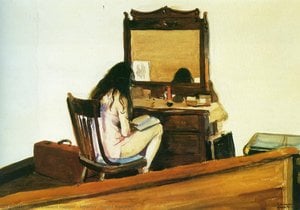
Reclining Nude (50 x 35 cm, New Realism, Watercolour), das seine Vielseitigkeit bei der Darstellung des menschlichen Körpers demonstriert.
**Vermächtnis und Einfluss**
- **Einfluss auf zukünftige Künstler:** Hoppers einzigartiger Stil hat zahlreiche Künstler beeinflusst, darunter
Pierre Sanford Ross, der für seine städtischen und ländlichen Szenen bekannt ist. - **dauernde Beliebtheit:** Seine Werke fesseln weiterhin das Publikum mit ihren zeitlosen Themen von Einsamkeit und dem menschlichen Dasein.
**Erfahren Sie mehr bei WahooArt**
- [https://WahooArt.com/@/edward-hopper](
Edward Hoppers Werke) - /de/art/show/art-8xyffg-de/
Kaufen Sie Kunst inspiriert von den Meistern)
- Erkunden Sie die Welt der Kunst mit der umfangreichen Kollektion von WahooArt.
- Entdecken Sie, wie Hoppers Vermächtnis weiterhin Künstler und Kunstliebhaber inspiriert.
**Referenzen**
- [https://WahooArt.com/@/edward-hopper](
Wikipedia: Edward Hopper) - [https://en.wikipedia.org/wiki/edward_hopper](
Wikipedia: Edward Hoppers Biografie)



 In echtem Maßstab anzeigen
 Zum Druck wechseln
 Versenden als Grußkarte
 Teilen
 Details anzeigen
 Leitfaden

 Herunterladen
 Ähnliche Objekte
 Röntgenaufnahme
 Diashow
 Besucherstatistiken

 Mehr anzeigen






































 Die Glasoption ist nur für Größen unter 110 cm verfügbar.