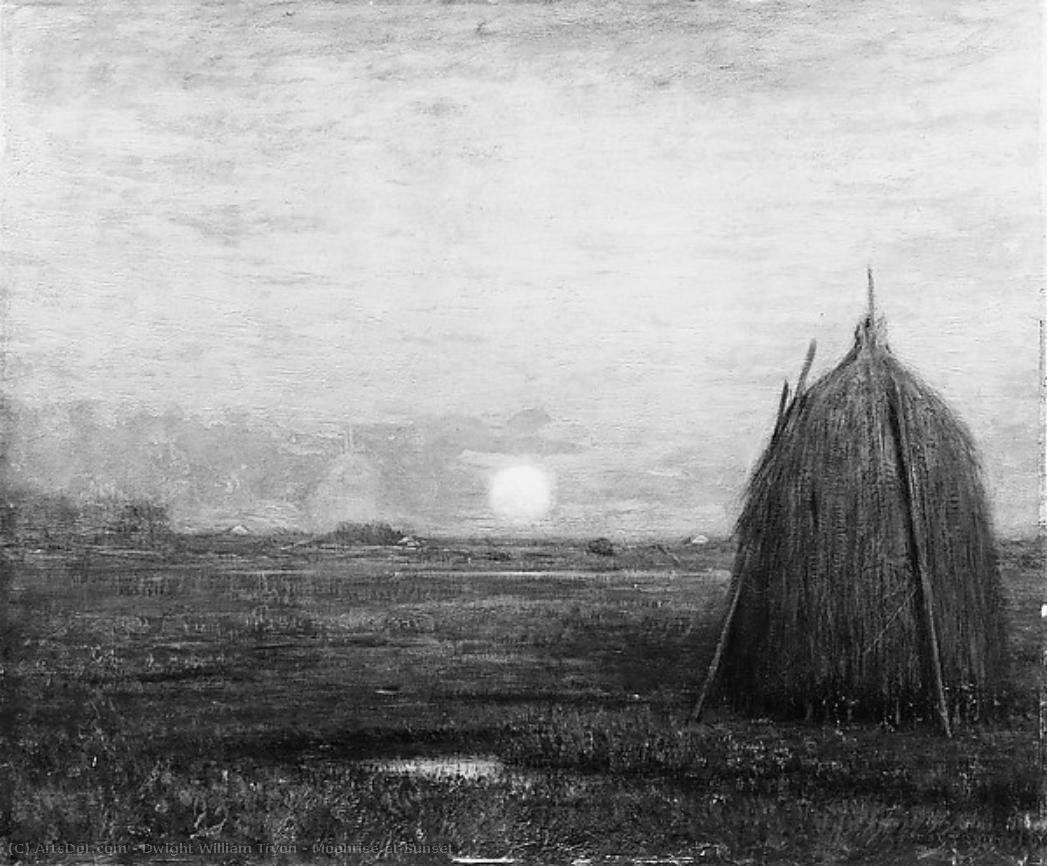
Moonrise at Sunset (1890) von Dwight William Tryon, handgemaltes Ölgemälde-Replikat eines Meisterkünstlers
Vorschau anzeigen In AR ansehen Zum Druck wechseln Zum digitalen Bild wechseln Versenden
Details anzeigen Leitfaden Zu Favoriten hinzufügen Herunterladen Ähnliche Objekte Röntgenaufnahme Diashow Fragen & Antworten Präsentation Statistiken

Moonrise at Sunset Handgemalte Ölmalerei-Reproduktion

Abmessungen
61.0 x 59.0 cm

This ethereal grayscale landscape captures the profound tranquility of Dwight William Tryon’s Tonalist masterpiece Moonrise at Sunset, inviting you to explore and own this serene piece of art history.

Dwight William Tryon (1849-1925): Amerikanischer Tonalist, berühmt für stimmungsvolle Landschaften & Meeresansichten. Beeinflusst von Whistler, seine zarten Farben & feine Stimmung erzeugen friedliche Naturszenen.

Handgefertigte Ölreproduktion

Handgemaltes Ölgemälde auf Leinwand in Ihrer Wunschgröße und mit Rahmen, auf Bestellung von unseren Künstlern angefertigt. ( Zum Druck wechseln Zum digitalen Bild wechseln)

Standardformat
individuell anpassbar
CM
INCH

Wählen Sie aus unseren vordefinierten Formaten, die den ursprünglichen Proportionen des Kunstwerks entsprechen.

Breite
Höhe

Geben Sie die Breite und die Höhe an, die Sie für Ihren Rahmen oder Ihre Wand benötigen. Da dieses Werk handgemalt ist, kann der Künstler bei einer anderen Form etwas mehr um das Bild herum malen oder etwas abschneiden – Sie entscheiden. Wir senden Ihnen ein digitales Mockup zur Freigabe, bevor mit dem Malen begonnen wird. Das auf dieser Seite gezeigte Bild stellt nicht das tatsächliche Ergebnis dar – dies tut nur das Mockup.

Beispiele für Anpassungsmöglichkeiten: Gesicht durch Kundenfoto ersetzen; Haustier hinzufügen (z. B. Katze durch Hund ersetzen); eine versteckte Nachricht im Hintergrund einfügen; Hintergrundlandschaft oder -elemente ändern.
Nach der Bestellung wird das WahooArt.com-Team dem Kunden Anweisungen per E-Mail zusenden und eine Mockup-Vorschau bereitstellen.

Weltweiter Versand () in nur 3 bis 4 Wochen statt der üblichen 5 Wochen. (7 November). Keine Kompromisse bei der Qualität.

Kostenloser weltweiter Expressversand
Hochwertige Leinenleinwand
Umfassender Versicherungsschutz beim Versand
Zollgebühren-Rückerstattungsgarantie
Garantie für exakte Farbtreue
100 Tage Rückgaberecht (nur bei Mängeln)
100% Geld-zurück-Garantie
Mengenrabatt verfügbar

Gesamtpreis

€ 243

Moonrise at Sunset

Art der Reproduktion

Format der Reproduktion

-

Endpreis

€ 243

Eckdaten

  • Subject or theme: Rural landscape
  • Medium: Oil on wood
  • Title: Moonrise at Sunset
  • Influences: Whistler
  • Artistic style: Dreamlike quality
  • Artist: Dwight William Tryon

Kunst-Quiz

Jede Frage hat nur eine richtige Antwort.

Frage 1:
What artistic movement is Dwight William Tryon’s ‘Moonrise at Sunset’ associated with?
Frage 2:
The painting predominantly utilizes what color palette?
Frage 3:
What technique is Tryon employing to achieve the hazy atmospheric perspective in ‘Moonrise at Sunset’?
Frage 4:
What symbolic element is represented by the haystack in the foreground?
Frage 5:
Where was Dwight William Tryon born?

Dwight William Tryon’s Moonrise at Sunset: A Symphony of Tranquility

The artwork “Moonrise at Sunset” by Dwight William Tryon stands as a testament to the Tonalist movement's enduring fascination with capturing atmospheric mood and subtle tonal variations. Executed in 1890, this oil on wood painting transports viewers to a serene rural landscape bathed in the ethereal glow of twilight—a scene meticulously rendered with delicate brushstrokes and muted colors that evoke profound peace and contemplation.
  • Subject Matter: Tryon’s composition centers around a sprawling field dominated by a prominent haystack, positioned on the right side of the canvas. A distant horizon is punctuated by a luminous moon or sun rising above hazy hills—a motif frequently explored in Tonalist art to symbolize transition and cyclical renewal.
  • Style & Technique: Tryon’s approach aligns perfectly with the tenets of Tonalism, prioritizing tonal harmony over vibrant color palettes. He achieves this effect through painstaking layering of thin glazes – a technique that allows for gradual blending and subtle gradations of tone—creating an immersive experience for the viewer. Soft brushwork contributes to the painting's dreamlike quality, blurring edges and diffusing light to mimic the hazy atmosphere characteristic of dusk.
  • Composition: The horizontal format emphasizes stability while guiding the eye across the expansive field towards the horizon line. The haystack serves as a vertical anchor, grounding the scene and providing textural contrast against the smooth expanse of grass. Careful attention to perspective reinforces this sense of spatial recession, drawing the viewer into the tranquil landscape.
  • Color Palette: Employing a predominantly grayscale palette—ranging from deep blacks to pale whites—Tryon eschews bold hues in favor of tonal nuances that convey emotion and atmosphere. This restrained color scheme amplifies the painting’s contemplative mood, focusing on form and texture rather than visual spectacle.
  • Historical Context: Born in Hartford, Connecticut, in 1849, Tryon's artistic vision was deeply influenced by Whistler’s pioneering explorations of tonalism—a movement that sought to elevate landscape painting beyond mere representation, aiming instead for an emotional response from the audience. “Moonrise at Sunset” embodies this spirit, reflecting a broader cultural preoccupation with capturing the sublime beauty of nature and conveying feelings of serenity and introspection during the late Victorian era.

Detailed Analysis: Texture & Lighting

Tryon’s masterful manipulation of texture is particularly noteworthy in the depiction of the haystack—rendered with visible brushstrokes that convey its rough, layered surface. These textured strokes aren't merely decorative; they actively contribute to the painting's overall impression of materiality and depth. Simultaneously, Tryon skillfully utilizes diffused lighting to illuminate the landscape, creating a gentle glow around the moon/sun and softening the contours of distant hills. This subtle illumination enhances the atmospheric effect, fostering a sense of tranquility and inviting contemplation.

Symbolism & Emotional Impact

Beyond its aesthetic qualities, “Moonrise at Sunset” carries symbolic weight—the haystack representing harvest or abundance, while the moonrise/sunset symbolizing transition and renewal. Tryon’s artwork transcends mere visual representation, prompting viewers to consider themes of cyclical change and the profound beauty inherent in quiet contemplation. It's a piece designed to evoke feelings of peace, solitude, and connection with the natural world—a timeless reminder of the power of art to inspire emotion and elevate our understanding of the sublime.

Further Research & Artistic Inspiration

For those interested in delving deeper into Tryon’s artistic legacy, The Metropolitan Museum of Art houses a remarkable collection of his works, offering invaluable insight into his stylistic evolution and thematic preoccupations. Examining “Moonrise at Sunset” alongside other Tonalist landscapes provides a compelling framework for appreciating the movement's enduring influence on American art history—a testament to Tryon’s ability to capture not just what he saw but also what he felt.

Fragen & Antworten

Warum ist der Urheberrechtsstatus von "Moonrise at Sunset" so, wie er ist?

"Moonrise at Sunset" von Dwight William Tryon ist gemeinfrei – das Urheberrecht ist abgelaufen. Die Urheberrechtsfristen werden ab dem Todesjahr des Künstlers berechnet, und Dwight William Tryon verstarb im Jahr 1925.

Welche Größe sollte ich für den Druck von "Moonrise at Sunset" für mein Zimmer wählen?

Für einen Living Room wird für „Moonrise at Sunset“ ein Druckformat von Medium empfohlen.

Wie stellt "Moonrise at Sunset" von Dwight William Tryon eine Verbindung zwischen Tonalist Landscape und dem Heimatland des Künstlers her?

"Moonrise at Sunset" verbindet die Tonalist Landscape-Bewegung durch den Geburtsort ihres Schöpfers mit Vereinigte Staaten von Amerika.

Künstlerbiografie

Frühes Leben und Ausbildung

  • Dwight William Tryon wurde am 13. August 1849 in Hartford, Connecticut, als Sohn von Anson Tryon und Delia O. Roberts geboren.
  • Der frühe Tod seines Vaters führte dazu, dass er nach dem Tod des Vaters von seiner Mutter auf dem Bauernhof seiner Großeltern in East Hartford aufgezogen wurde.
  • Er entwickelte ein natürliches Interesse an der Kunst, indem er Kunstlehrbücher aus einem Buchladen studierte, in dem er arbeitete.
  • Tryon begann in seiner Freizeit, die umliegende Landschaft zu skizzieren.
  • Er verkaufte 1870 sein erstes Gemälde und stellte es lokal aus, bevor er 1873 an der National Academy of Design Anerkennung fand.

Künstlerische Entwicklung und Einflüsse

  • 1876 studierte Tryon formell Kunst in Frankreich unter Jacquesson de la Chevreuse und an der École des Beaux-Arts. Er erhielt auch Unterricht von Charles-François Daubigny, Henri Harpignies und Jean Baptiste-Antoine Guillemet.
  • Anfangs neigte sein Stil zum Luminismus, bevor er sich der Barbizon-Schule zuwandte, beeinflusst von Künstlern wie George Inness und Alexander Helwig Wyant.
  • Trotz seiner Exposition gegenüber dem Impressionismus in Frankreich blieb Tryon seinem Barbizon-Ästhetik treu.
  • Seine Arbeit wurde maßgeblich von James McNeill Whistler beeinflusst, was sich in seinem Tonalistenstil zeigt.

Reifer Stil und bemerkenswerte Werke

  • Ende der 1880er Jahre entwickelte Tryon seinen ikonischen Stil, der durch eine Gruppe oder Reihe gebrochener Bäume im mittleren Abstand gekennzeichnet ist, oft mit Herbsttönen, die einen leuchtenden Himmel über und eine sumpfige oder weidliche Vordergrund unterteilen.
  • Er malte häufig Seelandschaften mit Pastellfarben, um weitläufiges Wasser, Himmel und Strände unter verschiedenen Wetterbedingungen darzustellen.
  • Bemerkenswerte Werke sind *Salt-Marsh, December*, das beim Tennessee Centennial Exposition 1897 den ersten Preis gewann.
  • Seine Gemälde wurden landesweit ausgestellt, wobei er eine Vorliebe für die Pennsylvania Academy of Fine Arts und die Montross Gallery hatte.

Förderung und Anerkennung

  • Charles Lang Freer wurde Tryons wichtigster Förderer, der Dutzende seiner Werke erwarb und mit ihm an der Innenraumgestaltung für sein Haus in Detroit zusammenarbeitete. Viele dieser Gemälde befinden sich heute in der Freer Gallery of Art.
  • Tryon erhielt 1908 den Carnegie Prize bei der Carnegie Exhibition.
  • Er war Mitglied mehrerer angesehener Kunstorganisationen, darunter die Society of American Artists, die American Watercolor Society und das National Institute of Arts and Letters (jetzt die American Academy of Arts and Letters).

Späteres Leben und Vermächtnis

  • 1887 baute er ein Sommerhaus in South Dartmouth, Massachusetts, das zu seinem Zuhause wurde.
  • Er unterrichtete von 1886 bis 1923 am Smith College und gründete die Tryon Gallery of Art.
  • Dwight William Tryon starb am 1. Juli 1925 an Krebs.
  • Sein Vermächtnis liegt in seinem Beitrag zum amerikanischen Tonalismus und seiner Fähigkeit, atmosphärische Landschaften und Seelandschaften mit zarter Farbe und verfeinertem Gefühl einzufangen. Seine Werke befinden sich in bedeutenden Sammlungen wie dem Smithsonian American Art Museum und der Freer Gallery of Art.
Dwight William Tryon

Dwight William Tryon

1849 - 1925 , Vereinigte Staaten von Amerika

Kurzinfos

  • Beeinflusste Künstler:
    • James McNeill Whistler
    • George Inness
  • Bemerkenswerte Werke: ['Salt-Marsh, Dezember']
  • Geburtsdatum: 13. August 1849
  • Geburtsort: Hartford, USA
  • Künstlerische Richtung: Tonalismus, Barbizon-Schule
  • Nationalität: Amerikanisch
  • Sterbedatum: 1. Juli 1925
  • Vollständiger Name: Dwight William Tryon
Entdecken Sie Kunstwerke, die nach Themen, Stilen und Merkmalen sortiert sind.