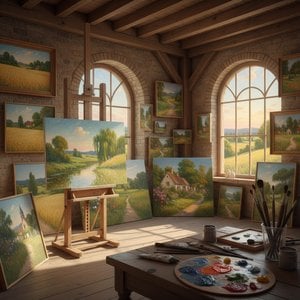
Biografie des Künstlers
Early Life and Education
Đoko Mazalić, a name inextricably linked to the vibrant artistic landscape of Bosnia and Herzegovina, was born in 1888 in Bosanska Kostajnica – a small town nestled amidst the rolling hills of the country. His early life, steeped in the traditions and natural beauty of his homeland, would profoundly shape his artistic vision. Mazalić’s journey into the world of art began with his enrollment at the prestigious Academy of Fine Arts in Budapest in 1910. This marked a pivotal moment, exposing him to the influential currents of European art movements like Secessionism and Naturalism – influences that would subtly permeate his later work. Alongside him were other rising stars of Bosnian art, including Gabrijel Jurkić, Petar Tiješić, and Špiro Bočarić, forming a cohort that would collectively contribute significantly to the nation’s artistic identity. Mazalić's time in Budapest wasn't merely an academic pursuit; it was a period of intense learning and experimentation, laying the foundation for his distinctive style.
Artistic Career and Style
Mazalić’s artistic career unfolded over six decades, during which he established himself as one of Bosnia and Herzegovina’s most respected painters. His body of work is characterized by remarkable stylistic versatility – a testament to his adaptability and deep understanding of artistic techniques. While landscapes undoubtedly constitute the core of his oeuvre, they are not rendered in a simplistic or conventional manner. Instead, Mazalić imbued them with a profound sense of observation and emotion, capturing the essence of the Bosnian countryside with an almost poetic sensibility. His 1920 painting, “Motif from Vranduk,” exemplifies this ability – it’s not just a depiction of a landscape; it's a distillation of light, shadow, and atmosphere, conveying a powerful sense of place and time. Throughout his career, Mazalić navigated various influences, drawing inspiration from magic realism, pointillism, plein air painting, classicism, and even hinting at the nascent possibilities of abstract expressionism. He never fully embraced abstraction, preferring to maintain a dialogue with tradition while simultaneously engaging with the changing artistic landscape.
Notable Works and Recognition
Mazalić’s legacy is secured by a collection of significant works that continue to resonate with audiences today. “Motif from Vogošća” (1930), held in the National Gallery of Bosnia and Herzegovina, offers a glimpse into his ability to capture urban life and its interplay with the natural world. “Village under snow” (1930) similarly showcases his talent for portraying the stark beauty of winter landscapes. Beyond these individual pieces, Mazalić’s influence extends to his role as a teacher and mentor. From 1923 to 1945, he served as a professor of drawing in Sarajevo and Travnik grammar schools, nurturing the talents of a new generation of artists. His dedication to art extended beyond teaching; he was actively involved in the formation of the Art Gallery of the National Museum of Bosnia and Herzegovina in 1930, managing it on a voluntary basis until 1943. He further solidified his contribution through publications such as “Lexicon of Artists of B&H” (1965) and “The Art of Painting in B&H in the Turkish Era” (1967), cementing his position as a leading scholar and art historian. His achievements were recognized with several awards and accolades, reflecting the esteem held for his artistic and intellectual contributions.
Legacy and Influence
Đoko Mazalić’s impact on Bosnian art extends far beyond his individual creations. His innovative approach to landscape painting, combined with his deep connection to his homeland, established a distinctively Bosnian aesthetic. He was one of the few Bosnian painters who chose to return home after studying abroad, dedicating himself entirely to capturing the beauty and spirit of Bosnia and Herzegovina. This commitment ensured that his work would remain deeply rooted in the national identity. Even towards the end of his career, Mazalić continued to experiment with color palettes and painting techniques, demonstrating a remarkable consistency in quality and an unwavering dedication to his craft. His retrospective exhibition held in 1970 at the National Gallery of Bosnia and Herzegovina served as a powerful testament to his enduring legacy. Today, his works continue to inspire artists and art enthusiasts alike, solidifying his place as a pivotal figure in Bosnian art history – a painter who not only documented the beauty of his country but also embodied its spirit.



 In echtem Maßstab anzeigen
 Handgemalte Reproduktion kaufen
 Versenden als Grußkarte
 Teilen
 Details anzeigen
 Leitfaden öffnen

 Herunterladen
 Ähnliche Objekte
 Röntgenaufnahme
 Diashow
 Besucherstatistiken


 Mehr anzeigen






































 Die Glasoption ist nur für Größen unter 110 cm verfügbar.