Frühe Jahre und Ausbildung
David Hockney, ein gefeierter englischer Maler, Zeichner, Grafiker, Bühnenbildner und Fotograf, wurde am 9. Juli 1937 in Bradford, England, geboren. Er war das vierte von fünf Kindern von Laura und Kenneth Hockney, wobei sein Vater während des Zweiten Weltkriegs Kriegsdienst verweigerte. Seine frühe Schulbildung erhielt er an der Wellington Primary School, gefolgt von der Bradford Grammar School und später am Bradford College of Art.
Karriere und künstlerischer Beitrag
Hockneys künstlerische Karriere blühte in den 1960er Jahren auf und etablierte ihn als eine Schlüsselfigur der Pop-Art-Bewegung. Seine Werke zeichnen sich durch lebendige Farben, kräftige Linien und erkennbare Bildsprache aus, was ihn zu einem der einflussreichsten britischen Künstler des 20. Jahrhunderts machte.
- A Bigger Splash (1966) ist ein Paradebeispiel für seine einzigartige Stilrichtung innerhalb der Pop Art.
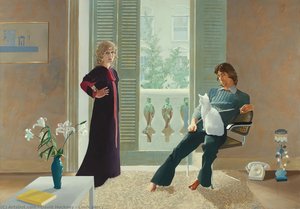
- Seine Doppelporträts, wie beispielsweise American Collectors (Fred and Marcia Weisman), demonstrieren seine Fähigkeit, die Essenz seiner Motive einzufangen.
- Hockneys Auseinandersetzung mit gleichgeschlechtlicher Liebe in seinen Porträts, wie in We Two Boys Together Clinging (1961) zu sehen ist, zeugt von seiner Offenheit und Bereitschaft, gesellschaftliche Normen herauszufordern.
Entwicklung und Einflüsse
Hockneys künstlerische Entwicklung war geprägt von verschiedenen Einflüssen. Zunächst orientierte er sich an der britischen Kunsttradition, insbesondere an den Werken von Francis Bacon und Lucian Freud. Später entwickelte er seinen eigenen unverwechselbaren Stil, der durch eine Kombination aus realistischer Darstellung und expressiver Farbgebung gekennzeichnet ist. Seine Zeit in Kalifornien ab den 1970er Jahren beeinflusste seine Arbeit maßgeblich, was sich besonders in seinen berühmten Schwimmbeckenbildern widerspiegelt. Die Fotografie spielte ebenfalls eine wichtige Rolle in seiner künstlerischen Praxis, sowohl als Inspirationsquelle als auch als eigenständiges Medium.
Auszeichnungen und Anerkennung
Im Laufe seiner Karriere hat David Hockney zahlreiche Auszeichnungen erhalten:
- Er wurde 2018 zum Order of the Companion of Honour (CH) ernannt.
- 2003 wurde er zum Fellow of the Royal Society (FRS) gewählt.
- Im Jahr 2000 erhielt er den Praemium Imperiale für Malerei.
Bedeutung und Vermächtnis
David Hockneys Einfluss auf die Kunstwelt, insbesondere im Bereich der Pop Art, ist unbestreitbar. Seine innovativen Techniken, seine farbenfrohe Ästhetik und seine Bereitschaft, gesellschaftliche Konventionen zu hinterfragen, haben ihn zu einer Ikone des 20. Jahrhunderts gemacht. Seine Werke sind in bedeutenden Museen auf der ganzen Welt vertreten und werden von Sammlern hoch geschätzt. Hockneys Auseinandersetzung mit Themen wie Identität, Sexualität und Landschaft hat seine Kunst zeitlos und relevant gemacht.



 In echtem Maßstab anzeigen
 Handgemalte Reproduktion kaufen
 Versenden als Grußkarte
 Teilen
 Details anzeigen
 Leitfaden öffnen

 Herunterladen
 Ähnliche Objekte
 Röntgenaufnahme
 Diashow
 Besucherstatistiken

 Mehr anzeigen






































 Die Glasoption ist nur für Größen unter 110 cm verfügbar.