A Poignant Encounter with Impermanence
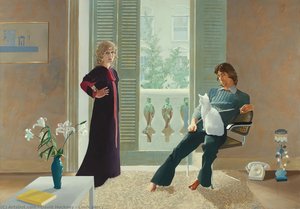
In the quietude of David Hockney’s “The Third Love,” we find ourselves standing before a composition that is as much a psychological landscape as it is a visual one. At first glance, the viewer is met with a striking, almost jarring simplicity: a solitary wooden chair, its seat a vibrant splash of red, bearing the stark, handwritten command “must go.” This single phrase transforms the object from a mere piece of furniture into a profound vessel for existential reflection. The painting does not merely depict a chair; it captures a moment of transition, an intersection between presence and departure, where the weight of memory meets the inevitability of change.
The emotional resonance of the work lies in its ability to evoke a sense of bittersweet nostalgia. There is a stillness here that feels heavy with the passage of time, inviting the observer to contemplate their own attachments and the transient nature of life. For the collector or the designer, this piece offers more than just aesthetic beauty; it provides a conversational anchor, a way to introduce themes of mindfulness and deep introspection into a living space.
The Mastery of Hockney’s Visual Language
To understand the power of “The Third Love,” one must look closely at Hockney’s signature approach to form and color. Eschewing the rigid constraints of photographic realism, Hockney employs a style that prioritizes atmosphere and feeling over literal accuracy. Influenced by the structural innovations of Cézanne and the bold contours of Picasso, his technique here utilizes flattened perspectives and a luminous palette to create a sense of depth that is felt rather than measured. The texture of the wood grain is rendered with meticulous care, yet it exists within a space where light and color take precedence over shadow.
The artist’s use of color is particularly masterful in this period of his career. The interplay between the muted, earthy tones of the background—reminiscent of the rolling Yorkshire hills—and the sudden, defiant brightness of the red seat creates a visual tension that keeps the eye moving. This deliberate rejection of illusionistic depth allows the subject to emerge with a graphic clarity, making the "must go" inscription feel like an inescapable truth etched into the very fabric of the scene.
A Legacy of Observation and Context
Created during a prolific era between 1968 and 1970, this work serves as a vital window into Hockney’s evolving relationship with his surroundings. During this time, the artist was deeply engaged in documenting the landscapes of Yorkshire, finding inspiration in the subtle shifts of light and the organic geometry of the English countryside. In “The Third Love,” we see the seeds of his transition from figuration toward a more nuanced abstraction. The background, though understated, carries the DNA of that landscape, grounding the surrealist element of the text within a recognizable, naturalistic world.
For those seeking to adorn a curated collection or an avant-garde interior, this painting represents a pinnacle of 20th-century British art. It is a piece that bridges the gap between Pop Art sensibilities and deep, emotive expressionism. Owning a reproduction of such a significant work allows one to bring a piece of art history into the modern home—a constant, quiet reminder of the beauty found in the fleeting moments of our lives.



 Vorschau anzeigen
 Zu Druck wechseln
 Versenden
 Teilen
 Details anzeigen

 Herunterladen
 Ähnliche Objekte
 Röntgenaufnahme
 Diashow
 Statistiken

 Weiterlesen






































 Die Glasoption ist nur für Größen unter 110 cm verfügbar.