Kostenlose Kunstberatung

x
Gemälde kaufen Gemälde kaufenBild kaufen Bild kaufen VersendenVersenden
DetailsDetails Zu Favoriten hinzufügen Zu Favoriten hinzufügen HerunterladenHerunterladen Ähnliche ObjekteÄhnliche Objekte X-RayX-Ray Diashow anzeigenDiashow anzeigen

Circus (Abstract Composition)

Discover 'Circus' by David Bomberg (1921), an abstract masterpiece blending cubism & futurism with vibrant colors and dynamic figures. Explore the work of this pioneering British artist.

David Bomberg (1890–1957): Von kubistischen Anfängen zu ausdrucksstarken Landschaften – entdecken Sie den Weg dieses einflussreichen britischen Malers & 'Whitechapel Boy'.

Giclée / Kunstdruck

Giclée- oder Leinwanddruck in Museumsqualität mit schneller Produktion und flexiblen Veredelungsoptionen.

P118B $10
P118H $10
P118W $10
P438Z $10
P508JH $12
P508YH $12
P805H $10
P805Z $10
P919BZ $10
P919G $10
P919XJ $10
P959ZH $10
P968JZ $12
W106C $8
W218G $10
W218JH $8
W218Y $10
W307PJ $10
W316G $10
W316PJ $8
W316Y $10
W398PJ $8
W4111J $10
W500HY $15
W500JH $15
W692G $12
W849H $8
W940BG $15
W953PJ $8

Standard
custom
CM
INCH

Wählen Sie aus unseren vordefinierten Größen, die den ursprünglichen Proportionen des Kunstwerks entsprechen.

Breite
Höhe

Sie können Ihre eigenen Maße eingeben, um ein bestimmtes Format oder einen speziellen Platz einzupassen. Wenn das von Ihnen gewählte Format nicht den Proportionen des Originalbildes entspricht, werden wir das Kunstwerk entweder beschneiden oder das Bild mit einem gespiegelten oder einfarbigen Rand erweitern. Ein digitaler Entwurf wird Ihnen zur Genehmigung zugesandt, bevor die Produktion beginnt.
Bitte beachten Sie, dass die Vorschau auf dem Bildschirm nicht den tatsächlichen Zuschnitt oder die Erweiterung widerspiegelt. Nur der Entwurf zeigt die endgültige Komposition präzise an.
Obwohl Sondermaße verfügbar sind, empfehlen wir die Auswahl eines Maßes aus der vordefinierten Liste, um die ursprünglichen Proportionen zu bewahren.

Weltweiter Versand () innerhalb von 2 Wochen statt der üblichen 4/5 Wochen. (2 Juli)

why_choose_icon
Kostenloser weltweiter Expressversand
why_choose_icon
Hochwertige Leinenleinwand
why_choose_icon
Umfassender Versicherungsschutz beim Versand
why_choose_icon
Zollsteuer-Rückerstattungsgarantie
why_choose_icon
Garantie für echte Farbtreue
why_choose_icon
60-Tage-Rückgaberecht (nur bei Mängeln)
why_choose_icon
100% Geld-zurück-Garantie
why_choose_icon
Mengenrabatt verfügbar

Gesamtpreis

-

reproduction

Circus (Abstract Composition)

Giclée / Kunstdruck

Größe der Reproduktion

-

Endpreis aller Optionen

-

Eckdaten auf einen Blick

  • Artist: David Bomberg
  • Movement: Cubism, Futurism
  • Location: Ashmolean Museum
  • Influences:
    • Cézanne
    • Sickert
  • Title: Circus (Abstract Composition)
  • Artistic style: Expressionist
  • Notable elements: Angular figures, color

Kunst-Quiz

Jede Frage hat nur eine richtige Antwort.

Frage 1:
What is the primary subject matter depicted in David Bomberg’s ‘Circus (Abstract Composition)’?
Frage 2:
In what year was ‘Circus (Abstract Composition)’ painted?
Frage 3:
Which artistic movement heavily influenced David Bomberg’s style during the creation of ‘Circus (Abstract Composition)’?
Frage 4:
What is the approximate size of the painting ‘Circus (Abstract Composition)’?
Frage 5:
David Bomberg was part of a group known as the ‘Whitechapel Boys’. What is significant about this group?

Beschreibung des Sammlerstücks

A Whirlwind of Color and Form: David Bomberg’s “Circus”

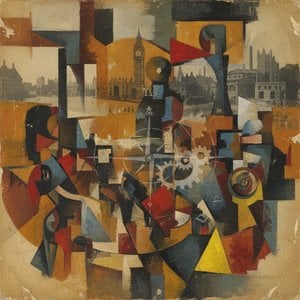
David Bomberg's "Circus (Abstract Composition)," painted in 1921, isn’t merely a depiction of a traveling show; it’s an explosion of energy, emotion, and the restless spirit of early modernism. This vibrant canvas, now housed at the Ashmolean Museum in Oxford, captures a fleeting moment within a chaotic yet strangely ordered spectacle – a testament to Bomberg's unique ability to distill complex experience into powerful visual form. The painting immediately assaults the senses with its bold palette: assertive blues and reds clash dynamically against yellows and whites, creating an atmosphere of both excitement and underlying tension.

Bomberg’s style during this period was deeply influenced by the avant-garde movements sweeping through Europe. He absorbed the geometric abstraction of Cubism – evident in the fragmented forms suggesting figures and structures – while simultaneously embracing the dynamism and expressive power of Futurism, particularly its fascination with movement and speed. The painting's composition isn’t static; it feels like a captured rush, a snapshot of a scene perpetually in motion. Notice how the figures are reduced to angular shapes, almost dissolving into the swirling colors, mirroring the fragmented reality presented by Cubist principles.

The Artist and His Time

Born in Birmingham in 1890, David Bomberg’s early life was shaped by his Polish-Jewish heritage and a challenging upbringing. He initially trained as a lithographer but quickly gravitated towards painting, finding himself drawn to the radical artistic currents of the time. He became part of the “Whitechapel Boys,” a group of East End artists who pushed against established conventions and experimented with new forms of expression. This group, including Mark Gertler and Stanley Spencer, formed a vital network of support and influence during a period of significant social and political upheaval in Britain.

Bomberg’s artistic journey was marked by experimentation and controversy. His early work, particularly his engagement with Cubism and Futurism, drew criticism from some quarters who viewed these movements as overly abstract or even decadent. However, Bomberg remained steadfast in his pursuit of a new visual language, reflecting the anxieties and aspirations of a rapidly changing world. His expulsion from the Slade School of Art in 1913, due to his perceived disregard for traditional artistic methods, further solidified his position as an outsider artist challenging established norms.

Decoding the Composition: Symbolism and Emotion

While seemingly abstract, “Circus” is rich with symbolic potential. The figures themselves – a jumble of shapes suggesting people and animals – represent not individual portraits but rather archetypal elements of the circus experience: performers, spectators, and the spectacle itself. The swirling colors aren’t simply decorative; they convey a sense of disorientation, excitement, and perhaps even underlying unease. The dominant blues could symbolize both the vastness of the sky and the melancholy associated with transient experiences.

Consider the elephant in the center of the composition. It's not rendered realistically but rather as a powerful, simplified form – a symbol of strength, memory, and perhaps even the weight of tradition. The overall effect is one of controlled chaos, inviting the viewer to contemplate the complexities of human experience within a world of illusion and spectacle. Bomberg masterfully uses color and form to evoke a visceral response, capturing not just what he saw but also how he *felt* about it.

A Legacy of Innovation

“Circus (Abstract Composition)” stands as a pivotal work in David Bomberg’s oeuvre and a significant example of early British abstraction. It demonstrates his willingness to embrace radical experimentation, blending influences from Cubism, Futurism, and his own unique artistic vision. His exploration of form, color, and emotion paved the way for subsequent generations of artists, solidifying his place as a key figure in the development of modern art in Britain. Reproductions of this dynamic painting continue to resonate with viewers today, offering a glimpse into the turbulent yet exhilarating world of early 20th-century artistic innovation.

Ähnliche Kunstwerke


Biografie des Künstlers

Frühe Jahre und künstlerische Ausbildung

  • Geboren: Birmingham, Großbritannien (5. Dezember 1890)
  • Gestorben: London, Großbritannien (19. August 1957)
  • Einer der 'Whitechapel Boys' – eine Gruppe von Künstlern aus East End, die im frühen 20. Jahrhundert hervortraten.

Geboren als Sohn polnisch-jüdischer Einwanderer, Abraham und Rebecca Bomberg, in Birmingham. Die Familie zog 1895 nach Whitechapel, London.

Zunächst studierte er an der City and Guilds Technical Art School, bevor er sich als Lithograph in Birmingham ausbildete.

Er studierte unter Walter Sickert an der Westminster School of Art (1908-1910), wo er von Sickerts Fokus auf Form und Stadtleben beeinflusst wurde. Erlangte durch die Ausstellung "Manet und die Post-Impressionisten" im Jahr 1910 eine bedeutende Vertrautheit mit Paul Cézanne. Besuchte die Slade School of Art (1911) und gewann den Tonks Prize für seine Zeichnung seines Kommilitonen Isaac Rosenberg.

Die Avantgarde-Jahre: Kubismus, Futurismus und Kontroversen

  • An der Slade gehörte Bomberg zu einer bemerkenswerten Generation, darunter Mark Gertler, Stanley Spencer, C.R.W. Nevinson und Dora Carrington.
  • Beeinflusst von den Londoner Ausstellungen italienischer Futuristen im Jahr 1912 und Fry's zweiter Post-Impressionisten-Ausstellung (Picasso, Matisse, Fauvisten, Wyndham Lewis).
  • Entwickelte einen unverwechselbaren Stil, der Kubismus und Futurismus kombinierte – gekennzeichnet durch geometrische Kompositionen, begrenzte Farbpaletten, eckige Figuren und gitterartige Strukturen.
  • Sein radikaler Ansatz führte 1913 zu seinem Ausschluss von der Slade School of Art, da er als zu kühn für die konventionellen Methoden der Institution galt.
  • War kurzzeitig mit den Omega Workshops der Bloomsbury Group verbunden und stellte mit der Camden Town Group aus. Zeigte eine Affinität zur Vorticist-Bewegung von Wyndham Lewis, blieb aber unabhängig und beteiligte sich nicht vollständig daran.

Von Krieg zu Landschaft: Ein Wandel im Stil

Die Erfahrungen als Soldat im Ersten Weltkrieg beeinflussten sein künstlerisches Schaffen tiefgreifend und führten zu einem Abschied vom Abstraktionismus.

In den 1920er Jahren übernahm Bomberg einen figurativeren Stil, der sich auf Porträts und Landschaften konzentrierte, die direkt aus der Natur entstanden. Entwickelte eine zunehmend expressionistische Technik, gekennzeichnet durch strukturierte Impastos und emotionale Intensität.

Umfangreiche Reisen durch den Nahen Osten (insbesondere Palästina) und Europa beeinflussten sein späteres Werk maßgeblich. Seine Darstellungen Jerusalems sind besonders bemerkenswert.

Spätere Jahre und Vermächtnis

  • Von 1945 bis 1953 unterrichtete er an der Borough Polytechnic (heute London South Bank University) und beeinflusste eine Generation von Künstlern, darunter Frank Auerbach, Leon Kossoff, Philip Holmes, Cliff Holden, Edna Mann, Dorothy Mead, Gustav Metzger, Dennis Creffield, Cecil Bailey und Miles Richmond.
  • Verheiratete sich mit der Landschaftsmalerin Lilian Holt.
  • Trotz Phasen relativer Obscurität während seines Lebens hat Bombergs Werk in den letzten Jahrzehnten zunehmend an Anerkennung gewonnen und gilt als bedeutender Beitrag zur britischen Moderne.
  • Das David Bomberg House an der London South Bank University ist ihm zu Ehren benannt.
  • Sein Vermächtnis liegt in seiner einzigartigen Synthese europäischer Avantgarde-Bewegungen und seiner späteren Entwicklung eines kraftvollen, ausdrucksstarken Landschaftsstils, der das Wesen von Ort und menschlicher Erfahrung einfing.

David Bomberg

David Bomberg

1890 - 1957 , Vereinigtes Königreich

Kurzinfos

  • Beeinflusste Künstler:
    • Paul Cézanne
    • Walter Sickert
  • Bemerkenswerte Werke:
    • Selbstporträt (1937)
    • Jerusalem-Darstellungen
  • Geburtsdatum: 5. Dezember 1890
  • Geburtsort: Birmingham, Vereinigtes Königreich
  • Künstlerische Richtung:
    • Kubismus
    • Futurismus
    • Expressionismus
  • Nationalität: Britisch
  • Sterbedatum: 19. August 1957
  • Vollständiger Name: David Garshen Bomberg
  • Von Künstlern Beeinflusst:
    • Frank Auerbach
    • Leon Kossoff
Entdecken Sie Kunstwerke, die nach Themen, Stilen und Merkmalen sortiert sind.