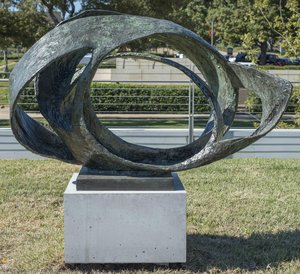
The Essence of Form: A Dialogue with Silence
In the quiet intersection of geometry and nature lies Barbara Hepworth’s Two Forms with White (Greek), a work that transcends its physical medium to become a profound meditation on existence. Captured in a striking monochrome composition, this piece invites the viewer into a world where the boundaries between object and space begin to dissolve. The artwork presents two wooden sculptures, masterfully carved by Hepworth, standing in silent conversation against a stark, minimalist backdrop. There is an undeniable gravity to these forms; they do not merely occupy space, but rather command it through a rhythmic balance of weight and lightness. For the discerning collector or interior designer, this piece offers more than visual interest—it provides a focal point of contemplative stillness, perfect for spaces that demand a sense of sophisticated serenity.
The brilliance of Hepworth’s technique lies in her commitment to truth to materials. Through a revolutionary process of reductive carving, she stripped away the superfluous to reveal the essential soul of the wood. One can almost feel the tactile smoothness of the polished surfaces, which catch the light with a subtle, ethereal glow. The deliberate perforation within one of the forms acts as a visual heartbeat, a window through which the concept of emptiness becomes just as tangible as the solid mass itself. This interplay between the presence of the wood and the void of the aperture creates a dynamic tension, reminding us that beauty often resides in what has been removed as much as in what remains.
A Legacy of Modernist Mastery
Emerging from the vibrant modernist movements of the mid-1960s, Two Forms with White (Greek) stands as a testament to Hepworth’s role in shaping the trajectory of British abstraction. During an era when art was moving away from the chaotic energy of Abstract Expressionism toward the disciplined clarity of Minimalism, Hepworth found a unique middle ground. Her work does not rely on cold, industrial rigidity; instead, it breathes with an organic vitality inspired by the landscapes of St Ives and the elemental shapes of pebbles and stones. This piece embodies that historical pivot—a moment where the mathematical precision of geometric abstraction met the primal, emotive power of natural forms.
To bring a high-quality reproduction of this masterpiece into a contemporary interior is to invite a piece of art history into the home. Whether placed in a sunlit gallery or a minimalist living space, the work functions as an anchor of elegance. It speaks to a refined aesthetic sensibility that values depth over decoration and substance over trend. For those seeking to curate an environment of intellectual and emotional resonance, Hepworth’s sculptural vision offers an eternal source of inspiration, bridging the gap between the ancient echoes of Greek form and the cutting-edge sophistication of modern design.



 Handgemalte Reproduktion kaufen
 Versenden als Grußkarte
 Teilen
 Details anzeigen
 Leitfaden

 Herunterladen
 Ähnliche Objekte
 Diashow
 Besucherstatistiken


 Mehr anzeigen






































 Die Glasoption ist nur für Größen unter 110 cm verfügbar.