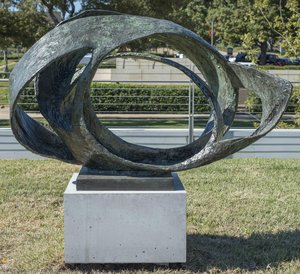
Barbara Hepworth’s ‘Totem’: A Silent Dialogue with Form and Space
Barbara Hepworth's “Totem,” created in 1960-62, is more than just a sculpture; it’s an invitation to contemplate the fundamental elements of form, space, and human experience. This remarkable piece, crafted from alabaster or marble – materials chosen for their inherent luminosity and tactile quality – stands as a testament to Hepworth's pioneering role in British modernism. The work immediately commands attention with its strikingly vertical orientation, a deliberate choice that draws the eye upwards, suggesting an aspiration towards something beyond the earthly realm. The contrast between this upward thrust and the grounded, angularity of the base creates a dynamic tension, inviting viewers to consider the interplay of stability and movement within the sculpture’s composition.
A Biomorphic Embrace: Form and Technique
Hepworth's signature style is powerfully evident in “Totem.” The form itself is profoundly biomorphic – an organic echo translated into stone. It eschews representational imagery, instead focusing on pure abstraction, exploring the inherent qualities of the material. The sculpture’s surface is remarkably smooth, achieved through a subtractive sculpting technique: Hepworth began with a larger block of stone and meticulously removed material to reveal the desired shape. This process isn't merely about creating an image; it’s about coaxing forth the form already latent within the stone itself. The subtle tonal shifts in the polished surface – from bright highlights to shadowed recesses – are not accidental; they are carefully orchestrated to emphasize the sculpture’s three-dimensionality and create a sense of depth and volume. The precision of the carving, combined with the inherent texture of the alabaster or marble, results in a piece that feels both solid and ethereal.
Symbolic Resonance: Ancestry and Spiritual Connection
The title “Totem” immediately evokes associations with ancient tribal cultures and ancestral figures. While Hepworth herself resisted overly literal interpretations, the sculpture undeniably carries a potent symbolic weight. The vertical element can be seen as representing a connection to the heavens or a spiritual ascent, mirroring the traditional role of totems as guardians and symbols of lineage. The pierced openings within the form aren’t simply decorative; they invite contemplation, creating pockets of negative space that seem to breathe with an inner light. These voids suggest a sense of openness, inviting viewers to project their own interpretations onto the sculpture – perhaps reflecting on personal journeys or universal themes of connection and belonging.
Historical Context: Modernism and Abstraction
“Totem” was created during a pivotal period in Hepworth’s career, aligning with her exploration of abstraction-creation. This movement sought to move beyond representational art, focusing instead on the intrinsic qualities of materials and the fundamental principles of form and space. Hepworth's work, alongside that of artists like Ben Nicholson and Paul Nash, challenged conventional notions of sculpture, embracing a more elemental and expressive approach. The piece reflects the broader shift within 20th-century art towards a rejection of traditional styles and a celebration of modern materials and techniques. It’s a powerful example of how abstraction could be used to convey profound emotional and spiritual ideas.
A Timeless Presence: Emotional Impact and Artistic Legacy
Looking at “Totem” is an experience that transcends mere visual appreciation. There's a quiet serenity, a sense of contemplative stillness that permeates the sculpture’s form. It evokes a feeling of calm, inviting viewers to slow down, breathe deeply, and connect with their own inner landscape. Hepworth’s ability to imbue stone with such emotional resonance is a testament to her extraordinary artistic vision. “Totem” remains a powerful symbol of modernism's enduring legacy – a silent dialogue between form, space, and the human spirit, offering a timeless invitation to contemplation.



 Zu Druck wechseln
 Versenden
 Teilen
 Details anzeigen

 Herunterladen
 Ähnliche Objekte
 Diashow
 Statistiken


 Weiterlesen






































 Die Glasoption ist nur für Größen unter 110 cm verfügbar.