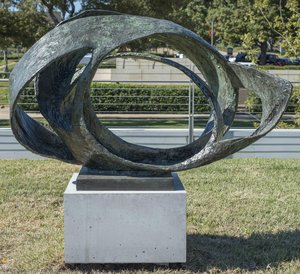
A Sculptural Meditation on Form and Space
Barbara Hepworth’s “Prototype for Maquette, Three Forms in Echelon,” a deceptively simple yet profoundly resonant sculpture, stands as a testament to the artist's pioneering approach to modern abstraction. Created in 1961 during a period of intense experimentation and exploration within her studio at St Ives, Cornwall, this piece isn’t merely a collection of shapes; it’s an invitation to contemplate the relationship between form, space, and the inherent qualities of materials – specifically, the cool, tactile embrace of stone or wood.
The sculpture presents three distinct, organically curved forms arranged vertically on a stark white background. These aren't representational figures; instead, they embody an elemental language, suggesting echoes of natural forms—waves, rocks, or perhaps even the contours of the human body—without ever explicitly depicting them. The arrangement follows an echelon pattern, each form subtly offset from the one below, creating a dynamic sense of upward movement and spatial depth. This deliberate asymmetry is key to Hepworth’s aesthetic; she sought to disrupt traditional notions of balance and harmony, favoring instead a more intuitive and expressive approach.
Materiality and Technique: A Dance Between Hand and Stone
Hepworth's process was deeply rooted in the materiality of her chosen medium. She rarely used preparatory sketches, preferring to work directly from intuition and feeling, allowing the stone or wood to guide the form. The “Prototype” itself is a crucial stage in this process – a preliminary model intended to refine the composition and explore the interplay of light and shadow before committing to a larger-scale version. The matte texture of the sculpture, achieved through careful carving and polishing, invites tactile engagement; one can almost feel the cool smoothness of the stone beneath their fingertips.
Her technique involved a subtractive approach – carefully removing material to reveal the underlying form—combined with an understanding of how light interacts with different surfaces. The subtle tonal shifts within the sculpture’s surface, achieved through meticulous polishing and manipulation of the grain, create a sense of depth and volume, drawing the eye upwards and inviting contemplation. The stark white background serves not as a distraction but as a crucial element in highlighting the forms' inherent qualities, emphasizing their purity and simplicity.
Symbolism and Emotional Resonance
Hepworth’s work consistently explores themes of human connection to nature and the inner self. These three abstract forms can be interpreted as representing interconnectedness—a visual metaphor for the flow of life forces or perhaps a meditation on the fundamental building blocks of existence. The vertical arrangement evokes a sense of aspiration, reaching towards something beyond the immediate, while the subtle curves suggest fluidity and movement.
Considering Hepworth’s broader body of work, this “Prototype” shares affinities with her earlier explorations of ‘Form and Function,’ where she sought to create sculptures that were both aesthetically pleasing and responsive to their environment. It's a piece that speaks to the enduring power of abstraction—its ability to evoke profound emotions and ideas through purely visual means. The sculpture’s quiet intensity invites viewers to engage in a personal dialogue with its forms, prompting reflection on the nature of beauty, space, and our relationship to the world around us.
Further Exploration



 Zum Druck wechseln
 Versenden als Grußkarte
 Teilen
 Details anzeigen
 Leitfaden öffnen

 Herunterladen
 Ähnliche Objekte
 Diashow
 Besucherstatistiken


 Mehr anzeigen