A Quiet Universe of Circles
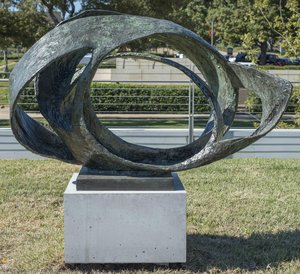
Barbara Hepworth’s Genesis III, a seminal work from 1966, isn't merely a depiction of two circles; it’s an invitation to contemplate the fundamental geometries of existence. Created during a period of profound personal and artistic evolution for the sculptor, this piece embodies her signature exploration of form, texture, and the interplay between abstraction and suggestion. The stark white background acts as a luminous void, amplifying the presence of the circular forms and drawing the viewer into their contained space. It’s a deliberate choice – Hepworth often favored simplicity to allow the inherent qualities of materials and shapes to speak for themselves.
- Material & Technique: Crafted primarily in oil paint on canvas, Genesis III showcases Hepworth's masterful control over layering and texture. The circles aren’t rendered with sharp edges but rather possess a subtly eroded quality, as if sculpted from memory or suggestion. The application of paint is deliberately loose, creating a sense of movement and dynamism that contrasts sharply with the stillness implied by the forms themselves.
- Compositional Balance: The asymmetrical arrangement of the circles – one positioned slightly higher left, the other lower right – generates an immediate visual tension. This imbalance isn’t jarring but rather creates a subtle push and pull, preventing the composition from feeling static or predictable. It mirrors Hepworth's broader interest in exploring balance and equilibrium within her sculptures.
- Color Palette: The restrained color palette—a dominant white punctuated by terracotta and grey—further emphasizes the forms’ presence. These earthy tones evoke a sense of grounding, anchoring the abstract shapes within a more tangible realm. The strategic use of black spots adds an element of spontaneity and visual interest, hinting at the underlying process of creation.
Echoes of Modernism & Sculpture
To fully appreciate Genesis III, it’s crucial to understand Hepworth's place within the broader context of mid-20th century art. She was a key figure in the movement towards abstraction, influenced by European avant-garde artists like Piet Mondrian and Constantin Brâncuși. However, unlike purely geometric abstractions, Hepworth retained a deep connection to her sculptural roots. The circular forms resonate with the organic shapes found in her three-dimensional works – particularly her celebrated “oval forms.” This piece can be seen as a translation of sculptural principles into a two-dimensional format, demonstrating how she explored similar themes of form, space, and material through different mediums.
Historical Context: Created in 1966, the artwork reflects a period of significant artistic experimentation. Hepworth was increasingly focused on exploring the relationship between surface and volume, often referencing her own sculptural practice. The work also aligns with the broader trends of Minimalism and Abstract Expressionism that were gaining prominence during this time.
Symbolic Resonance & Emotional Depth
The circles themselves are open to interpretation, inviting viewers to project their own meanings onto the artwork. They can be seen as representations of wholeness, cycles, or interconnectedness – fundamental concepts explored throughout Hepworth’s career. The scattered black spots, like fleeting moments in time, suggest spontaneity and energy, hinting at the dynamic process of creation. The overall mood is one of quiet contemplation—a serene invitation to lose oneself within the simplicity of form and color.
A Legacy of Form & Texture
Genesis III stands as a testament to Barbara Hepworth’s enduring legacy as one of the most innovative sculptors of the 20th century. It's a deceptively simple work, yet brimming with subtle complexities and emotional depth. Reproductions capture the delicate texture and layered application of paint that are so vital to the original’s impact. It remains a powerful example of how abstraction can be used to explore profound philosophical questions about existence, form, and the human experience.



 Vorschau anzeigen
 Handgemalte Reproduktion bestellen
 Versenden
 Teilen
 Details anzeigen

 Herunterladen
 Ähnliche Objekte
 Röntgenaufnahme
 Diashow
 Statistiken


 Weiterlesen






































 Die Glasoption ist nur für Größen unter 110 cm verfügbar.