


Giclée- oder Leinwanddruck in Museumsqualität mit schneller Produktion und flexiblen Veredelungsoptionen. ( Handgemalte Reproduktion bestellen Bild kaufen)





























Wählen Sie aus unseren vordefinierten Formaten, die den ursprünglichen Proportionen des Kunstwerks entsprechen.

Sie können Ihre eigenen Maße eingeben, um ein bestimmtes Format oder einen speziellen Platz einzupassen. Wenn das von Ihnen gewählte Format nicht den Proportionen des Originalbildes entspricht, werden wir das Kunstwerk entweder beschneiden oder das Bild mit einem gespiegelten oder einfarbigen Rand erweitern. Ein digitaler Entwurf wird Ihnen zur Genehmigung zugesandt, bevor die Produktion beginnt.
Bitte beachten Sie, dass die Vorschau auf dem Bildschirm nicht den tatsächlichen Zuschnitt oder die Erweiterung widerspiegelt. Nur der Entwurf zeigt die endgültige Komposition präzise an.
Obwohl Sondermaße verfügbar sind, empfehlen wir die Auswahl eines Maßes aus der vordefinierten Liste, um die ursprünglichen Proportionen zu bewahren.
Weltweiter Versand () innerhalb von 2 Wochen statt der üblichen 4/5 Wochen. (7 September)


Portrait von Pedro
Format der Reproduktion
Amedeo Modigliani’s “Portrait of Pedro,” a work shrouded in the quiet contemplation of early 20th-century Europe, is more than just a likeness; it's an embodiment of longing and a subtle exploration of the human condition. Born in Livorno, Italy, in 1884 into a family with roots tracing back to Sephardic Jewish heritage, Modigliani’s life was inextricably linked to both artistic passion and personal hardship. Frequent illnesses – pleurisy and typhoid fever were persistent shadows – likely fostered within him an acute awareness of fragility, a sensitivity that profoundly shaped his art. His early years, though marked by relative comfort, were punctuated by intellectual stimulation from his mother and grandfather, who introduced him to the radical philosophies of Nietzsche, Baudelaire, and Lautréamont, providing a foundation for an artistic vision that deliberately challenged conventional norms.
“Portrait of Pedro” exemplifies Modigliani’s distinctive style – a captivating blend of Cubism, African art influences, and his own deeply personal sensibility. The elongated forms, particularly the neck and head, are immediately recognizable hallmarks of his oeuvre. He eschewed sharp lines and precise detail in favor of a softer, more fluid approach. The painting technique is characterized by thin, layered washes of oil paint, creating subtle gradations of color and a remarkable sense of depth despite the flattened perspective. This layering technique allows for an almost hazy effect, contributing to the overall mood of quiet introspection. The artist’s deliberate choice of muted browns, grays, and ochre tones reinforces this feeling, avoiding any dramatic or overly vibrant statements.
The composition is remarkably simple yet powerfully effective. The subject – a man gazing directly at the viewer – occupies the central space of the canvas, drawing immediate attention to his face. There’s minimal background detail; the soft gray-purple hue serves primarily as a neutral backdrop, further emphasizing the figure's presence and directing all focus onto his expression. This restrained palette is not devoid of warmth, however. The subtle highlights on his face – perhaps hinting at a pale pink or cream – offer delicate points of contrast against the dominant earth tones. The overall effect is one of understated elegance and profound emotional resonance.
“Portrait of Pedro” speaks volumes through its subtle symbolism. The man’s direct gaze, a hallmark of Modigliani's portraits, isn’t merely observational; it feels intensely personal, almost challenging the viewer to connect with his inner world. The slightly downturned mouth suggests a hint of melancholy, an underlying sadness that permeates the entire composition. This is not a portrait celebrating triumph or joy, but rather one capturing a moment of quiet contemplation – a feeling of being lost in thought, perhaps even burdened by unspoken longing. The elongated features themselves can be interpreted as symbols of striving for beauty and transcendence, yet tempered with a sense of unattainable desire.
Created during the tumultuous years of the early 20th century, “Portrait of Pedro” reflects the broader artistic currents of the time. Modigliani’s work resonated with the anxieties and uncertainties of a rapidly changing world, while simultaneously embracing a sense of timeless beauty. His exploration of form and expression anticipated many of the developments in modern art, paving the way for subsequent generations of artists. Today, “Portrait of Pedro” stands as a poignant reminder of Modigliani’s enduring legacy – a testament to his ability to capture not just physical likeness but also the complex emotions that lie beneath the surface of human experience. A reproduction offers a beautiful and accessible window into this remarkable artist's world.


1884 - 1920 , Italien
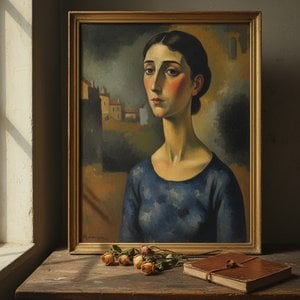
Delve into the haunting beauty of Amedeo Modigliani's portraits. Explore the intersection of Expressionism and Modernism through an expert analysis of his iconic elongated forms, melancholic gazes, and profound influence on art history.

 Vorschau anzeigen
 Versenden
 Teilen
 Details anzeigen

 Herunterladen
 Ähnliche Objekte
 Röntgenaufnahme
 Diashow
 Weiterlesen







 Die Glasoption ist nur für Größen unter 110 cm verfügbar.


