Das melancholische Porträt: Leopold Zborowski von Amedeo Modigliani
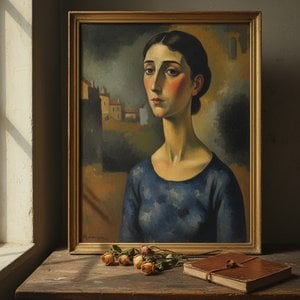
Amedeo Modigliani’s “Portrait of Leopold Zborowski” – painted in 1916 – is not merely a likeness; it's a distilled essence of longing, intellectualism, and the quiet tragedy that permeated the artist’s life. The painting immediately draws the viewer into a world of understated elegance and profound sadness, capturing the sitter within a frame of subtle yet powerful symbolism. Zborowski, a Polish art dealer and collector, becomes an emblem of the era's shifting social landscape – a man caught between old wealth and the burgeoning modernity of Paris.
Modigliani’s distinctive style is immediately recognizable. He eschewed academic realism in favor of elongated forms, subtly distorted features, and a deliberate flattening of perspective. This approach, influenced by African sculpture and the works of Rodin, creates an immediate sense of intimacy and psychological depth. Notice how Zborowski's face – with its prominent nose, almond-shaped eyes, and carefully rendered beard – is presented not as a photographic representation but as a carefully constructed portrait designed to reveal character. The subtle shift in his gaze, directed directly at the viewer, invites an unspoken dialogue, suggesting a quiet contemplation or perhaps even a hint of melancholy.
Die Bedeutung des Kontexts: Paris im Umbruch
To fully appreciate “Portrait of Leopold Zborowski,” it’s crucial to understand the historical context in which it was created. 1916 marked a pivotal year for Europe, dominated by the horrors of World War I. Paris, though still vibrant and artistic, felt the strain of conflict – a sense of loss and uncertainty hung heavy in the air. Zborowski himself was a figure deeply embedded within this milieu; he was known for his patronage of artists like Picasso and Braque, and his involvement in the Parisian art market. His wealth, derived from his family’s textile business, provided him with access to the finest artistic circles, yet it couldn't shield him from the pervasive anxieties of the time.
The inclusion of the book – a volume of poetry or philosophy is often speculated – speaks volumes about Zborowski’s intellectual pursuits. It suggests a man who valued knowledge and contemplation amidst the chaos of his world. The positioning of the book in his hand isn't casual; it’s deliberately placed to draw attention to his engagement with ideas, hinting at a mind constantly seeking solace or understanding.
Farben und Technik: Ein Hauch von Melancholie
Modigliani’s palette is restrained and muted – predominantly browns, ochres, and subtle blues. These colors contribute significantly to the painting's overall mood of quiet sadness. He employs a technique of thin, layered brushstrokes, creating a delicate surface texture that emphasizes the contours of Zborowski’s face and clothing. The use of *sfumato*, a blurring effect achieved through subtle gradations of tone, softens the edges and adds to the painting's dreamlike quality. The lighting is particularly noteworthy; it’s diffused and indirect, casting shadows that accentuate the lines of his face and creating a sense of depth without resorting to dramatic contrasts.
Symbolik und Emotionale Wirkung: Ein Porträt der Seele
Ultimately, “Portrait of Leopold Zborowski” transcends a simple depiction of a man. It’s a poignant meditation on beauty, loss, and the human condition. The elongated features, characteristic of Modigliani's style, lend an air of timelessness to the portrait, suggesting that Zborowski’s melancholy is not confined to his own lifetime but resonates across generations. The painting evokes a powerful sense of empathy – we are invited to contemplate the quiet dignity and underlying sadness of this enigmatic figure. It’s a testament to Modigliani's ability to capture not just outward appearance, but also the inner life of his subjects, making “Portrait of Leopold Zborowski” a truly unforgettable work of art.



 In echtem Maßstab anzeigen
 Handgemalte Reproduktion kaufen
 Versenden als Grußkarte
 Teilen
 Details anzeigen
 Leitfaden

 Herunterladen
 Ähnliche Objekte
 Röntgenaufnahme
 Diashow
 Besucherstatistiken


 Mehr anzeigen






































 Die Glasoption ist nur für Größen unter 110 cm verfügbar.