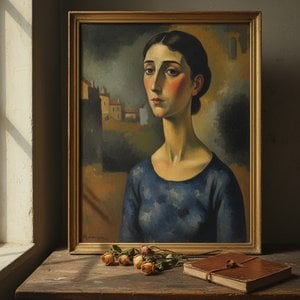
Das melancholische Echo einer Seele: Amedeo Modiglianis "Marie, Tochter des Volkes"
Amedeo Clemente Modigliani’s “Marie, Tochter des Volkes” – a poignant portrait painted in 1918 – isn't merely a depiction of a woman; it is an immersion into the very heart of Expressionism. Held within the esteemed Kunstmuseum Basel, this oil on canvas transcends the boundaries of simple representation, offering instead a profound meditation on loneliness, introspection, and the quiet dignity of human experience. The painting’s enduring power lies in its ability to evoke a deep emotional response, drawing the viewer into the contemplative gaze of its subject – a woman whose story remains subtly veiled within the artwork itself.
Modigliani's signature style is immediately apparent. He masterfully employs elongated forms and subtly distorted features, creating figures that possess an almost ethereal quality. The subject’s head, particularly her flowing hair cascading down her shoulders, seems to float slightly above the plane of the canvas – a characteristic technique designed to emphasize vulnerability and inner turmoil. The muted palette—primarily ochres, browns, and deep blues—further contributes to the painting's somber mood, reinforcing the sense of melancholy that permeates the scene. The artist’s deliberate use of thick impasto in certain areas adds textural depth, highlighting the contours of her face and drawing attention to the intensity of her expression.
Expressionismus und die Seele des Augenblicks
“Marie, Tochter des Volkes” firmly establishes itself within the context of Expressionism, a movement that sought to capture not just external reality but also the subjective emotional experience. Unlike earlier artistic traditions focused on objective representation, Expressionists aimed to convey inner feelings and anxieties through distorted forms, jarring colors, and unsettling compositions. Modigliani’s work embodies this spirit perfectly; he doesn't offer a straightforward portrait but rather an exploration of the subject’s internal landscape. The painting feels intensely immediate – as if frozen in a single, fleeting moment of contemplation.
The year 1918 was a pivotal one, marked by the end of World War I and its devastating consequences. Europe was grappling with profound loss and uncertainty. It's plausible that Modigliani’s work reflects this atmosphere of disillusionment and quiet despair. The woman in the painting embodies a sense of isolation – a feeling acutely felt during a period of immense societal upheaval. Her averted gaze suggests a withdrawal from the world, a silent acknowledgment of hardship and perhaps even a yearning for solace.
Symbolik und die verborgene Geschichte
While the identity of “Marie” remains deliberately ambiguous, her attire—a simple black shirt and scarf—hints at a certain social standing or perhaps a sense of quiet dignity. The long hair, often interpreted as a symbol of femininity and vulnerability, further emphasizes this aspect. The painting’s composition itself is carefully constructed to draw the viewer's eye to the subject’s face – the epicenter of her emotional state. It’s important to note that Modigliani frequently depicted women in states of quiet contemplation, suggesting an interest in exploring female psychology and the complexities of human relationships.
The Kunstmuseum Basel, a cornerstone of Swiss art history, provides the perfect setting for this evocative work. Its collection showcases not only Modigliani’s genius but also the broader trajectory of modern art. Owning a reproduction of “Marie, Tochter des Volkes” offers more than just a beautiful image; it's an opportunity to connect with a pivotal moment in artistic history and to contemplate the enduring power of human emotion.
Ein Meisterwerk für Sammler und Innenarchitekten
Amedeo Modigliani’s “Marie, Tochter des Volkes” is a timeless masterpiece that continues to resonate with audiences today. Its haunting beauty, coupled with its profound emotional depth, makes it an ideal addition to any art collection or interior space. The painting's muted color palette and elegant composition lend themselves beautifully to various design styles, from classic interiors to contemporary minimalist spaces. A high-quality reproduction captures the essence of this remarkable artwork, allowing you to bring its melancholic charm into your home.



 In echtem Maßstab anzeigen
 Handgemalte Reproduktion kaufen
 Versenden als Grußkarte
 Teilen
 Details anzeigen
 Leitfaden öffnen

 Herunterladen
 Ähnliche Objekte
 Röntgenaufnahme
 Diashow
 Besucherstatistiken


 Mehr anzeigen






































 Die Glasoption ist nur für Größen unter 110 cm verfügbar.