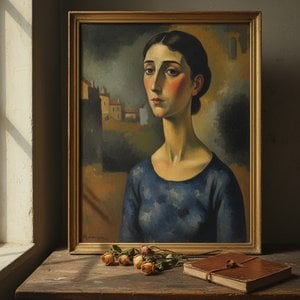
Ein Blick in die Seele: Amedeo Modigliani’s “Chaim Soutine”
Amedeo Modigliani's 1916 painting, "Chaim Soutine," is not merely a portrait; it’s an intimate glimpse into the soul of a man – and, by extension, a profound meditation on human vulnerability. This arresting work, measuring 100 x 65 cm, immediately draws the viewer in with its dramatic intensity. The subject, a woman with dark hair framed by a vibrant yellow jacket, sits poised against a stark red backdrop, her expression a carefully constructed mask of seriousness. It’s a face etched with an unspoken story, hinting at both resilience and profound melancholy – a characteristic deeply rooted in Modigliani's own life experiences.
The painting is firmly anchored within the Expressionist movement, a period defined by its rejection of photographic realism in favor of conveying raw emotion. Modigliani’s signature style—characterized by elongated figures, simplified forms, and bold, often clashing colors—is powerfully evident here. The red background isn't simply a backdrop; it acts as an amplifier, intensifying the woman’s gaze and contributing to the overall sense of unease and drama. Notice how Modigliani deliberately distorts perspective and proportion – a technique frequently employed by Expressionists to heighten emotional impact. The brushstrokes themselves are visible, adding a layer of texture and immediacy that invites close inspection.
The Shadow of Sephardic Heritage and Personal Turmoil
Understanding the context surrounding Modigliani’s work is crucial to appreciating its depth. Born in Livorno, Italy, into a family of Sephardic Jewish descent, Modigliani's life was profoundly shaped by his heritage and the hardships it entailed. Frequent illnesses throughout his youth – particularly pleurisy and typhoid fever – instilled within him a heightened sensitivity to fragility and mortality. These personal struggles undoubtedly informed his artistic vision, leading him to explore themes of loneliness, longing, and the transient nature of beauty. His family’s financial instability further added to this sense of precariousness, contributing to a life marked by uncertainty and displacement.
The influence of philosophers like Nietzsche and Baudelaire, introduced to him by his mother and grandfather, is also palpable in “Chaim Soutine.” These figures championed the exploration of darker emotions and challenged conventional notions of beauty. Modigliani’s work reflects this intellectual engagement, moving beyond mere representation to delve into the complexities of human experience.
Symbolism and Emotional Resonance
The yellow jacket itself is a potent symbol – often associated with warmth, optimism, and even madness in art history. Here, however, it feels somewhat jarring against the somber red background, creating a visual tension that mirrors the subject’s internal state. The woman's serious expression isn’t one of defiance or strength; rather, it suggests a quiet contemplation, perhaps even resignation. Her gaze is direct and unwavering, demanding attention and inviting the viewer to share in her unspoken thoughts.
The painting’s emotional impact stems from Modigliani’s masterful manipulation of color and form. The stark contrast between the red background and the yellow jacket creates a dramatic visual effect, while the distorted features of the woman's face evoke a sense of unease and vulnerability. It is this skillful combination that elevates “Chaim Soutine” beyond a simple portrait, transforming it into a powerful expression of human emotion.
A Legacy of Melancholy Beauty
“Chaim Soutine” stands as a testament to Amedeo Modigliani’s unique artistic vision and his ability to capture the complexities of the human condition. Alongside works like “Portrait of Margarita” and “Nude on sofa (Almaisa),” this painting exemplifies his signature style – characterized by elongated figures, simplified forms, and bold colors—and offers a poignant glimpse into the artist's own struggles and vulnerabilities. Today, reproductions of this evocative masterpiece offer art lovers and collectors alike an opportunity to experience the profound beauty and emotional resonance of Modigliani’s work in their own homes. Consider how this piece would complement your interior design – its dramatic intensity and melancholic beauty will undoubtedly add a touch of sophistication and intrigue.
Fragen & Antworten
Aus welcher Schaffensperiode von Amedeo Modigliani stammt "Chaim Soutine"?
Innerhalb der Schaffensperiode von Amedeo Modigliani lässt sich „Chaim Soutine“ der Early Period zuordnen. Diese Phase ermöglicht einen Vergleich mit anderen Werken des Künstlers.
Ist "Chaim Soutine" typisch für das, was Amedeo Modigliani üblicherweise geschaffen hat?
Zu den wiederkehrenden Themen von Amedeo Modigliani gehören nietzschean longing, sephardic heritage, modern angst, italian art, modigliani’s style; „Chaim Soutine“ konzentriert sich auf portrait, woman, yellow jacket, red background, intense expression, 1916, modigliani, melancholy.
Ist "Chaim Soutine" urheberrechtlich frei?
"Chaim Soutine" von Amedeo Modigliani ist gemeinfrei – das Urheberrecht ist abgelaufen. Dieser Status bestimmt, wie das Bild des Werkes vervielfältigt werden darf.



 In echtem Maßstab anzeigen
 Zum Druck wechseln
 Versenden als Grußkarte
 Teilen
 Details anzeigen
 Leitfaden öffnen

 Herunterladen
 Ähnliche Objekte
 Röntgenaufnahme
 Diashow
 Besucherstatistiken


 Mehr anzeigen






































 Die Glasoption ist nur für Größen unter 110 cm verfügbar.