In echtem Maßstab anzeigen In AR an der Wand sehen Handgemalte Reproduktion kaufen Zum digitalen Bild wechseln Versenden als Grußkarte
Details anzeigen Leitfaden öffnen Zu Favoriten hinzufügen Herunterladen Ähnliche Objekte Röntgenaufnahme Diashow Besucherstatistiken

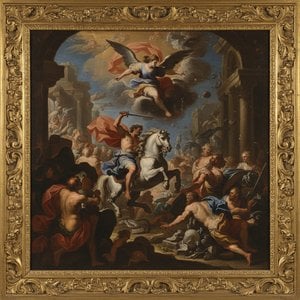
La Chiaruccia

La Chiaroscuro - Alexandre Cabanel (1875-1889) portrays a woman adorned with flowers and gazing intently at the viewer against a backdrop of serene mountains and trees. Executed in 1848, this masterpiece exemplifies the meticulous craftsmanship characteristic of academic art.

Erleben Sie Alexanders Cabanels "Heruntergefallten Engel" – ein dramatisches Romantik-Meisterwerk! Erkunden Sie seine Symbolik, akademische Technik und seinen tiefen emotionalen Eindruck. Eine atemberaubende Ergänzung für jede Kunstsammlung.

Giclée / Kunstdruck

Giclée- oder Leinwanddruck in Museumsqualität mit schneller Produktion und flexiblen Veredelungsoptionen. ( Handgemalte Reproduktion kaufen Zum digitalen Bild wechseln)

Corner sample of the P118B picture frame: formgepresstes Polystyrol, 5 cm wide and 3 cm thick
P118B €10
Corner sample of the P118H picture frame: formgepresstes Polystyrol, 5 cm wide and 3 cm thick
P118H €10
Corner sample of the P118W picture frame: formgepresstes Polystyrol, 5 cm wide and 3 cm thick
P118W €10
Corner sample of the P438Z picture frame: formgepresstes Polystyrol, 5.5 cm wide and 3.5 cm thick
P438Z €10
Corner sample of the P508JH picture frame: formgepresstes Polystyrol, 7 cm wide and 3.5 cm thick
P508JH €12
Corner sample of the P508YH picture frame: formgepresstes Polystyrol, 7 cm wide and 3.5 cm thick
P508YH €12
Corner sample of the P805H picture frame: formgepresstes Polystyrol, 5 cm wide and 3.5 cm thick
P805H €10
Corner sample of the P805Z picture frame: formgepresstes Polystyrol, 5 cm wide and 3.5 cm thick
P805Z €10
Corner sample of the P919BZ picture frame: formgepresstes Polystyrol, 7 cm wide and 3.5 cm thick
P919BZ €10
Corner sample of the P919G picture frame: formgepresstes Polystyrol, 7 cm wide and 3.5 cm thick
P919G €10
Corner sample of the P919XJ picture frame: formgepresstes Polystyrol, 7 cm wide and 3.5 cm thick
P919XJ €10
Corner sample of the P959ZH picture frame: formgepresstes Polystyrol, 5 cm wide and 3 cm thick
P959ZH €10
Corner sample of the P968JZ picture frame: formgepresstes Polystyrol, 6 cm wide and 4 cm thick
P968JZ €12
Corner sample of the W106C picture frame: Massivholz, 5 cm wide and 3 cm thick
W106C €8
Corner sample of the W218G picture frame: Massivholz, 5 cm wide and 3 cm thick
W218G €10
Corner sample of the W218JH picture frame: Massivholz, 5 cm wide and 3 cm thick
W218JH €8
Corner sample of the W218Y picture frame: Massivholz, 5 cm wide and 3 cm thick
W218Y €10
Corner sample of the W307PJ picture frame: Massivholz, 6 cm wide and 3 cm thick
W307PJ €10
Corner sample of the W316G picture frame: Massivholz, 6 cm wide and 3 cm thick
W316G €10
Corner sample of the W316PJ picture frame: Massivholz, 6 cm wide and 3 cm thick
W316PJ €8
Corner sample of the W316Y picture frame: Massivholz, 6 cm wide and 3 cm thick
W316Y €10
Corner sample of the W398PJ picture frame: Massivholz, 5 cm wide and 3 cm thick
W398PJ €8
Corner sample of the W4111J picture frame: Massivholz, 6.5 cm wide and 3.5 cm thick
W4111J €10
Corner sample of the W500HY picture frame: Massivholz, 7 cm wide and 5 cm thick
W500HY €15
Corner sample of the W500JH picture frame: Massivholz, 7 cm wide and 5 cm thick
W500JH €15
Corner sample of the W692G picture frame: Massivholz, 8 cm wide and 4 cm thick
W692G €12
Corner sample of the W849H picture frame: Massivholz, 5 cm wide and 3 cm thick
W849H €8
Corner sample of the W940BG picture frame: Massivholz, 7.5 cm wide and 4.5 cm thick
W940BG €15
Corner sample of the W953PJ picture frame: Massivholz, 6 cm wide and 3.5 cm thick
W953PJ €8

Standardformat
individuell anpassbar
CM
INCH

Wählen Sie aus unseren vordefinierten Formaten, die den ursprünglichen Proportionen des Kunstwerks entsprechen.

Breite
Höhe

Geben Sie die Breite und die Höhe an, die Sie benötigen, damit der Druck perfekt in Ihren Rahmen oder an Ihre Wand passt. Ein Druck kann nur beschnitten werden und niemals größer als das Originalbild gemacht werden; daher verliert ein Format mit einer anderen Proportion einen Teil des Bildes. Wir senden Ihnen ein digitales Mockup zur Freigabe, bevor wir den Druck ausführen. Das auf dieser Seite gezeigte Bild zeigt nicht den tatsächlichen Beschnitt – dies ist nur im Mockup ersichtlich.

Weltweiter Versand () innerhalb von 2 Wochen statt der üblichen 4/5 Wochen. (25 Oktober)

Kostenloser weltweiter Expressversand
Hochwertige Leinenleinwand
Vollständiger Versicherungsschutz beim Versand
Zollgebühren-Rückerstattungsgarantie
Garantie für exakte Farbtreue
100-tägiges Rückgaberecht (nur bei Mängeln)
100% Geld-zurück-Garantie
Angebot für Mengenrabatt

Gesamtpreis

€ 60

La Chiaruccia

Giclée / Kunstdruck

Format der Reproduktion

-

Gesamtpreis

€ 60

Alexandre Cabanel’s “La Chiaroscuro”: A Portrait of Elegance Rooted in Classical Tradition

  • Subject Matter: Alexandre Cabanel's "La Chiaroscuro" depicts a woman—likely intended to represent Marie Alexandrine Louise Bonaparte, Napoleon III’s sister—seated gracefully amidst a tranquil landscape. Her gaze is directed towards the viewer, establishing an intimate connection between subject and observer.
  • Style: The painting embodies the quintessential style of academic art prevalent in France during its Belle Époque period. Characterized by meticulous detail and idealized beauty, it adheres to classical conventions—specifically those championed by Jacques-Louis David—emphasizing harmony, balance, and proportion.
  • Technique: Cabanel employed oil paint on canvas with exceptional precision. He utilized glazing techniques—applying thin layers of translucent pigment over subsequent coats—to achieve luminous effects and subtle tonal variations. The artist’s masterful brushwork contributes to the painting's textural richness, capturing the delicate folds of the woman’s gown and the intricate patterns of the foliage.
  • Historical Context: Painted in 1848, “La Chiaroscuro” reflects the artistic sensibilities of a time marked by optimism and grandeur. Napoleon III’s reign witnessed a flourishing of cultural endeavors—a deliberate effort to revive France's prestige after the Franco-Prussian War. Cabanel’s work aligns perfectly with this prevailing ethos, serving as a testament to the enduring power of classical ideals.
  • Symbolism: The woman’s pose and attire convey notions of dignity and composure—symbols of aristocratic virtue. The flowers held in her hands represent beauty, purity, and remembrance—suggesting an allusion to Marie Bonaparte's familial heritage and honoring the memory of Napoleon Bonaparte.

The Luminosity of Glazing: Cabanel’s Approach to Light and Color

Cabanel’s technique is particularly noteworthy for its incorporation of glazing—a method that elevates oil paint beyond mere pigment application. By applying thin, translucent layers of color over previously painted surfaces, he achieved remarkable tonal depth and luminosity. This process allowed him to capture the subtle nuances of light filtering through the trees and mountains in the background, creating an atmospheric illusion that enhances the painting’s overall visual impact. The glazing technique is a hallmark of Baroque art but was skillfully adapted by Cabanel to suit the aesthetic demands of his era.

A Window into Napoleon III's Vision: Artistic Patronage and National Identity

Napoleon III recognized the importance of artistic patronage in shaping national identity. He actively supported artists like Cabanel—commissioning monumental canvases that celebrated French history and culture—aiming to instill pride and patriotism among his subjects. “La Chiaroscuro” exemplifies this ambition, presenting Marie Bonaparte as a figure of noble grace and embodying the ideals of classical beauty—values deemed crucial for upholding France’s cultural heritage.

Emotional Resonance: Capturing Graceful Dignity

Despite its formal aesthetic, “La Chiaroscuro” possesses an undeniable emotional resonance. Cabanel succeeds in conveying a sense of serene dignity and contemplative beauty—capturing the essence of Marie Bonaparte’s character with remarkable sensitivity. The painting's harmonious composition and masterful execution evoke feelings of tranquility and admiration—inspiring viewers to contemplate the enduring legacy of classical art.

Fragen & Antworten

Welche Größe und Ausrichtung werden für einen Druck von "La Chiaruccia" von Alexandre Cabanel empfohlen?

Für einen Druck von "La Chiaruccia" von Alexandre Cabanel wird ein Format von Großformatig in der Ausrichtung Hochformat empfohlen.

Zu welcher Stilrichtung gehört "La Chiaruccia"?

„La Chiaruccia“ ist ein Werk der Romanticism. Die Stilrichtung gibt die künstlerische Tradition an, der das Werk angehört.

Gibt es für "La Chiaruccia" eine Augmented-Reality-Vorschau?

"La Chiaruccia" von Alexandre Cabanel kann mithilfe der AR-Vorschau-Seite des Kunstwerks in Ihrem eigenen Raum mit Augmented Reality auf einem kompatiblen Gerät an Ihrer Wand vorab betrachtet werden.


Biografie des Künstlers

Frühe Jahre und Ausbildung

Alexandre Cabanel, ein renommierter französischer Maler, wurde am 28. September 1823 in Montpellier, Hérault, geboren. Im Alter von siebzehn Jahren trat er in die École des Beaux-Arts in Paris ein, wo er unter François-Édouard Picot studierte.

Künstlerischer Stil und Bekannte Werke

Cabanels künstlerischer Stil war durch seine Einhaltung des akademischen Stils gekennzeichnet, wobei er sich auf historische, klassische und religiöse Themen konzentrierte. Er war auch ein begabter Porträtmaler. Zu seinen bekanntesten Werken gehören:
  • Ophelia (1883), ein Meisterwerk, das seine Fähigkeit zeigt, die Essenz einer Szene einzufangen.
  • Die Geburt der Venus (1863), ein Paradebeispiel für die akademische Malerei des 19. Jahrhunderts, das vom Kaiser Napoleon III. erworben wurde.
  • Porträt der Gräfin E. A. Worontzowa-Daschkowa, das seine Fähigkeit demonstriert, die Essenz seiner Motive einzufangen.

Einflüsse und Entwicklung

Cabanel stand durch seinen Lehrer François-Édouard Picot in Verbindung mit der klassischen Schule Jacques-Louis Davids. Seine frühen Bilder wie „Der Tod des Moses“ (1852) und „Der heilige Ludwig“ (1855) hielten sich noch durchaus an die strengen akademischen Regeln, zeigten aber schon innerhalb derselben Talent für Zeichnung und Komposition. Er näherte sich der modernen Empfindungsweise in dem Bild „Die Witwe des Kapellmeisters, die mit ihren Kindern den Klängen der Orgel lauscht“, das mit seinen rosigen Tönen an die Werke François Bouchers und anderer Meister des Rokoko erinnerte.

Auszeichnungen und Anerkennung

Cabanels Arbeit wurde weithin anerkannt, und er erhielt mehrere Auszeichnungen, darunter:
  • Das Prix de Rome-Stipendium im Jahr 1845
  • Die Grande Médaille d'Honneur bei den Salons von 1865, 1867 und 1878

Lehre und Vermächtnis

Cabanel wurde 1864 zum Professor an der École des Beaux-Arts ernannt, wo er bis zu seinem Tod unterrichtete. Seine Schüler waren zahlreiche erfolgreiche Künstler, was sein Erbe in der Kunstwelt sicherstellte. Er war seit 1887 assoziiertes Mitglied der Académie royale des Sciences, des Lettres et des Beaux-Arts de Belgique. Cabanels Malweise wurde im Laufe der Zeit weniger geschätzt, aber eine umfassende Sonderausstellung im Jahr 2011 zeigte seine Bedeutung neu.

Alexandre Cabanel

Alexandre Cabanel

1823 - 1889 , Frankreich

Eckdaten zum Künstler

  • Beeinflusste Künstler:
    • François-Édouard Picot
    • Jacques-Louis David
  • Bemerkenswerte Werke:
    • Ophelia (1883)
    • Die Geburt der Venus (1863)
  • Geburtsdatum: 28. September 1823
  • Geburtsort: Montpellier, Frankreich
  • Künstlerischer Stil: Akademische Kunst
  • Nationalität: Französisch
  • Sterbedatum: 23. Januar 1889
  • Vollständiger Name: Alexandre Cabanel
Entdecken Sie Kunstwerke, die nach Themen, Stilen und Merkmalen sortiert sind.