The Tapestry of Tradition and Innovation
The artistic lineage of Alex Russell is one deeply rooted in the soil of British heritage, yet it reaches toward the boundless possibilities of modern abstraction. Born in Dorset, UK, Russell entered a world where art was not merely a profession but a familial language. He carries the weight and the wonder of a significant legacy, being the grandson of the celebrated Victorian painter Sir William Russell Flint. While his grandfather was renowned for capturing the romantic, pastoral essence of the British countryside, Alex has carved a path that moves beyond mere representation, seeking instead to explore the profound philosophical tensions between the tangible and the intangible. His early life in Dorset provided a foundation of craftsmanship, but his creative spirit was destined to wander far beyond the borders of traditional landscape painting.
This journey of self-discovery led him to formal academic rigor at Manchester Metropolitan University and Manchester Polytechnic, where he specialized in Textiles and Fashion & Textiles. This period of study was transformative, instilling in him a sophisticated understanding of surface design, texture, and the intricate mechanics of printmaking. It was here that the seeds of his multidisciplinary approach were sown, allowing him to bridge the gap between the tactile nature of fabric and the expansive freedom of fine art. His education provided the technical vocabulary necessary to navigate complex mediums, from the delicate precision of etching and lithography to the emotive depth of oil on canvas.
A Dialogue Between Chaos and Order
At the heart of Russell’s practice lies a fascinating investigation into duality. He operates within the liminal spaces where seemingly contradictory realms meet: the handmade versus the digital, methodical precision alongside intuitive spontaneity, and science interwoven with art’s expressive power. His work often grapples with the tension between faith and doubt, or the structured logic of complex systems theory against the unpredictable beauty of chance. To achieve this, Russell frequently employs stochastic processes—a method where he introduces elements of randomness within defined parameters. This allows the imagery to guide his decisions, mirroring the way patterns emerge from chaos in the natural world, a concept that reflects his deep interest in how emergent behavior drives both biological and artistic systems.
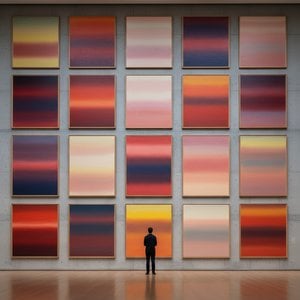
His technical repertoire is as diverse as his conceptual interests. Whether working with the heavy, textured layers of oil paint or the sharp, graphic clarity of charcoal and print, Russell seeks to create immersive visual experiences. His pieces often invite a slow, contemplative viewing, rewarding those who linger long enough to notice the subtle interplay of light and shadow. In works such as Currency 2, one can observe the hallmarks of Abstract Expressionism, where vibrant hues and dynamic shapes create an undeniable sense of energy and movement. Through the layering of color and the use of geometric forms, he constructs worlds that are both intellectually stimulating and emotionally resonant.
Capturing the Spirit of the West
While much of his conceptual work leans toward the abstract, Russell possesses a remarkable ability to capture the evocative spirit of the American West. This facet of his oeuvre focuses on striking portraits and sweeping landscapes that resonate with a sense of rugged nostalgia and profound solitude. In these works, the artist’s fascination with visual representation meets a deep respect for the landscape's raw power. He utilizes his mastery of texture to evoke the grit of the earth and the vastness of the horizon, creating images that feel as much like memories as they do observations.
The significance of Russell's contribution to contemporary art lies in this very ability to synthesize disparate influences. He does not merely paint; he constructs narratives that bridge the gap between the historical weight of his ancestry and the experimental frontiers of modern abstraction. His work stands as a testament to the idea that true creativity emerges from embracing unpredictability and finding harmony within complexity. Through his exploration of color, shape, and process, Alex Russell continues to push the boundaries of what it means to represent both the seen and the unseen worlds.



 In echtem Maßstab anzeigen
 Handgemalte Reproduktion kaufen
 Versenden als Grußkarte
 Teilen
 Details anzeigen
 Leitfaden öffnen

 Herunterladen
 Ähnliche Objekte
 Röntgenaufnahme
 Diashow
 Besucherstatistiken


 Mehr anzeigen






































 Die Glasoption ist nur für Größen unter 110 cm verfügbar.